Sept. 18, 2024 – by Meg Bjordal, Research and Policy Coordinator
Protecting Biodiversity and Habitat for Species at Risk is the Key to our Shared Futures
BC needs a Biodiversity law, complete with protections for habitat for species-at-risk to ensure a future where wildlife and people can thrive.
British Columbia lists over 1,700 species at risk and counting, yet there is no effective provincial law to protect them or their habitat. Some of BC’s most iconic animals are on this list including southern mountain caribou, grizzly bears and southern resident killer whales. The biggest threat most endangered species face is from habitat loss and degradation.
For example, southern mountain caribou and spotted owls – two of the most threatened wildlife populations in BC, depend on old-growth forests for their homes. Old growth forests are an ecosystem that has long been identified of high conservation importance, but most of it (82%) remains unprotected and clearcutting is continuing.
Pathway to a Biodiversity Law
Out of rising concern for how old-growth forests are managed in the province, an independent review was conducted and released in 2020. The Old Growth Strategic Review put forward 14 recommendations on how to better manage forests based on wide consultation and expert opinions.
All recommendations from this report were adopted, though none have yet been fully implemented. Some of the recommendations outline conditions required for change, and include the need for legislation that establishes “conservation of ecosystem health and biodiversity of British Columbia’s forests as an overarching priority”.
Out of this recommendation came the draft Biodiversity and Ecosystem Health Framework. This framework sets the stage for a needed paradigm shift that prioritizes biodiversity and the health of ecosystems above resource extraction. With continued momentum this could lead to a biodiversity law, and even include protections for species at risk and their habitat.
Protecting Biodiversity Benefits Wildlife and People
Protecting habitat for species-at-risk not only provides a future for BC’s favourite wildlife, but also for the people who live and recreate in these important places. Healthy, functioning and connected ecosystems facilitate natural processes and animal movements. Meaning that critical planet support systems like nutrient cycling can occur, and that animals can move as needed to find food, shelter and mates. This also allows for mitigation of climate change effects and better ability to adapt. Protecting and restoring habitat, especially large and interconnected landscapes, makes it possible for biodiversity to thrive and ensures functioning ecosystems.
What should you ask Candidates ahead of the BC Election?
Sept. 12, 2024 – A question guide to the 2024 BC Provincial Election
BC’s Provincial election is this fall, and candidates who want your vote may come door-knocking or host events where you have an opportunity to chat about what matters to you. Below are some questions to start a conversation about their position on nature conservation and safeguarding our futures:
Question 1: The science-backed target of protecting 30% of lands and waters by 2030 provides a pathway to tackle the biodiversity crisis and ensure a healthy future for people and nature… What immediate actions will you take to protect more land in BC and advance 30×30?
2024 Townhall – Candidate Questions PDF(2)
Question 2: BC currently has over 1700 species at risk but no Provincial law to protect them or their habitat. The majority of BC residents (88%) support protecting habitat for species at risk… What will you and your government do to protect species at risk and their habitat?
2024 Townhall – Candidate Questions PDF(3)
Question 3: 8 in 10 BC residents are concerned about biodiversity loss, pollution, and overfishing on BC’s coasts. These threats loom as BC’s Coastal Marine Strategy awaits implementation and resourcing… How will you ensure a healthy coast for both marine life and people?
Want to save a copy? Download the PDF version!
We want to hear from you! Tell us how the conversation goes and if you or the candidates would like further information: info@cpawsbc.org
Sept. 9, 2024
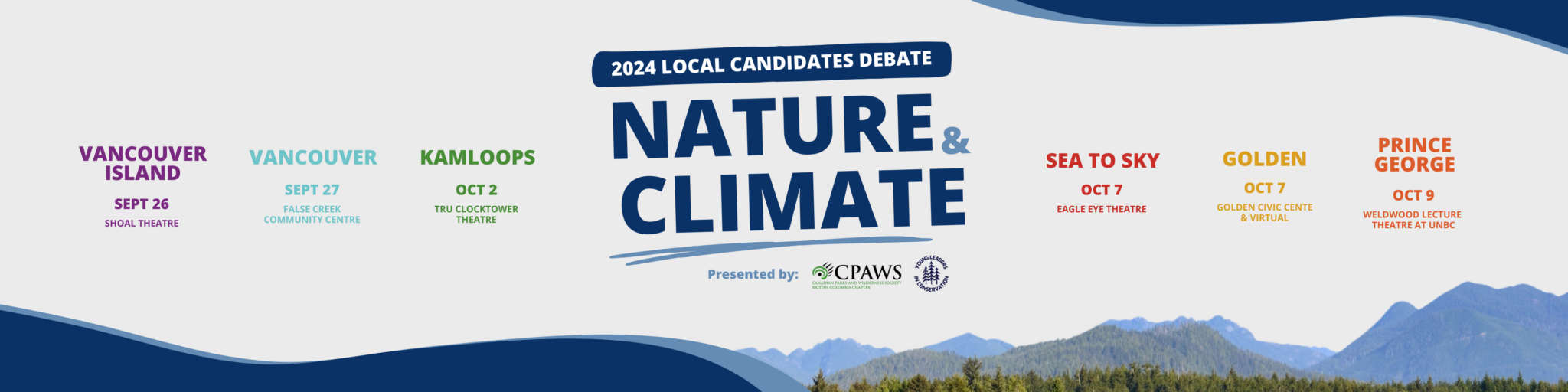
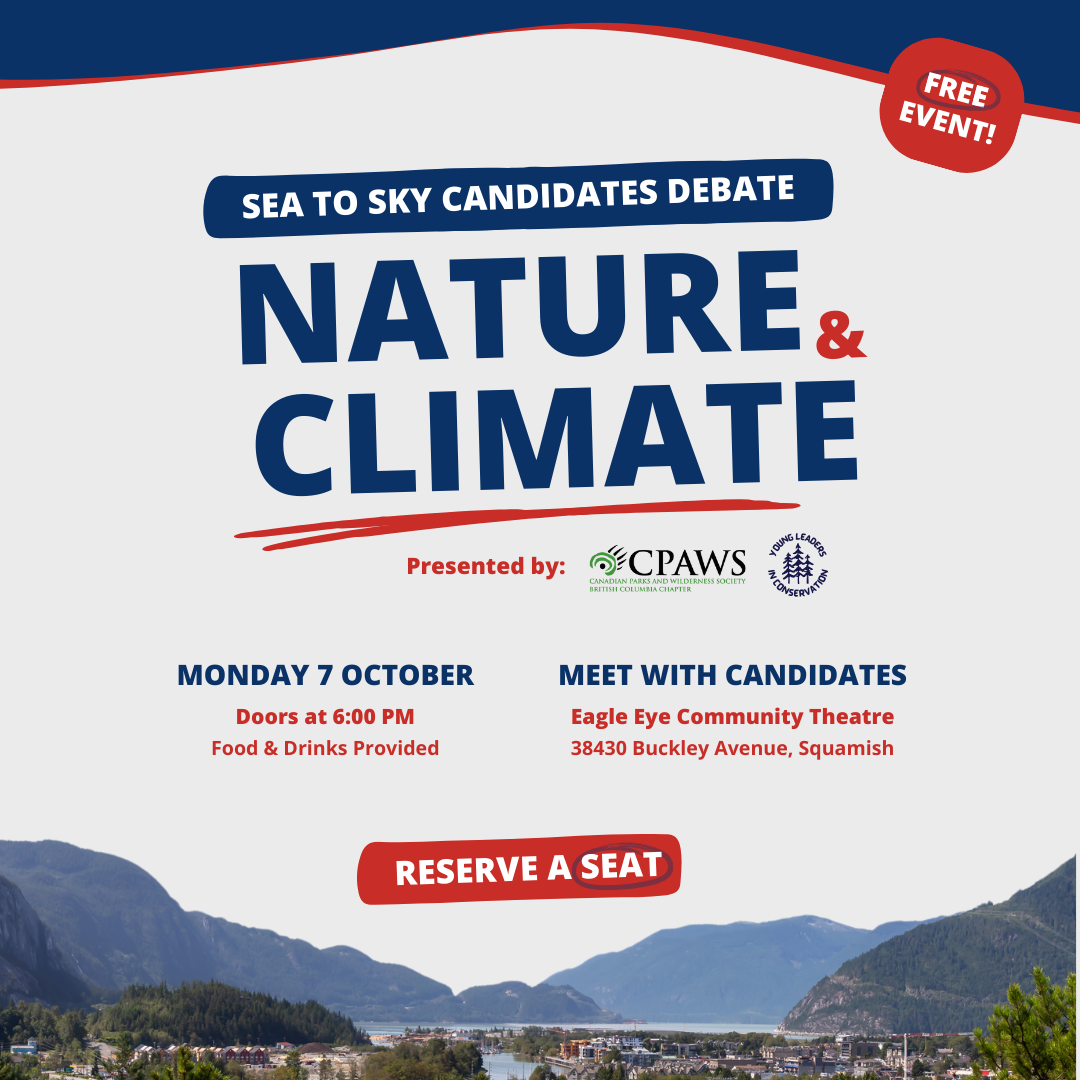
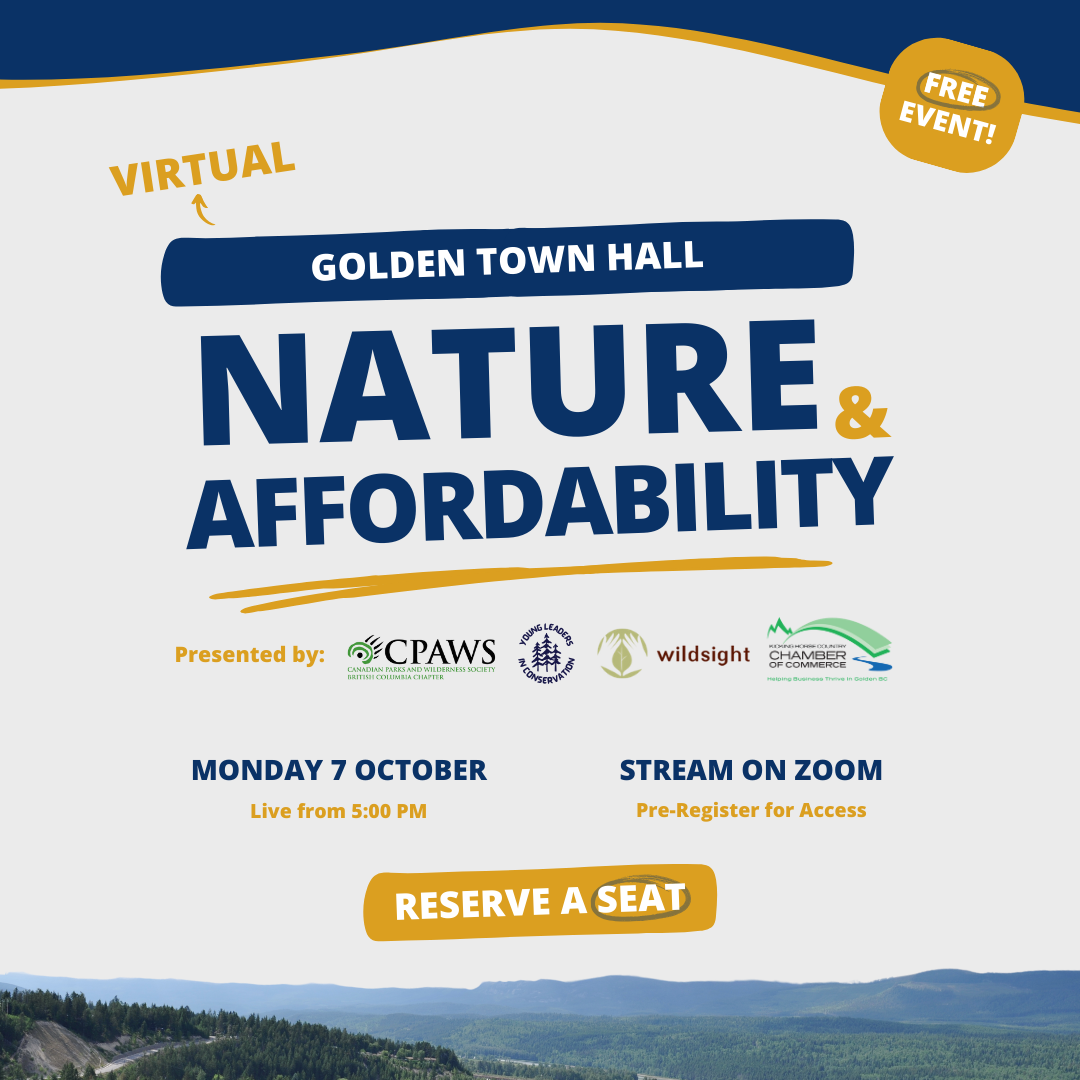
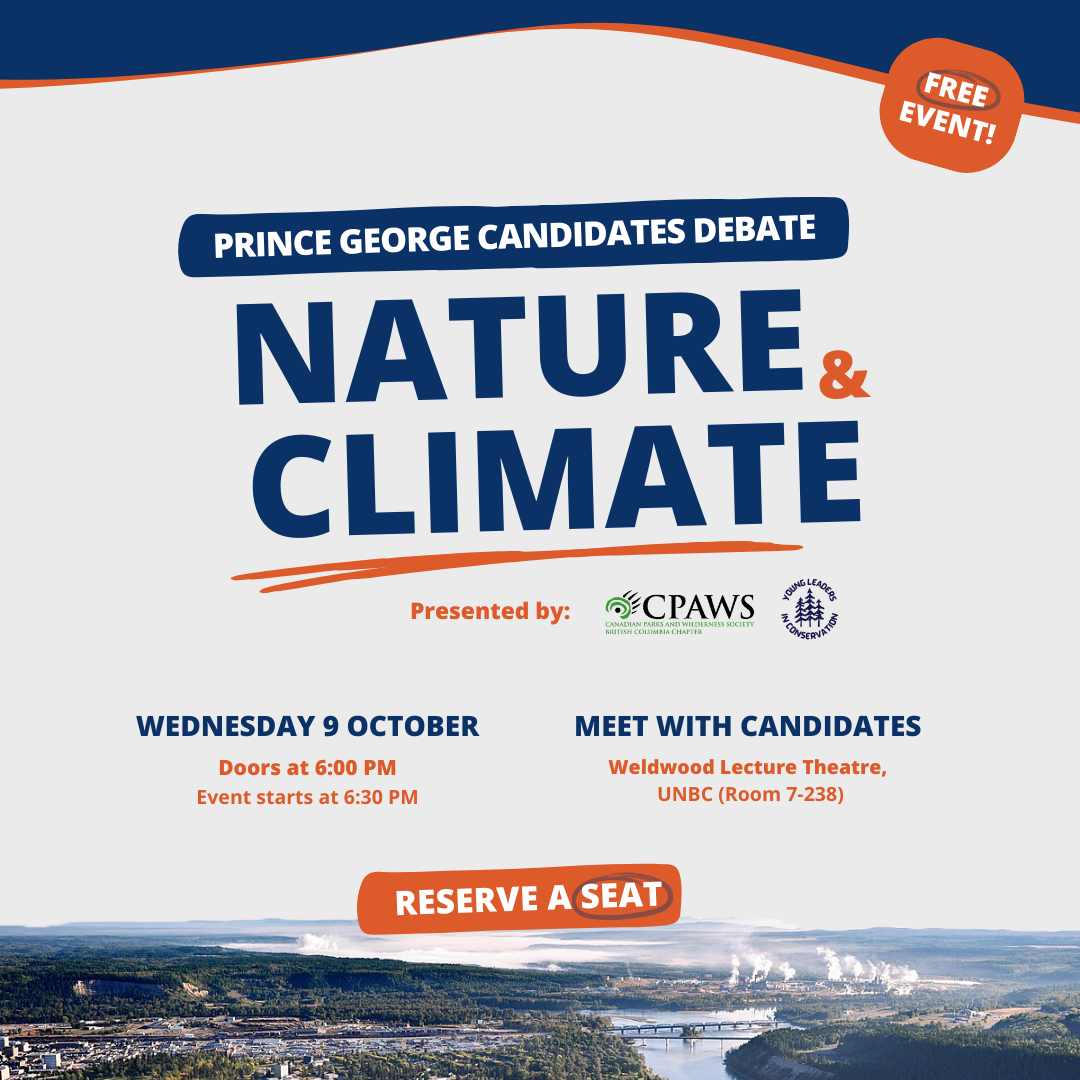
Our Nature & Climate debates bring candidates in your riding together to discuss conservation, climate policy, and environmental issues. Hear what they have to say, ask candidates questions directly, and make your community’s concerns heard this election. This debate is co-hosted with local youth from our Young Leaders in Conservation Program (YLICP). Young people are especially encouraged to attend and participate. CPAWS-BC will be moderating the debates and asking candidates about their positions on various environmental issues, followed by an open audience Q&A.
Join us for food and refreshments when doors open, at no charge. Please come mingle and share your views with the candidates. Register now to save your seat!
Find a Candidates Debate near you!
August 28, 2024 – by Meaghen McCord, Executive Director
Back in March, we embarked on an ambitious journey—one that fundamentally challenged the traditional work model many of us have been accustomed to. We transitioned to a 4-day, 32-hour work week (4DWW) with the hope of enhancing work-life balance, reducing burnout, and maintaining our commitment to protecting British Columbia’s wilderness. As promised, we’re sharing an update with our supporters and community on how this experiment is unfolding. Today, as we reach the end of our pilot, we’re excited to share the impact this change has had on our team and the insights we’ve gained along the way.
A Breath of Fresh Air: Positive Impacts So Far
The results from our midpoint evaluation have been nothing short of encouraging. Since the pilot’s inception, we’ve seen significant improvements in several key areas:
- Work-Life Balance: Our team’s work-life balance has improved significantly. The extra day off has provided more time for personal activities, health, and spending time with loved ones. Sarah, for instance, has found more quality time with her family, reconnecting with what matters most.
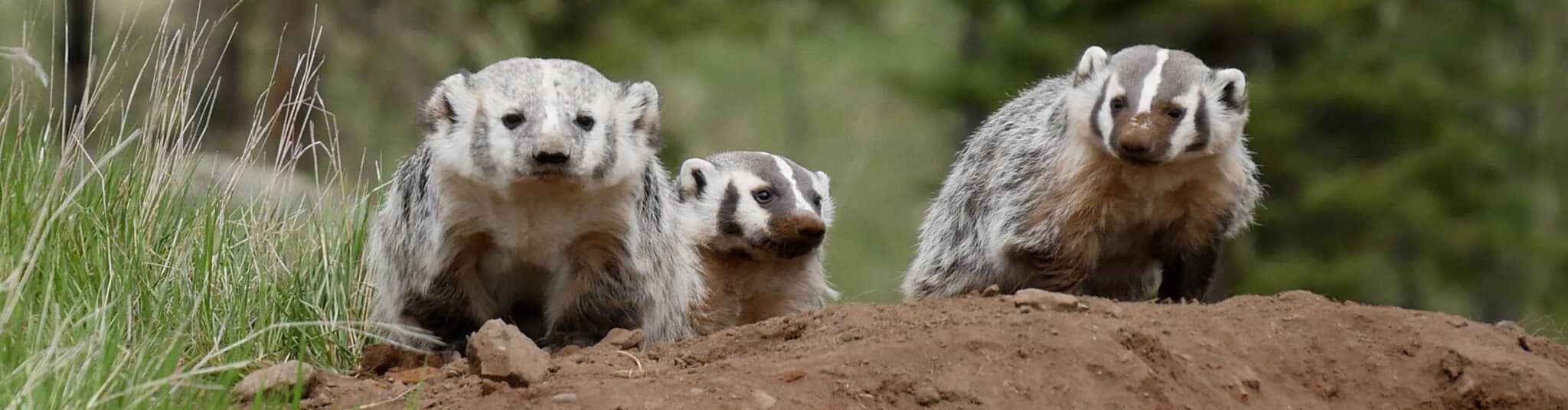
- Reduced Burnout: The shift has also led to a significant reduction in feelings of burnout. Staff are returning to work refreshed and more focused, which has been instrumental in enhancing overall job performance. Max spent one of the Fridays, instead of sitting behind a desk, watching a family of badgers play, reinforcing his passion for conservation.
- Maintaining Effectiveness: Despite the shorter work week, our team’s effectiveness remains strong. Staff’s rating for CPAWS-BC as an effective organization increased, and job performance ratings also saw a slight uptick.
- Health and Well-being: We’ve also noticed improvements in physical health and opportunities for recreation and leisure, contributing to significant long-term benefits for our people and our organization.
Celebrating Conservation Wins
While we’ve been focusing on work-life balance and team well-being, we haven’t lost sight of our core mission—conservation. In fact, the past few months have been marked by some incredible conservation wins including:
- Biggest Park Expansion in Over a Decade: We’re proud to have been part of the effort leading to the largest BC parks expansion in over a decade, which will protect critical habitat for the southern mountain caribou. This expansion is a major victory for biodiversity and a testament to the power of collaborative conservation efforts. Read more about this milestone here.
- A New Marine Protected Area: We’ve also been instrumental in the announcement of a new Marine Protected Area (MPA) off the coast of BC, which is four times the size of Vancouver Island. This new MPA is a groundbreaking step forward in safeguarding vital marine ecosystems and ensuring the health of our oceans for future generations. Learn more about this significant achievement here.
- Successful Campaigns: Beyond these major milestones, several of our conservation campaigns have seen significant progress. Our ability to engage in deep, focused work during the shortened week has played a key role in these successes.
These wins are a testament to the dedication and passion of our team, proving that even with a shorter work week, we can achieve great things for the environment and our communities.
Challenges and Collaborative Solutions
While the overall sentiment has been positive, we’ve also faced some challenges particularly during shortened weeks where additional office closures due to holidays or absences have made it difficult for some to manage workloads. Professional development, especially our ongoing Justice, Equity, Diversity, and Inclusion (JEDI) efforts, has been more challenging to prioritize within the compressed schedule.
In response, we’ve made a few immediate adjustments, such as revising our guidelines around off-hours communication and time-in-lieu management. We’re also considering further solutions, like more flexible working hours and specific, protected time slots for professional development and JEDI learning. These adjustments will help us address the challenges while staying true to our commitment to a 32-hour work week.
Looking Forward: A Shared Vision
As we continue our journey, we remain committed to listening, learning, and adapting. The next few months will be crucial as we wrap up the pilot in September and conduct a comprehensive evaluation. Our goal is to present thoughtful recommendations to our board on how to move forward together in a way that balances team well-being with our mission and commitment to biodiversity and effective conservation.
We promised to keep our supporters and community informed, and we’re thankful for your ongoing interest and encouragement. If you have thoughts on our 4DWW pilot, or if you’d like to get involved in our latest conservation campaigns, we invite you to reach out—we’d love to hear from you. Together, we can continue to push boundaries and make a lasting impact on our beautiful province.
We’ll be sharing our final recommendations and decisions regarding the future of the 4DWW later this year. Until then, we remain optimistic and committed to finding the best balance for our team and our mission.
Thank you for being part of this journey with us. We look forward to continuing to share our progress with you.

The abyssal plains of the deep sea floor are often viewed as vast, dark, empty spaces. But the deep sea far off the BC coast couldn’t be more different. Dotting the flat seascape are geologic wonders such as seamounts and hydrothermal vents teeming with abundant otherworldly marine life!
Located 150 km west of the coast of Vancouver Island, deep in the ocean, is a unique and spectacular underwater world. The Tang.ɢ̱wan – ḥačxwiqak – Tsig̱is MPA (TḥT for short) will protect a network of hydrothermal vents (think deep sea geysers or hot springs releasing superheated and mineral-enriched water) and seamounts (ancient volcanic mountains that can tower higher than Whistler Mountain). These biological hotspots provide habitat, shelter, food, spawning grounds, and nurseries for wildlife. It truly is a “Deepsea Oasis.”
Canada’s first MPA, Endeavour Hydrothermal Vents, which protected 5 vents and 97 km2 since 2003, is now part of this new MPA that spans over 133,000 km2.
Indigenous-led Conservation
The name for this new MPA is three words from the Haida, Quatsino, Nuu-chah-nulth and Pacheedaht Nations.
- Tang.ɢ̱wan: a Haida word meaning deep ocean (pronounced “Tung – Gwun”)
- ḥačxwiqak: a Nuu-chah-nulth and Pacheedaht word meaning deepest part of the ocean (pronounced “huch/khwi/kuk”)
- Tsig̱is: a Quatsino word referring to a monster of the deep (pronounced “tsee-geese”)
It’s easier to pronounce than it seems! If you need some more help, listen to the pronunciation.
This incredible area will be co-managed by the Nuu-chah-nulth Tribal Council, Council of the Haida Nation, Pacheedaht First Nation, Quatsino First Nation and the Government of Canada. In the spirit of reconciliation, it will be managed using both science and traditional knowledge and uphold First Nations rights to governance.
Weird and Wonderful Wildlife
The area is home to some of the weirdest and most wonderful creatures on the planet:
- Dumbo octopuses are a group of deep sea octopuses that flap ear-like flippers on their heads to move around, much like Dumbo the elephant in the famous Disney movie.
- Tubeworms are unlike almost any other creature on the planet. Instead of getting their energy from sunlight , they rely on bacteria that are able to produce energy from the mineral rich water expelled from hydrothermal vents.
- Sea pigs are actually types of sea cucumbers, named for their pinkish colour. They use their tubelike feet to walk along the sea floor while they feed on organic matter that sinks down from shallower waters.
- Last year, scientists discovered a seamount covered in a million skate eggs in the MPA. The ancient volcano is spouting warm fluid, providing little-known species of skates with an ideal nursery. Scientists believe the geothermal heat helps incubate the eggs and speeds up development.
The deep sea is a dark and mysterious place — under-mapped and under-explored. We have only begun to scratch the surface of what lives here. Who knows what other amazing creatures will be found in the future?
Upholding Strong Protection is a must
Canada’s new MPA protection standard will prohibit oil and gas exploration, development, and production, disposal at sea of waste, and most importantly for this area specifically, mineral exploration and exploitation and the use of bottom-trawl gear. With the growing need for rare minerals to power electric vehicles, deep sea environments are under threat from an industry that would tear apart wildlife-rich seamounts. This environment is also especially vulnerable to bottom trawling which uses heavy weighted nets dragged on the seafloor to indiscriminately capture any and all sea life, including rare protected species and habitat-forming corals and sponges.
Protection of these important and rare ecosystems would not be possible without the support of the public who signed petitions, wrote letters, and participated in consultations. Thank you also goes out to First Nations leadership and elected officials for helping secure legal protections. And finally, thanks are given to the scientists, communicators, and marine planning professionals from Federal and Indigenous governments, non-profit organizations, and universities such as those at the Northeast Pacific Deep-sea Exploration Project (NEPDEP). They explored and discovered these amazing places, conveyed their importance to the world, and worked tirelessly behind the scenes conducting the much needed technical work to make this new Marine Protected Area a reality.
This Is Only The Beginning
The MPA work doesn’t stop with designation. The Haida, Quatsino, Nuu-chah-nulth and Pacheedaht Nations and the Government of Canada must now work to form a management board. An advisory committee, with conservation groups like CPAWS-BC, will also be established. Together, they will create a management plan to make sure we know the MPA is protecting the ecosystem, which means monitoring, enforcement and management of human activities. We will be there to help ensure this special part of the ocean is strongly protected.
Read more about THT.
July 18, 2024
Unceded territories of the Coast Salish Peoples/Vancouver, BC – The Canadian Parks and Wilderness Society, British Columbia is celebrating a $49 million federal investment to address climate change through nature conservation in BC. This funding is focused on thousands of hectares of carbon-rich ecosystems such as grasslands, wetlands, mature forests and overlapping with habitat for species at risk such as grizzly bears and Marbled Murrelets.
“We are thrilled to see this massive investment into the protection of nature in BC,” says Tori Ball, Conservation Director for the Land & Freshwater Program with CPAWS-BC. “This funding has the potential to make a massive impact by protecting ecologically and culturally important ecosystems that hold and sequester carbon while benefitting clean water, air and wildlife.”
The funds were announced on July 18 by Steven Guilbeault, Minister of Environment and Climate Change Canada and are part of the federal Nature Smart Climate Solutions Fund. The three successful BC recipients are:
- $37 million will go to the BC Parks Foundation to protect 4,000 hectares of private land
- $8 million will go to the Nature Trust of British Columbia to create 11 new protected areas
- $4 million will go to Nuxálk Nation to protect private land in the Great Bear Rainforest
The announcement follows a heat wave which saw 37 heat records broken in BC, with multiple places clocking highs over 40C. Natural climate solutions such as protecting areas from land use changes, namely development or resource extraction, are a proven and lower-cost way to capture or reduce greenhouse gas emissions. These actions must also be paired with the reduction of fossil fuel emissions to avoid the worst effects of climate change.
“We know that protecting carbon-rich and intact ecosystems such as grasslands and mature forests is a proven way to protect species at risk while increasing the resiliency to wildfires, floods and drought which is increasingly important in a warming world,” continued Ball. “We also know that these solutions are most effective when put in place with the leadership of First Nations knowledge and direction on land use within their territories.”
This comes just a few weeks after the release of a new survey which found overwhelming support for nature protection amongst British Columbians with 85% supporting the provincial commitment to protect 30% by 2030.
“It is clear that people across BC want to see the government use available resources and tools to protect and connect landscapes that nurture people, wildlife and the essential services that ecosystems provide. This must be done in partnership with First Nations who are already putting forward bold plans to protect their traditional territories,” said Ball.
For interviews contact:
Max Winkelman
Communications Manager
max@cpawsbc.org
604-685-7445 x3
Additional resources:
REPORT: Protected Areas as a Nature-Based Climate Solution
July 11, 2024
Unceded, traditional, and ancestral Xʷməθkʷəy̓əm (Musqueam), Sḵwx̱wú7mesh (Squamish), and səlilwətaɬ (Tsleil-Waututh) territories / Vancouver, BC – BC is joining other coastal regions in North America with the release of its first and much-needed Coastal Marine Strategy, which will provide BC with better tools to deal with cumulative impacts on the coast and ensure healthier oceans for both nature and people.
“The absence of a Coastal Marine Strategy until this point has resulted in a lack of cohesion and jurisdictional confusion that harms ocean biodiversity, the people who live on the coast and the stability of the jobs they depend on,” says Kate MacMillan, Conservation Director – Ocean Program at the Canadian Parks and Wilderness Society – British Columbia (CPAWS-BC). “A strong Coastal Marine Strategy, co-developed with First Nations, is long overdue and we’re hopeful that it will lead to a better future for nature and coastal prosperity.”
The “made-in-BC” Coastal Marine Strategy was co-developed by First Nations and the BC government with input from nearly 1,000 people during the public consultation, as well as meetings with coastal stakeholders from fishing, forestry, tourism and conservation sectors.
“In order for a coastal strategy to be successful, it’s critical that it protects and restores marine ecosystems, including coordinated monitoring and incorporating nature-based solutions along the coast in a way that enables coastal communities to flourish and respects the rights and leadership of First Nations. The input of people across BC in shaping the strategy will undoubtedly aid in that goal.”
Until now, British Columbia has remained one of the only coastal regions in North America without a unifying and strategic plan to protect and manage the coast.
“Now, with the release of this strategy, we have the opportunity to transition from being reactive to proactive when it comes to making decisions that impact the future of the coast,” added MacMillan.
CPAWS-BC and West Coast Environmental Law have been working together on Blueprint for the Coast, a campaign to find a solution to the issue of BC’s coastal and marine areas being regulated through a patchwork of ministries and departments, with no overarching vision to guide decisions. We have brought people together to learn about coastal issues and to investigate how a coast-wide strategy and law will help to address these issues, as we work together for a healthy, abundant future for the coast and all those who depend on it.
The strategy also commits the Province to partnering with First Nations to develop a proposal for coastal marine legislation, a key focus for the Blueprint for the Coast campaign.
“The release of British Columbia’s first Coastal Marine Strategy is an exciting step towards biodiverse, resilient marine ecosystems that can mitigate and adapt to the impacts of climate change and provide a respite for species at risk, ensuring their abundance for generations to come. The Strategy holds the promise of advancing meaningful acts of reconciliation, through Indigenous marine spatial planning, Indigenous Protected and Conserved Areas, and coastal Guardian programs,” said Georgia Lloyd-Smith, Staff Lawyer at West Coast Environmental Law.
The groups say that the release of the strategy is the start of a new path and a better future for the coastal marine environment across BC.
“It will help protect biodiversity, the well-being of coastal communities, and the stability of over 170,000 ocean-based jobs,” said Lloyd-Smith. “Now with this holistic vision that has a 20-year outlook, the work begins on the actions outlined in the plan to ensure the goals of a healthy coast, resilience to climate change, thriving coastal economies and communities and informed governance are met.”
For interviews, contact:
Max Winkelman (he/him)
Communications Manager, CPAWS-BC
max@cpawsbc.org
604-685-7445 ext. 3
Georgia Lloyd-Smith (she/her)
Staff Lawyer, West Coast Environmental Law
glsmith@wcel.org
604-817-3940
Resources

July 11, 2024
Unceded territories of the Coast Salish Peoples/Vancouver, BC – The newest Marine Protected Area (MPA), Tang.ɢ̱wan – ḥačxwiqak – Tsig̱is (ThT), was announced by the Nuu-chah-nulth Tribal Council, the Council of the Haida Nation, Pacheedaht First Nation, Quatsino First Nation and the Government of Canada. Located 150 km west of Vancouver Island, this protected area will safeguard rare seamounts and hydrothermal vents — ecological hotspots that are home to an array of wildlife, including species found nowhere else in the world.
“This MPA will safeguard rare deep-sea ecosystems that are home to species that get their energy not from the sun, like most life on Earth, but from chemicals released underwater vents. We all can now be proud to say that this incredible and important area is permanently protected,” says Carlo Acuña, Senior Conservation Campaigner for the Ocean Program at the Canadian Parks And Wilderness Society – British Columbia (CPAWS-BC). “This would not have been possible without the vision and leadership of the First Nations, who have deep connections to this incredible deep-sea place.
Tang.ɢ̱wan – ḥačxwiqak – Tsig̱is MPA will be collaboratively managed by the Nuu-chah-nulth Tribal Council by the Nuu-chah-nulth Tribal Council, the Council of the Haida Nation, Pacheedaht First Nation, Quatsino First Nation and Canada. It will protect over 130,000 km2 of the ocean, an area 4 times larger than Vancouver Island, in Canada’s Exclusive Economic Zone (EEZ).
Habitats and species found at the bottom of the ocean are slow-growing and sensitive, and they are under threat from industrial activities. The establishment of a marine protected area by Canada’s Ocean Act means that deep-sea mining and the use of bottom-trawl gear will be restricted. Mineral exploration and exploitation activities would destroy the seamounts and the life around them. And bottom trawling, which uses heavily weighted nets that are dragged on the seafloor to indiscriminately capture any and all sea life, including rare and protected species and habitats, and those we have much to still discover and learn about.
“While these protections are good, we are still concerned about vertical zoning that allows fishing in biodiverse waters up to 100 m deep above two large seamounts. When ocean currents meet a seamount, they mix nutrients from the seafloor with sunlit shallower water. This fuels plankton growth which attracts a diverse array of wildlife to feed there. We hope the management plans will address this issue and ensure protection standards are in place,” added Acuña.
Protecting this area has been growing in momentum since 2003 when five hydrothermal vent fields became the site of Canada’s first marine protected area, the Endeavour Hydrothermal Vents MPA. In 2017, much of what is now part of the MPA was designated as a fisheries closure, banning bottom contact fishing such as bottom trawling. In October 2022, a portion of the MPA that is inside Haida territory was declared a heritage site by the Council of the Haida Nation House of Assembly.
The seamounts in Tang.ɢ̱wan – ḥačxwiqak – Tsig̱is MPA are ancient underwater volcanoes, towering 3000 m above the seafloor, taller than Whistler Mountain. They serve as spawning sites for many species like skates, crabs, and octopuses. Marine mammals such as whales and dolphins and large predators such as sharks rely on them to feed and rest during migrations. The hydrothermal vents are like deep sea geysers or hot springs releasing superheated and mineral-enriched water. Unique wildlife here has adapted to obtain energy from chemicals released from the vents instead of the sun.
“There is so much to learn about the plants and animals that live around the towering underwater mountains and along hydrothermal vents with temperatures over 350 degrees Celsius. And now with long-term protection established, we can continue to learn about them while knowing they are protected,“ said Acuña.
– 30 –
For interviews contact:
Max Winkelman
Communications Manager
max@cpawsbc.org
604-685-7445 x3
Resources:
Government of Canada and coastal First Nations announce largest marine protected area in Canada
Tang.ɢwan – ḥačxʷiqak – Tsig̱is Marine Protected Area. Fisheries and Oceans Canada. June 26, 2024.
Tang.ɢwan – ḥačxʷiqak – Tsig̱is Marine Protected Area Regulations: SOR/2024-122. Canada Gazette. June 10, 2024.
Government of Canada and coastal First Nations announce progress to protect a large ecologically unique ocean area off the Pacific West Coast. Nuu-chah-nulth Tribal Council, Council of the Haida Nation, Pacheedaht First Nations, Quatsino First Nation, with Fisheries and Oceans Canada. Feb 07. 2023. News release.
Video: Underwater volcano still active and covered in a million giant skate eggs. Cherisse Du Preez -DFO (YouTube).
Learn more about the deep-sea oasis that is the Tang.ɢwan – ḥačxʷiqak – Tsig̱is Marine Protected Ares.
Learn more about MPAs.

July 9, 2024 – Debra Sinarta, Marine Research Coordinator, Ocean Program
Despite success stories and significant progress in marine conservation initiatives, their planning, implementation, and effective management are often hindered by a seemingly stale yet crucial element: finance.
We see the same problem in many different forms: conservation projects never get started because of a lack of necessary funds, or initiatives get underway but progress falls short when the money runs out.
To reach the United Nations Convention on Biological Diversity’s goal of protecting 30% of the ocean by 2030 globally, the estimated annual management costs range between $103 billion and $178 billion, according to a report (Waldron et al., 2020). However, global investments in protected areas hover around $24 billion per year, highlighting a significant boost in funding is needed to meet this goal.
It’s a problem that’s on the verge of being solved in parts of BC.
Over the past year, we’ve started to see announcements that will secure the long-term health of nature. In November, we saw the Nature Agreement and the BC Conservation Fund. On June 25, 2024, a similar $335 million agreement was announced for the Great Bear Sea, which covers two-thirds of the coast of British Columbia!
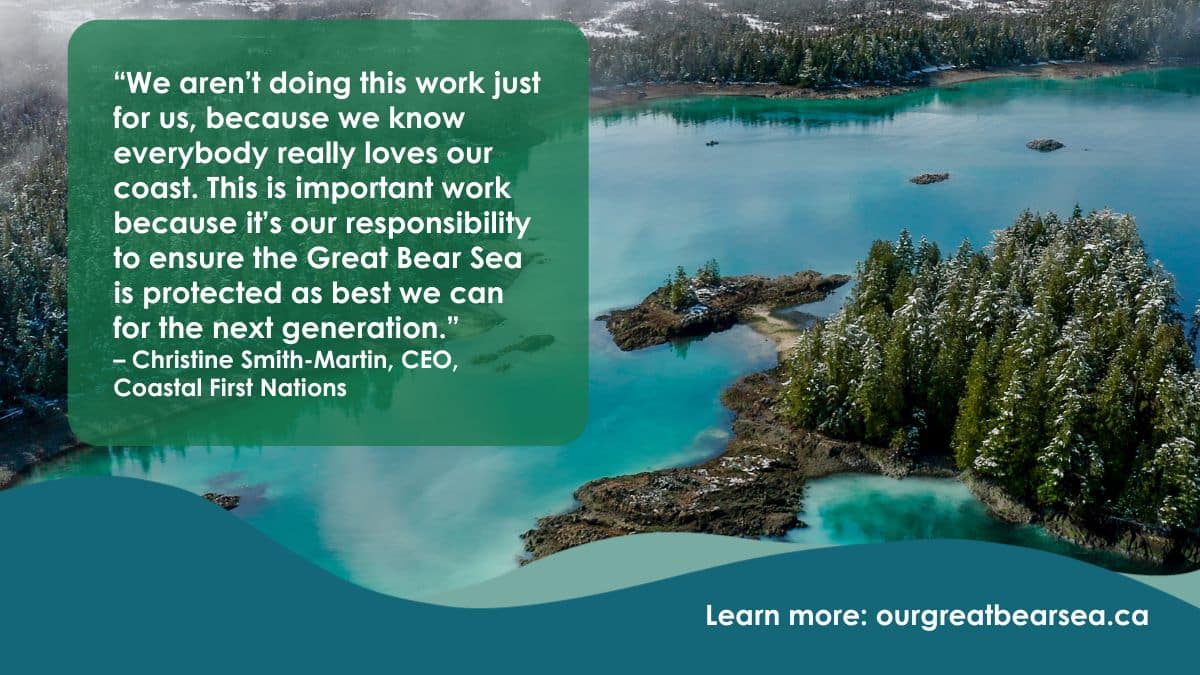
The Great Bear Sea is an ecological and cultural treasure that supports vast open ocean, estuaries, kelp forests, coral and sponges, and deep fjords. Unfortunately, overfishing, habitat degradation, increased shipping, and climate change are threatening the health and resilience of the Great Bear Sea and the coastal peoples that depend on it.
Image courtesy of ourgreatbearsea.ca // Photo Credit: Kitasoo Xai’Xais Territory / Moonfish Media
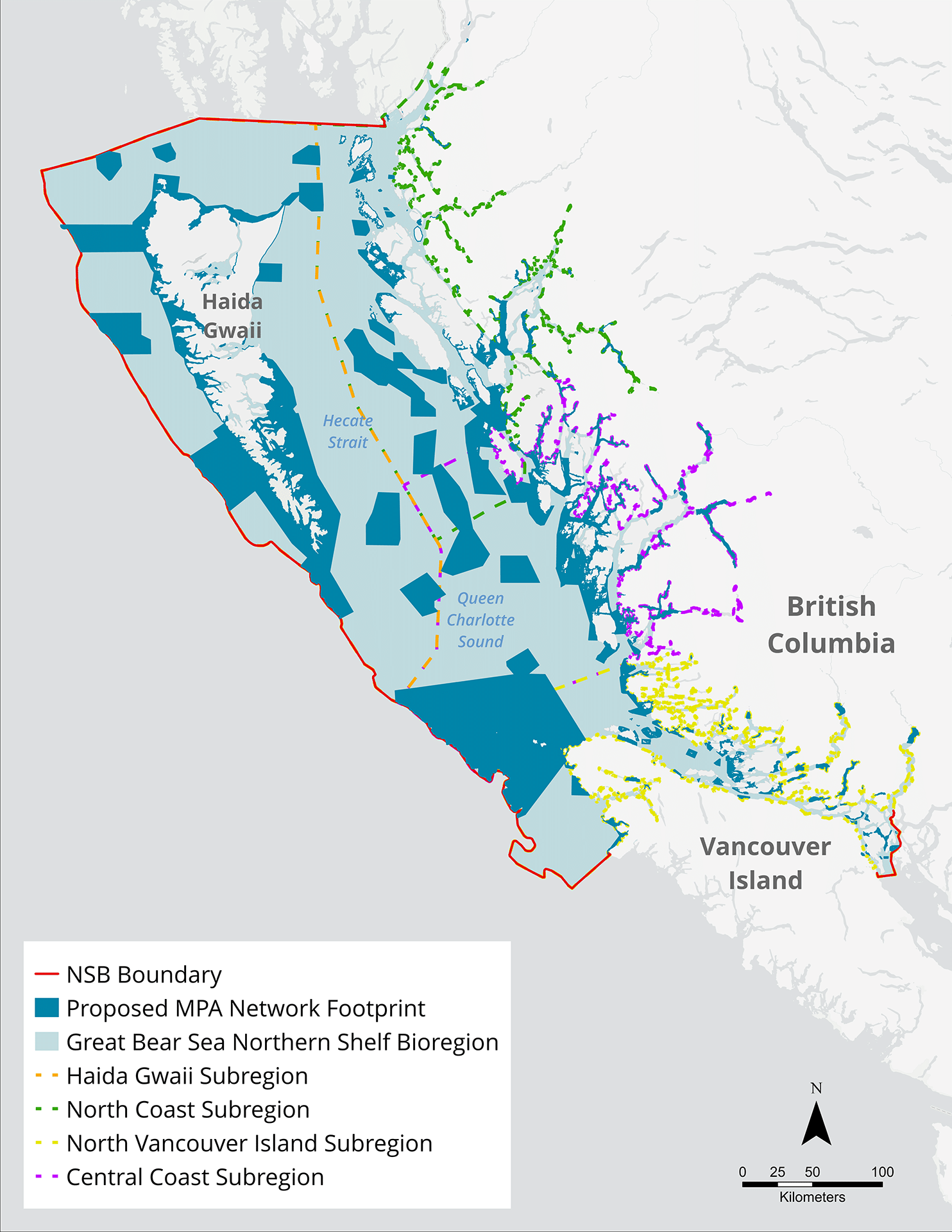
We need a two-pronged approach to help address these problems: creating a Marine Protected Area Network that considers the ecosystem as a whole, and securing the necessary lasting funding to bring it to life.
The Great Bear Sea Project Finance for Permanence initiative can help to advance both. Here’s how:
Long-Term and Large-Scale Impact:
The Project Finance for Permanence (PFP) is an innovative and proven conservation finance model that combines public and private investments from a diverse array of partners—including governments, NGOs, private investors, and local communities— to support permanent conservation strategies and sustainable economic development.
Often, conservation efforts rely on one-time or limited donations or grants. Although these funds are crucial for supporting individual projects, depending on incremental funding can introduce instability, lack of continuity, and gaps in protection.
Rather than seeking short-term funding to support one site, this new model aims to secure the necessary long-term financing, governance agreements, and strong conservation and development goals needed for lasting success across large-scale conservation efforts.
Collaborative Management:
The PFP approach unites governments, NGOs, donors, and local communities to fulfill a common conservation vision. It coordinates resources and efforts across these key partners to ensure that strong, sustained governance is in place for designing and implementing conservation commitments.
Following the Great Bear Sea MPA Network endorsement one year ago, collective and timely work is needed to bring the network to life. The Great Bear Sea announcement is an essential backing to advance the collaborative implementation of the Network Action Plan. This stable funding will be crucial in building capacity across partners, ensuring the continued management and monitoring of the MPAs, and fostering Indigenous-led governance in the decision-making process.
It’s anticipated it will also support the creation of more than 3,000 new jobs and 200 new businesses over the next 20 years. This is critical to ensure that those living near these vulnerable habitats can thrive where they live and help ensure local support. These opportunities will span diverse sectors, including marine stewardship, renewable energy, sustainable fisheries, and eco-cultural tourism. This will not only bolster local communities but also contribute to a sustainable and prosperous future for the region.
Holistic and Shared Vision:
The Great Bear Sea Initiative and MPA Network are the result of nearly two decades of collaborative work led by 17 First Nations, who’ve been stewarding these lands and waters for thousands of years, in partnership with the Government of Canada and the Province of British Columbia. And the vision is clear: Indigenous-led governance and stewardship, supported by stable, self-determined finance, to ensure the well-being of people and ecosystems across the Great Bear Sea for future generations.
Map of the proposed Great Bear Sea Marine Protected Area Network.
The Great Bear Sea PFP is transforming how we finance and manage conservation, ensuring ecological, social, political, and financial sustainability. This is an exciting milestone for the lasting protection of the Great Bear Sea and a historic step forward for Indigenous-led conservation. It’s the realization of decades of vision and collaboration across the region. As we look to the future, this initiative showcases the power of collaboration and innovative finance in securing a thriving Great Bear Sea for generations to come.

July 2, 2024
Unceded territories of the Coast Salish Peoples/Vancouver, BC – British Columbians are sending an overwhelming message of support for nature conservation and environmental protections ahead of the upcoming 2024 BC election, according to a new survey. Among BC residents, 85% support the goal of protecting 30% of lands by 2030, with protecting species at risk, intact watersheds and wildlife corridors topping the charts.
“It is clear that people want to take care of the places where they live to support healthy ecosystems that will deliver more sustainable and secure futures for their families and neighbours,” says Tori Ball, Land and Freshwater Program Conservation Director with CPAWS-BC. “We know that protected areas are critical to halt the biodiversity crisis and help us adapt to a rapidly changing climate.”
- Key findings
- The vast majority support more protected areas on land and in the ocean.
- 85% support the Government of BC’s commitment to protecting 30% of the province’s land and water by 2030.
- 82% express support for creating Marine Protected Areas.
- British Columbians feel it is important to see species at risk protected.
- 88% feel it is important to expand protected areas where there is a high number of species at risk of extinction;
- 86% think it is important to expand protection across both areas of natural beauty and intact watersheds and landscapes;
- 84% feel it is important to expand protection in areas that allow wildlife to connect between different habitats.
- A large majority of British Columbians believe some areas should be off-limits to mining and support permission requirements for mineral claims.
- More than 7 in 10, respectively, support restricting mining in municipal drinking water sources, salmon rivers, parks and wildlife habitat areas;
- 8 in 10 British Columbians agree that permission from landowners, municipalities and First Nations is needed for mining exploration.
Following recent expansions to the protected areas network, protected areas cover 15.8% of the land base in BC. BC will still need to nearly double current land protection to meet its 2030 target of protecting 30% of lands and waters by 2030, a critical target for halting biodiversity loss.
The survey also found that at least eight out of ten, respectively, were concerned about declining biodiversity, pollution and overfishing on BC coasts.
“The results of this survey reaffirm that British Columbians want to see bold commitments and action to protect lands, waters and wildlife as we head towards a fall election. These results lay out a path for us to move forward together and ensure we have areas safeguarded for important ecological, recreational and cultural values that thriving communities depend on,” added Ball.
Leger was commissioned to conduct this online survey of 1,001 British Columbians,
aged 19 and older between May 30 and June 10, 2024. For comparison purposes, a probability sample of this size yields a margin of error no greater than 3.1%, 19 times out of 20. The results were weighted by age, gender, and region to ensure a representative sample of BC residents.
– 30 –
For interviews contact:
Max Winkelman
Communications Manager
max@cpawsbc.org
604-685-7445 x3
Other findings:
- Seven in ten (71%) BC residents support the creation of more Indigenous Protected and Conserved Areas in BC.
- Conservation and wildlife experts are seen as providing the most important perspective on land use planning (86%), followed by local community/residents and landowners. First Nations perspectives have the second-highest level of “very important” support, behind conservation and wildlife experts.
What people are saying:
“Across BC’s lands and ocean, we have unique and globally significant ecosystems and British Columbians want to defend them against the multiple threats that risk their survival. Protected areas are the holistic tool BCers support and want to use to achieve this goal, not only for themselves but also for their kids and grandkids.”
– Kate MacMillan, Ocean Program Conservation Director with CPAWS-BC
“We need to do more to protect and conserve British Columbia’s fish, wildlife and habitat, and there’s strong support to make sure some areas are off-limits to mining. The province is committed to changing its free-entry staking regime from the 1850s and there’s overwhelming support that permission be required before mineral claims are granted (right now, it’s not).”
– Nikki Skuce, Director of Northern Confluence Initiative
“Respondents valued conservation and local input highly while industry was near the bottom of the list, coming only ahead of visitors and tourists. We’d love to see this reflected with land use planning being less industry focused and more emphasis on conservation and local perspectives.”
– Tori Ball, Land and Freshwater Program Conservation Director with CPAWS-BC
Link to PDF report