Active cutblocks the size of 68 Stanley parks in areas BC considers ‘protected’
Less than one third of Old Growth Management Areas in BC is actually old growth
January 29, 2024
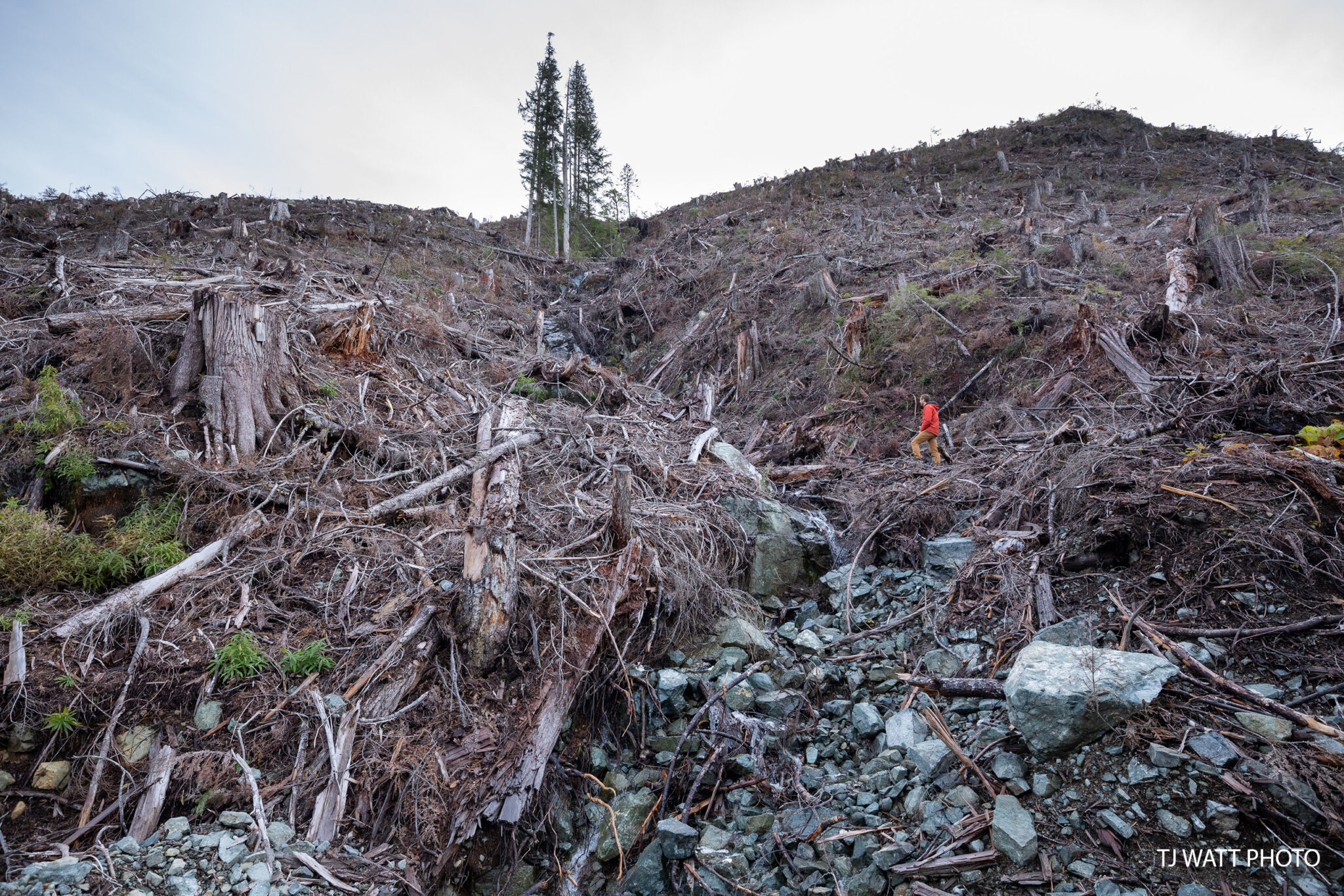
Unceded territories of the Coast Salish Peoples/Vancouver, BC – A new report from the Canadian Parks and Wilderness Society British Columbia (CPAWS-BC) finds that areas the BC government counts as ‘protected’ and uses to conserve biodiverse old growth forests do not meet conservation standards and contain little old growth.
Key Findings:
Less than one third (29 per cent) of legal Old Growth Management Areas (OGMAs) are composed of old forests (by area).
The majority (58 per cent) of legal OGMAs are young forest (by area).
Active forestry cutblocks also overlap 27,300 hectares of legal OGMAs in the province, an area 68 times larger than Stanley Park.
Furthermore, when broken down into individual OGMAs, 37 per cent of the approximately 22,000 legal OGMAS in BC do not contain any old trees.
“We’ve known for a while that OGMAs are poorly protected but these results were just shocking and show how far off conservation standards these protections are,” says Meg Bjordal, author of the report and the conservation research and policy coordinator at CPAWS-BC.
The report also looked at examples of OGMAs in the Campbell River Resource District to see what was happening on a smaller scale, and found frequent boundary changes to permit logging, and fragmented areas that cannot foster biodiversity.
“Looking at these OGMA examples, between the data, satellite views and on-the-ground pictures, this is a black mark on BC’s progress to protect endangered ecosystems. It is devastating that we’re still destroying old growth forests.”
The report recommends three key changes:
Amend OGMA guidelines to effectively protect old growth. OGMAs must be predominantly old forest, and represent large, unfragmented areas without clearcuts or roads. Boundary changes for resource extraction must not be permitted.
Conduct a provincial review of OGMAs: assess OGMA management and immediately rectify where targets for retention of old forests are not being met. Identify sites that offer large, unfragmented, old growth forests to meet the retention targets and achieve biodiversity protection with OGMAs.
Upgrade laws and regulations to ensure protection from boundary changes and industrial activity, such as logging and road building, to prevent further fragmentation of OGMAs. Put in place proper monitoring to track changes and incursions.
“B.C. recently reaffirmed their commitment to protecting 30 per cent of the province’s lands and waters in the widely celebrated Trilateral Framework Agreement for Nature Conservation. To reach this target, the province must either take significant steps to meet protection standards for ‘other conserved areas’ or completely exclude OGMAs from B.C. and Canada’s tally of protected areas,” says CPAWS-BC Executive Director Meaghen McCord.
-30-
For interviews, contact: Max Winkelman, Communications Manager max@cpawsbc.org 604-685-7445 x22
Background:
According to BC government accounting, 19.6 per cent of BC lands are currently protected. This total comprises 15.5 per cent in protected areas, including Provincial Parks, Conservancies and Ecological Reserves; and the remaining 4.1 per cent in Other Effective Conservation Measures (OECMs), 37 per cent of which are OGMAs.
This report used open source data from the BC Data Catalogue and the Canadian Protected and Conserved Areas Database. Old forest was classified by age and biogeoclimatic subzones as per similar methods that the Old Growth Technical Advisory Panel used.
New funding announced today by BC government adds to the funding announced last December
December 5, 2023
Unceded territories of the Coast Salish Peoples/Vancouver, BC – Today’s announcement of $60 million from the Province of BC to support Indigenous-led initiatives along the Great Bear Sea is celebrated by the Canadian Parks And Wilderness Society British Columbia.
“This announcement shows the provincial government’s ongoing commitment to Indigenous-led stewardship and sustainable development of the coast,” says Executive Director Meaghen McCord. “This adds to the other recent investments BC has made, and we are encouraged by BC’s ongoing efforts to support First Nation leadership across the province, on land and coast.”
The contribution from the BC government will be added to the previously announced Project Funding for Permanence (PFP) for the Great Bear Sea Initiative along with three other Indigenous-led initiatives announced almost exactly a year ago in Montreal.
The funding will support ongoing work, including the Great Bear Sea Marine Protected Area (MPA) Network– a process started over a decade ago between Indigenous Nations, BC, and Canada. Collaborative and well-managed marine conservation efforts in this region can lead to benefits, including improving the health of the coast, protecting culturally important sites, protecting the future of fisheries and food security, and more.
The announcement comes on the heels of recent polling that shows there is strong support for marine protected areas in the Great Bear Sea. Seventy-nine percent of British Columbians support the creation of a network of Marine Protected Areas that will protect 30 percent of the waters of BC’s Northern Shelf Bioregion (Great Bear Sea), while only nine percent were opposed, according to Mario Canseco.
“We know that a Marine Protected Area Network is what is needed to protect these sensitive and threatened marine areas, which First Nations in the area have been calling for for over a decade,” says Ocean Conservation Manager Kate MacMillan. “This funding will help the implementation of the Marine Protected Area Network Action Plan that was endorsed in February. This funding will help marine life and entire ecosystems to recover, rebound, and adapt, and it will also benefit local communities with dependable food and support local economies, now and for our children and grandchildren.
The funding will also support the Marine Plan Partnership (MaPP), Guardian programs, and sustainable economic development to support new businesses, permanent jobs, and more across the region.
For more information or to request interviews, please contact:
Recognition of First Nations as a partner is monumental in new nature conservation agreement
November 3, 2023
Unceded territories of the Coast Salish Peoples/Vancouver, BC – Today’s announcement of a historic Trilateral Framework Agreement for Nature Conservation (the Agreement) sets the stage for significant action to beat back the biodiversity crisis and advances a new model of leadership to advance conservation in BC.
The federal government will be contributing $500M, and the BC government has over $500M to reach the goal of protecting 30 per cent of lands and waters by 2030, and beyond. This includes a specific fund for old-growth forests and the opportunity for additional funds from the philanthropic community. The Agreement includes an important commitment to work together towards protecting 25 per cent by 2025, including on Indigenous protected areas.
“This is the largest investment into conservation in the history of the province, and the result of historic collaboration. BC now has all the tools needed to put these commitments into action in partnership with First Nations,” says Tori Ball, Terrestrial Conservation Manager for CPAWS-BC.
As BC works toward the goal of protecting 30 per cent of lands and waters by 2030, parallel work to support and recognize Indigenous Protected and Conserved Areas (IPCAs) must be prioritized with increased capacity, resources and coordination. CPAWS-BC is excited to see a commitment to co-develop long-term and interim measures for protecting wildife habitat and ecosystems outlined in the Agreement.
Alongside prioritizing new policy and legal pathways to support and recognize IPCAs, CPAWS-BC is also advocating for a new law that prioritizes biodiversity in all decision-making. This is a widely supported, key recommendation to protect threatened ecosystems such as ancient, old-growth forests and endangered grasslands. To ensure that this money is directed where it is needed to advance conservation, existing commitments to review and revise industry-focused resource policies and laws must be expedited to align with best practices.
“This agreement is a huge milestone and the start of major work. We know that protecting lands and waters takes time to get it right, and we need to make sure that endangered and intact landscapes are protected from immediate threats before they’re lost,” continued Ball.
BC will need to nearly double the amount of land protected to reach the goal of protecting 30 per cent. BC has 15.5 per cent of lands protected in long-term, legislated protected areas, and claims an additional 4.1 per cent in other conserved areas (OECMs). These other conserved areas do not meet the agreed-upon Canadian and international protection standards referred to in the Agreement and many can easily be moved to allow for activities harmful to biodiversity, such as logging.
“The agreement announced today provides a real dose of hope for change that can be made by empowering First Nations with additional capacity, sustainable economic growth and all governments pulling in the same direction to halt and reverse the rapid loss of biodiversity. It’s great to see BC has already launched some critical parts of this agreement such as the new $300 million fund for nature. There’s no time to lose on vital conservation initiatives,” says Ball.
– 30 –
For interviews, contact:
Max Winkelman, Communications Manager max@cpawsbc.org, 604-685-7445 x22
Background Facts:
A Canada-BC Nature Agreement was launched in February 2021 alongside commitments to support species at risk, including the Spotted Owl.
In December 2022, BC committed to protecting 30 per cent of lands by 2030, doubling the amount of land currently protected, and developing a conservation financing mechanism to support the protection of biodiverse areas through a mandate letter to Nathan Cullen, Minister of Water, Land, and Resource Stewardship.
In February 2023, BC committed to rolling out a new conservation financing mechanism within a six-month timeframe as part of its forest policy updates. This was released on October 26, 2023 as the Conservation & Stewardship Alliance Fund.
In October 2022, CPAWS released national polling results that show the majority of Canadians support protecting much more land and sea in Canada, and that the majority consider land and ocean protection a major voting issue.
Key facts about the Framework Agreement:
The funding includes $500M from the Federal government and $563M from the Provincial government. This includes funding that has already been made public, such as the $300M Conservation and Stewardship Alliance Fund announced last week.
Canada and B.C. have committed to an Old Growth Nature Fund, with matching funding of $50M each and potential funding from third-party organizations, and work in partnership with First Nations to permanently protect and conserve 4,000 to 13,000 km2 of high-priority at-risk old growth forests.
Canada will fund new restoration activities that achieve high co-benefits for species at risk, ecosystem services, connectivity, and ecological corridors. Canada and B.C. will also consult and cooperate with First Nations on species at risk protection and recovery, including ongoing partnerships to implement existing, and future, co-developed species protection and recovery plans.
A Tripartite Nature Committee will be established with representatives from Canada, B.C., and FNLC whose roles will be to coordinate activities under the Agreement.
About CPAWS-BC:
The Canadian Parks and Wilderness Society (CPAWS) is Canada’s only nationwide charity dedicated solely to the protection of our public land, ocean, and freshwater, and ensuring our parks and protected areas are managed to protect nature. Since 1963, CPAWS has played a leading role in protecting over half a million square kilometres. Our vision is to protect at least half of Canada’s public land and water in a framework of reconciliation – for the benefit of wildlife and people.
The CPAWS British Columbia chapter (CPAWS-BC) works to protect wilderness in every corner of BC and deep into the ocean. We have been defending BC since 1978, and are dedicated to keeping BC’s natural environment thriving forever. Nature is BC’s best hope.
The Government of B.C. just announced a new $300 provincial Conservation and Stewardship Alliance Fund. Here are 5 things you need to know about this fund designed to conserve land and marine areas:
1 Long-term area-based conservation
The Conservation and Stewardship Alliance Fund will supply funding for area-based conservation through the planning, establishment and implementation of protected and conserved areas.
Activities that are eligible for funding include capacity support for planning and negotiations, removing tenures from the land base that would harm biodiversity, restoration work, and economic transition support for communities.
2 Indigenous-led
In order to be eligible, First Nations must have a leadership role in the proposed project. Research has shown that biodiversity thrives in protected areas managed by Indigenous Peoples. They have stewarded their territories since time immemorial and deeply understand the relationships between land, water, wildlife and people.
3 Independent oversight
The fund will rest outside of provincial government, hosted within the BC Parks Foundation. It will be administered by an oversight committee that includes at least half First Nation representation. The committee will be made up of experts in the field of conservation and stewardship. This, along with the public reporting requirements, is critical as it will insulate the fund from political shifts and offer increased transparency. It’ll also enable the cooperation and coordination of funding for First Nations-led conservation initiatives.
4 Matched funding
Of the $300 million, $150 million comes from the provincial government and $150 million comes from private, philanthropic sources. This really underlines how important conservation is in British Columbia not only to the Government of B.C. but also to the residents of British Columbia. This fund will endure beyond 2030, supporting nature to make a full recovery beyond the current biodiversity targets.
5 There may be more to come
The funding announcement comes ahead of the highly anticipated Tripartite Framework Agreement for Nature Conservation. This Agreement could bring a whopping additional $1.2B investment made by the federal and provincial governments to advance conservation across BC.
The announcement of the Fund builds on recent commitments and action from the province. Work is well underway to create the first province-wide Coastal Marine Strategy, which will provide a much-needed and long-overdue blueprint for coastal protection. Earlier this year, the province removed an archaic clause that prevented ecological protections from “unduly reducing the supply of timber from British Columbia’s forests.” These are key milestones that set BC on a path to prioritize ecosystem health, keeping forests, wildlife and communities healthy for generations to come.
New independent BC fund is aimed at supporting Indigenous-led protection
Unceded territories of the Coast Salish Peoples/Vancouver, BC – The Canadian Parks and Wilderness Society – British Columbia (CPAWS-BC) welcomes today’s announcement of a new $300 million fund for conservation projects. The Conservation and Stewardship Alliance Fund will help the province deliver on its commitment to protect biodiversity in BC and, in partnership with First Nations, will set nature on a path to recovery by 2050.
The new fund is made up of a $150 million contribution from the provincial government and $150 million contributed from private, philanthropic sources. It will support the creation of land and marine-based protected areas and is overseen by a committee of First Nation representatives, conservation experts and ex-officio government.
“This is a massive step towards closing the gap in ongoing funding for conservation projects in BC. The fund’s requirement for projects to include First Nation leadership is critical and promotes reconciliation in a way that supports Indigenous rights and values,” says Tori Ball, Terrestrial Conservation manager for CPAWS-BC. “This is the kind of long-term funding that we have been calling for and shows the BC government is serious about biodiversity loss and the extinction crisis.”
Key facts:
The Fund is hosted at and administered by the BC Parks Foundation, which will provide at least a 1:1 match for approved projects;
The BC government provided $150M to create the Fund, previously called a Conservation Financing Mechanism and committed to in Dec 2022;
Eligible activities include capacity planning, removal of tenures, restoration work, stewardship programs, and economic transition, and all projects must include a First Nations leadership role;
The outcomes of the initiatives are long-term protection designations, working towards the 30 per cent protection by 2030 targets;
Five new Forest Landscape Plans have been confirmed in partnership with local First Nations; Bulkley Valley, 100 Mile House, Williams Lake, East-Central Vancouver Island and West-Central Vancouver Island.
To make sure these funds will truly support Indigenous-led conservation and stewardship on the ground, CPAWS-BC wants to see the province work with First Nations to develop a pathway to recognize Indigenous Protected and Conserved Areas through legislation or policy.
“Having an expert and Indigenous-focused independent oversight committee for the fund will provide critical connections to community needs, transparency and longevity,” says Ball.
The funding announcement comes ahead of the highly anticipated Tripartite Framework Agreement for Nature Conservation which could bring the largest investment into nature conservation in the history of the province. This positive shift is echoed through the promise of a province-wide Coastal Marine Strategy and work to shift the forestry industry to integrate long-term ecosystem health. These initiatives not only prioritize healthy lands and waters but also support communities and their economic well-being through the transition.
– 30 –
For interviews, contact:
Max Winkelman (he/him), Communications Manager CPAWS-BC max@cpawsbc.org 604-685-7445 x22
Background Facts:
In December 2022, BC committed to protecting 30% of lands by 2030, doubling the amount of land currently protected, and developing a conservation financing mechanism to support the protection of biodiverse areas through a mandate letter to Nathan Cullen, Minister of Water, Land, and Resource Stewardship.
In February 2023, BC committed to rolling out a new conservation financing mechanism within a six-month timeframe as part of its forest policy updates.
Alongside this announcement, the government removed a clause in February that ecological protections could not “unduly reduce the supply of timber from British Columbia’s forests.”
About CPAWS-BC:
The Canadian Parks and Wilderness Society (CPAWS) is Canada’s only nationwide charity dedicated solely to the protection of our public land, ocean, and freshwater, and ensuring our parks and protected areas are managed to protect nature. Since 1963, CPAWS has played a leading role in protecting over half a million square kilometres. Our vision is to protect at least half of Canada’s public land and water in a framework of reconciliation – for the benefit of wildlife and people.
The CPAWS British Columbia chapter (CPAWS-BC) works to protect wilderness in every corner of BC and deep into the ocean. We have been defending BC since 1978, and are dedicated to keeping BC’s natural environment thriving forever. Nature is BC’s best hope.
Here are 5 things you should know about the Great Bear Sea Marine Protected Area Network:
1) Many years, many voices
The Great Bear Sea Marine Protected Area Network was created collaboratively by Indigenous and coastal communities from North Vancouver Island, along the Central Coast to the North Coast and across to Haida Gwaii.
For over 10 years, there have been many meetings and conversations with people who live and work on the coast, including the fishing, tourism, and environmental sectors.
Together, governance partners—First Nations, federal and provincial governments—and stakeholders have developed a plan that will protect the vibrant network of life in the Great Bear Sea for generations to come.
2) More fish in the ocean
Right now, we see fish populations in Pacific Canada at a fraction of their historical levels [1]. The Great Bear Sea Marine Protected Area Network is a tool to help rebuild fisheries and recover ecosystems, limiting catches of certain species should be coupled with protecting habitats where marine life feed, breed, and grow up.
We can look at long-term studies from other areas to see the real and powerful benefits of marine protected areas for helping fisheries and improving food security. One example is the marine protected area network established in California a decade ago which has already shown encouraging results, including more and larger fish beyond the boundaries of the protected areas, including species targeted by fisheries [2][3]. Over the first 10 years, local fisheries either improved or stayed the same in terms of catch, effort and dollar value [4].
3) Defence from many different threats
Marine protected areas limit activities that threaten marine life. Whether it’s the loss of critical ecosystems like cold water corals and sponges, seagrass and kelp or impacts on marine animals from ship dumping, we can reduce threats to ocean health by managing destructive human activities. Canada has committed to ban the most harmful activities in all marine protected areas, these include oil and gas, mining, bottom-trawling, and dumping. When the damage and destruction from these industrial activities is removed, these areas are refuges that better support marine life and whole ecosystems to adapt to other threats, such as warming waters and ocean acidification [5][6].
4) Benefits far beyond the boundaries
Marine protected areas provide both direct and indirect benefits to local economies and beyond. Marine protected areas help rebuild and sustain fisheries. They’re a proven tool to help enhance community involvement and support marine tourism. Local economies also benefit from creating conservation-related jobs such as monitoring, management, and research [7][8].
Marine protected areas also protect the ecosystem services these areas provide, such as protecting key coastal habitats that reduce the vulnerability of communities to climate change threats such as storm damage, flooding and coastal erosion [9], and protecting and restoring kelp forest and seagrass meadows that help the sequestration of carbon [10]. Moreover, a healthy, safe, and thriving ocean uplifts cultural and spiritual values across generations.
5) Supercharge conservation effectiveness!
Establishing a connected network of marine protected areas in the Great Bear Sea will defend and support a diversity of habitats. By establishing a network of marine protected areas rather than creating individual protected areas without considering the connections across the ocean, will supercharge their effectiveness. This is the opportunity to work together across communities and sectors to amplify the benefits of individual protected areas and ensure the large-scale processes that keep ecosystems and wildlife populations healthy will remain.
What’s next?
A healthy ocean full of fish, kelp, and whales, and is part of the legacy we want to leave for our children and grandchildren.
After years of work to develop the draft action plan for the Great Bear Sea Marine Protected Area Network, the announcement in February 2023 meant that everyone can continue working on the details to make the plan a reality. Equipped with the long-standing process between Indigenous Nations and governments, input advisory tables with stakeholders, and feedback during the public consultations, we can build on these collaborations.
Debra Sinarta, Marine Research Coordinator Kate MacMillan, Ocean Conservation Manager
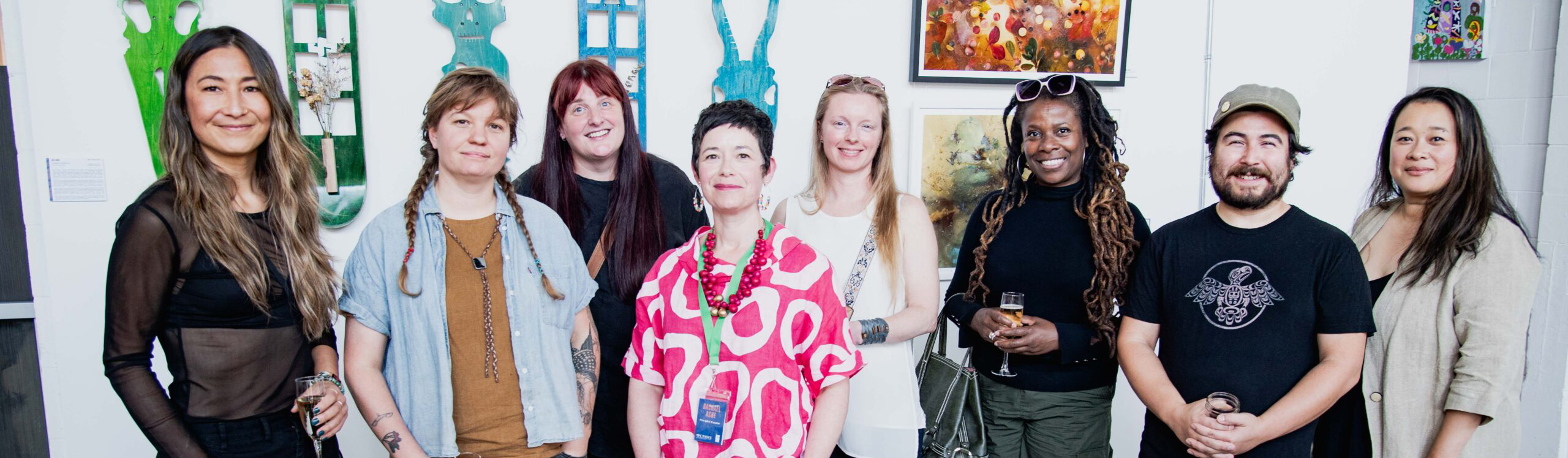
A year ago we hatched a plan to create a real-world art exhibit and community space where we could mourn biodiversity loss in BC, honour animals and plants trying to survive in an extinction crisis and recognize the possibility for hope at a moment where we can glimpse positive shifts ahead.
At Precipice: Changing the Course of the Extinction Crisis in BC we looked forward to what can be in BC – more Indigenous-led conservation; 30% of the province protected by 2030 and a resilient future. At Precipice we celebrated these opportunities, embraced hope and were filled with inspiration for the next leg of the journey to ensure decision-makers turn those promises into action.
We’ve shared some of the artists’ experiences here and we hope you’ll find hope and inspiration from them and their exquisite artwork as well as in some of the joyful moments of Precipice.
Sarah Ronald
As an artist I was really happy to be invited to participate in Precipice because it aligned perfectly with my interest in connecting with the world beyond the gallery. It was an opportunity to present my work where it had the potential to have a positive impact in the broader community. Precipice was also a great opportunity to connect with fellow wildlife concerned artists and art collectors, as well as a variety of individuals working in the fields of conservation, science and private sectors.
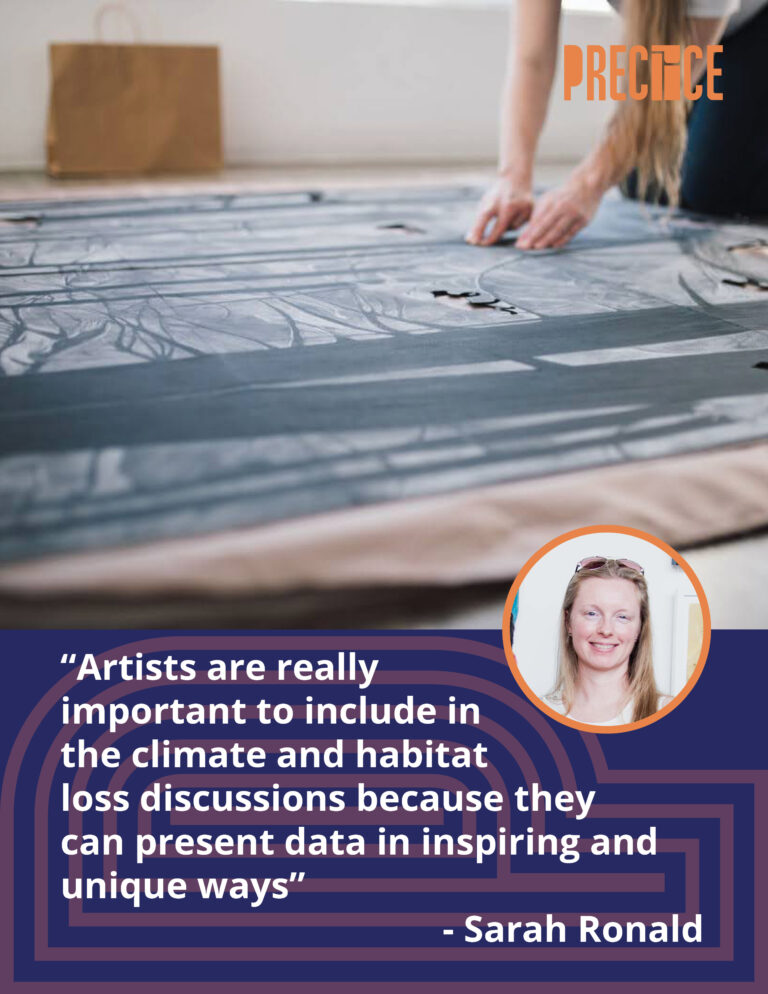
Along with talking about my piece (and our problematic concept of wildlife relocation to address habitat loss and poor human behaviour around coexistence with wildlife), I spoke about the importance of art and storytelling in this current time on the planet. Artists are really important to include in the climate and habitat loss discussions because they can present data in inspiring and unique ways, and those pieces can further engage and create massive ripple effects in generating solutions.
Through this exhibition I was also able to listen and learn. For instance after hearing CPAWS staff in media interviews, I was inspired to take a closer look at the UN report about biodiversity loss and excellerating extinction rates – which will no doubt become influence for future artwork, which will bring further awareness and acknowledgment to the broader community.
For my particular piece in this exhibition, The Transference of Landsharks, the message is for each of us to personally and continually check how our behaviours impact the natural world in daily life. Even where our current culture sets us up for complacency, we need to choose not to be complacent – we need to choose to stay engaged and to make positive changes for the rest of our lives.
If one loses sight of things, just consider that we are all living on clear cuts that were once massive healthy ecosystems: for this reason alone we have a responsibility to provide meaningful compassionate action towards all that is more-than-human.
Being part of this group exhibit at Precipice was such a meaningful experience as it showed the passion and dedication to environmental preservation that many of us are fiercely protective of.
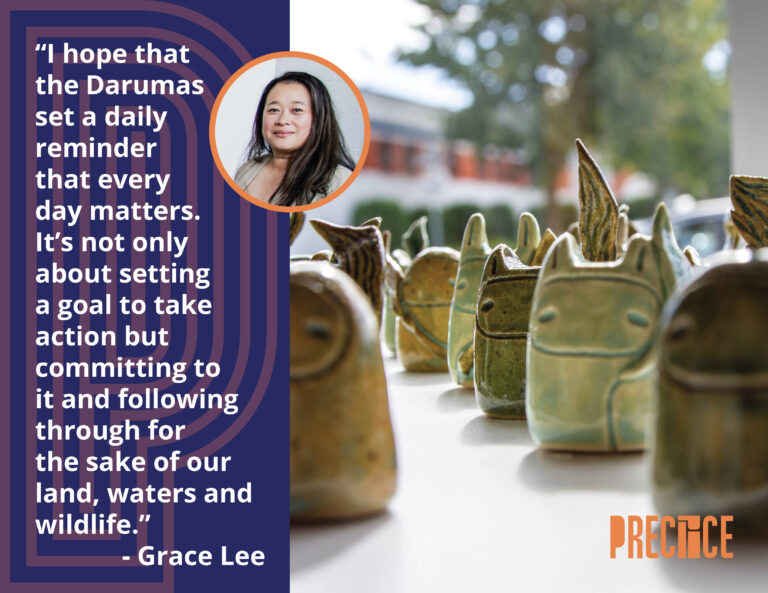
Many conversations revolved around setting an intention with the Daruma dolls to make change and taking that first step and promise to further the work needed to protect our environment & wildlife.
I hope that the Darumas set a daily reminder that every day matters.
It’s not only about setting a goal to take action but committing to it and following through for the sake of our land, waters and wildlife.
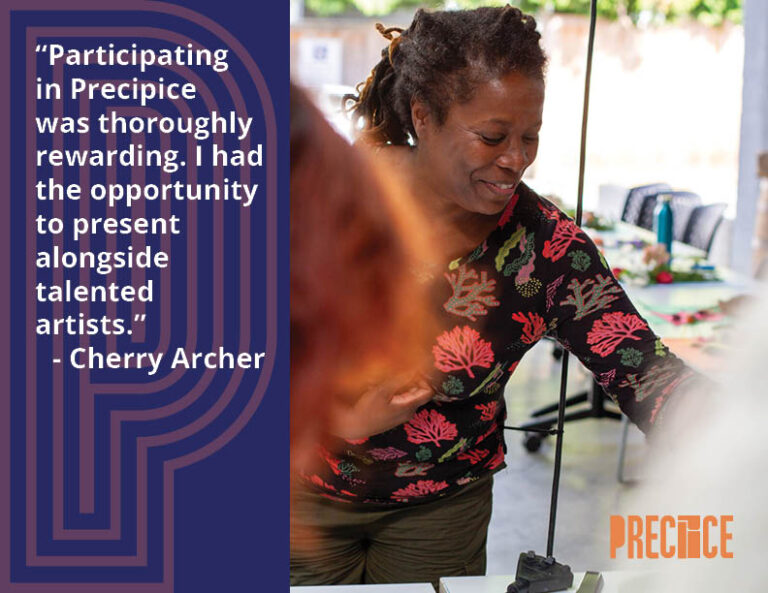
Participating in Precipice was thoroughly rewarding. The curator had a clear vision. She assembled an engaging and informative group of speakers and workshops. I had the opportunity to present alongside talented artists. Each body of work complimented the next. I felt supported and had an excellent time presenting my workshop.-
The best way to keep informed on her work is to follow ger Instagram @cherry.archer
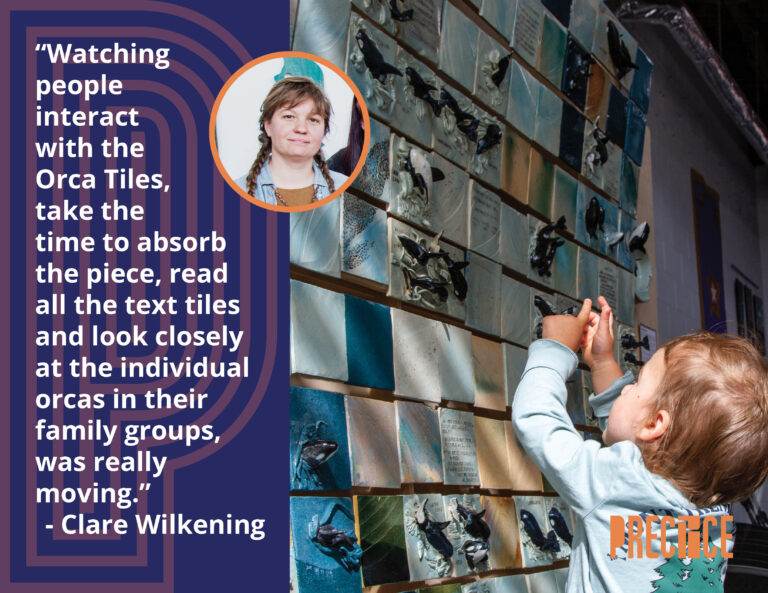
It was great to meet and make a connection with the other artists and the team that put together the show. During the opening, watching people interact with the Orca Tiles, take the time to absorb the piece, read all the text tiles and look closely at the individual orcas in their family groups, was really moving. I could tell from watching and speaking to people that they came away from the work with an emotional resonance and deeper knowledge of the way the Southern Residents live and what can be done to help prevent their extinction. With the Fraser River Sturgeon, people had a big reaction to how striking the work is, and that draws them in to learn more about this mysterious species who is our neighbour. Sturgeon in the Fraser have fairly robust population numbers, but most of the population is old; there are not enough juveniles to sustain the future numbers of this long-lived species. It’s unknown why there are so few juveniles, but part of the reason may be the stress of the catch-and-release fishery- stress can disrupt spawning biological processes and behaviours. Fishers have already voluntarily stopped fishing in certain areas during spawning season, but maybe more needs to be done. I had a sturgeon facts card next to the sculpture, and I equally enjoyed watching people read that as I did watching people absorb the Orca Tiles.
Some great conversations I had included talking with MP Jenny Kwan about ceramics and about these species, as well as being interviewed by Sheryl McKay for CBC: North by Northwest.
A major issue that the Southern Resident Orca currently face is the proposed expansion of the Deltaport/Roberts Bank terminal. This construction would greatly increase freighter traffic through the Salish Sea, which brings with it noise pollution (making it harder for the orca to locate prey), risk of ship strikes, and additional pollution from the vessels themselves and risk of oil spills. Construction would also destroy large areas of eelgrass in the underwater shore along the bank and the estuary- this is crucial habitat for migrating juvenile salmon, the orca’s primary food source. You can write to your MP, to Ministers Guilbeault (Environment), Alghabra (Transport), Lebouthillier (Fisheries & Oceans), Freeland (Deputy Prime Minister), and Trudeau (PM), and let them you do not support this port expansion and why. You can also visit https://georgiastrait.org/work/species-at-risk/proposed-terminal-2-deltaport-expansion-2/ and https://www.againstportexpansion.org to learn more.
You can find Clare’s work at her open studio Oct. 19-21 in Roberts Creek for the Sunshine Coast Art Crawl. She will be vending her ocean-themed pottery at Make It Vancouver at the PNE December 7-10th, and on clarewilkening.com or on Instagram @clarewilkening.ceramics.
Adea Chung
It was an honour to be part of Precipice and among such inspiring and passionate artists. I generally make small jewellery and home wares, having the opportunity to do something on a larger scale for the show was such a treat.
Adea’s work can be found at: The Billy Would store 2168 E. Hastings St. Vancouver, BC or visit billywould.com.
September 17, 2023
Unceded Coast Salish Territory/Vancouver, BC— Chief Rebecca David of Pauquachin Nation will join a special panel on marine pollution alongside leading coastal environmental groups on Tuesday, September 19 in Vancouver. Turning the Tide on BC’s Marine Pollution Crisis is presented as part of an art exhibition showing in Vancouver this fall, Precipice: Changing the Course of the Extinction Crisis in BC.
Lucas Harris, Executive Director, Surfrider Canada
Turning the Tide on BC’s Marine Pollution Crisis is hosted by Alicia Elgert, Ocean Conservation Campaigner, Canadian Parks and Wilderness Society – British Coulmbia (CPAWS-BC).
The coast faces many threats–from pollution to loss of salmon habitat to overharvesting. That’s why it’s so hard to believe BC is one of the only coastal regions in North America without a cohesive plan and laws to protect it.
British Columbians are drawing a new blueprint for the coast. A blueprint, co-designed with Indigenous nations, that ensures marine life and coastal communities get the future they deserve. Learn more: Blueprintforthecoast.ca
Event information:
Kate MacMillan Ocean Conservation Manager kate@cpawsbc.org
About Precipice: Changing the Course of the Extinction Crisis in BC
Precipice is a new art exhibition that tells stories of biodiversity loss and hope in British Columbia. Working in mixed mediums, seven BC-based artists will compel you to mourn, understand and ultimately protect the lands and waters of Canada’s most biodiverse province.
From September 15-23, 2023 Precipice is an exhibit and gathering place where artists, biologists and activists will teach, play and host conversations about biodiversity with the community.
Precipice features work by Cherry Archer, Nell Burns, Adea Chung, Grace Lee, Jessie Recalma, Sarah Ronald, and Clare Wilkening and is curated by Rachael Ashe.
Precipice is presented by Canadian Parks and Wilderness Society – British Columbia. Find more information about the Precipice art exhibition: ontheprecipice.ca
September 14, 2023
Unceded Coast Salish Territory/Vancouver, BC — Precipice: Changing the Course of the Extinction Crisis in BC welcomes the public for Opening Night on Friday, September 15 from 6-9 PM. Celebrate opening night with a very first look at this special show. Enjoy wine, beer or kombucha and music from Hussein DJ A-SLAM all night.
*The official opening is open to media. Media wishing to attend are encouraged to RSVP online or email media@cpawsbc.org
About Precipice: Changing the course of the Extinction Crisis in BC
Precipice is a new art exhibition that tells stories of biodiversity loss and hope in British Columbia. Working in mixed mediums, seven BC-based artists will compel you to mourn, understand and ultimately protect the lands and waters of Canada’s most biodiverse province.
From September 15-23, 2023 Precipice is an exhibit and gathering place where artists, biologists and activists will teach, play and host conversations about biodiversity with the community.
Precipice features work by Cherry Archer, Nell Burns, Adea Chung, Grace Lee, Jessie Recalma, Sarah Ronald, and Clare Wilkening and is curated by Rachael Ashe.
We open on Friday, September 15, 2023 from 6-9 PM and would love to have you as our guest.
Regular Gallery hours are free and open to the public Tuesday-Thursday from 3-6PM, in addition to special evening and weekend programs.
Mediating on Nature art workshop with Cherry Archer: Sunday September 17, 2023
Beginner-friendly ceramics workshop with Clare Wilkening: September 23, 2023
Precipice is presented by Canadian Parks and Wilderness Society – British Columbia. Find more information about the Precipice art exhibition: ontheprecipice.ca
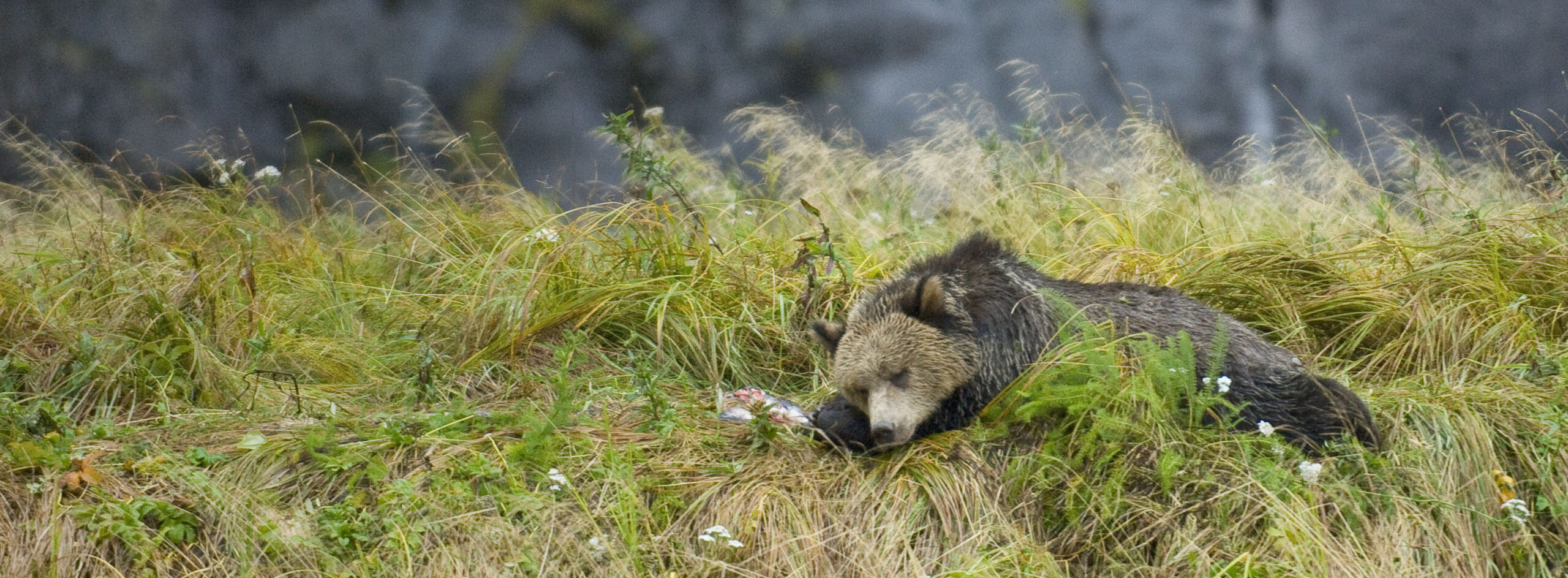
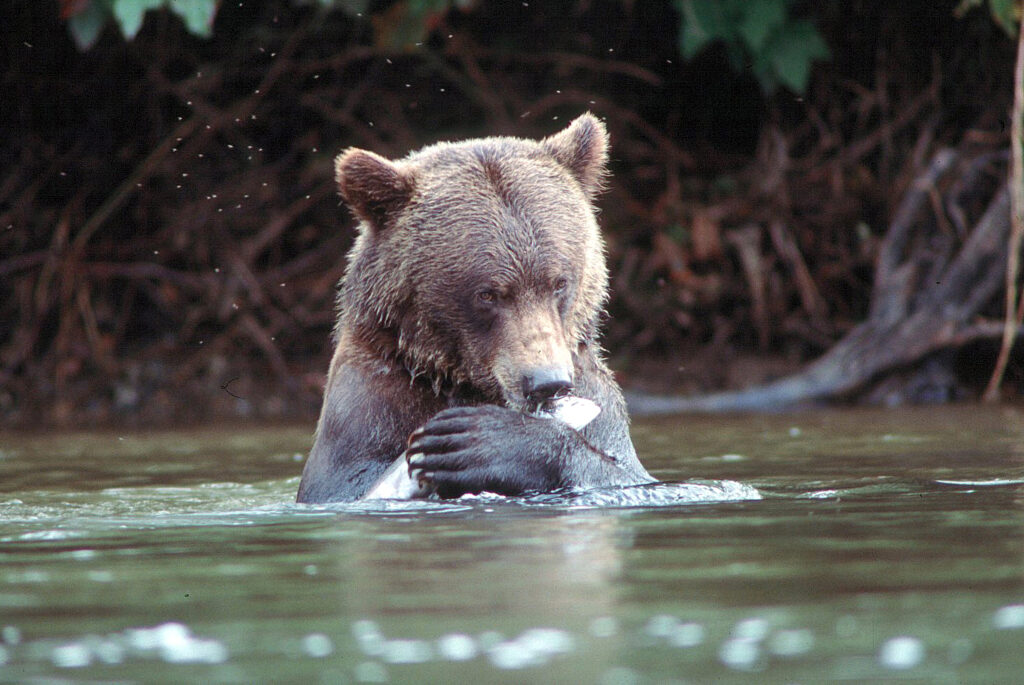
You have probably heard about hibernation, but what is hyperphagia? This term means intense eating, and is a phase that bears go through in the fall to increase their body weight and prepare for winter denning. Bears need to increase their body weight by approximately 30% in order to have enough energy stores to survive winter denning.
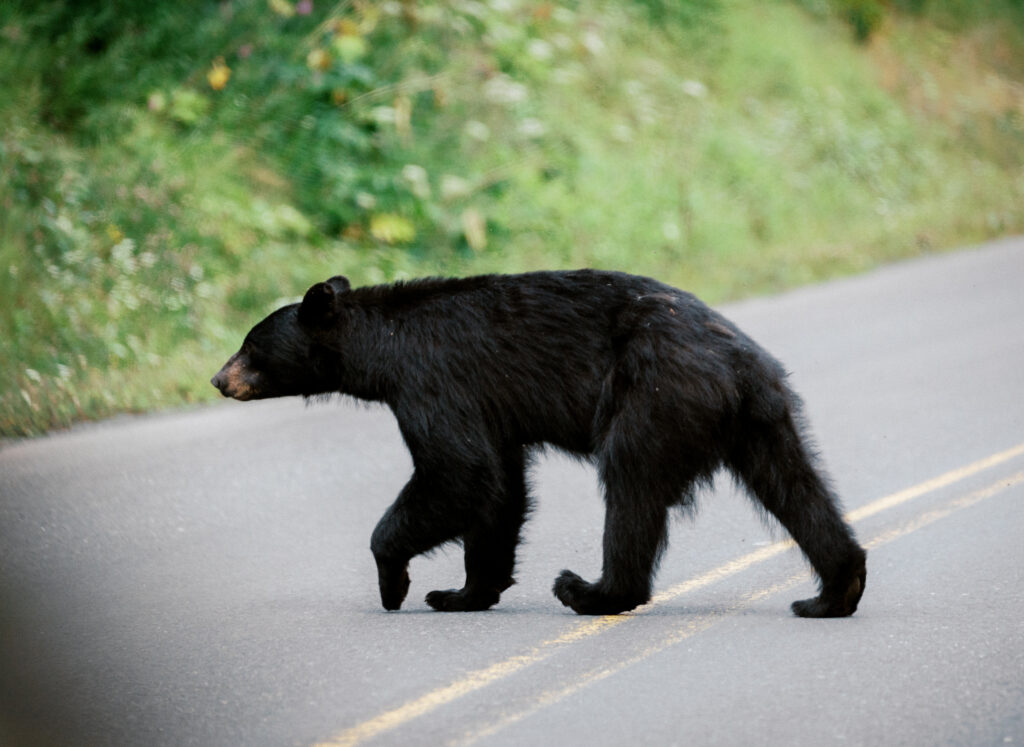
As the fall progresses bears may move to lower elevations where there is still lush greenery to snack on. These lower elevations are where many of our communities in BC lay, which means an increased chance of conflicts with bears this time of year.
Bears have an excellent sense of smell which they use to guide them to food sources. This can also lead them straight into towns if attractants are present. Access to unnatural food sources like garbage, domestic fruit trees and even bird seed can lead to bears becoming food conditioned and/or habituated to humans. This can result in unsafe situations for both bears and people.
People have an important role to play as wildlife stewards. You can help keep bears safe and your neighbourhood free from bear conflicts by practising attractant management. Our friends from WildSafeBC have a Top 10 List you can use to keep bears wild and your community safe!
Keep your garbage secure – store it indoors, in a secure shed, or in a bear-resistant enclosure.
Only put your garbage/yard waste/recyclables out on collection day – never the night before.
Manage your fruit trees so that fruit is picked as it ripens, and no windfall accumulates.
Bring bird feeders in from April through November – and when they are out, ensure that the ground underneath is kept free of seeds.
Feed pets indoors.
Maintain your compost so that it doesn’t smell. Add fruit slowly. Never add meat or dairy.
Protect fruit trees, beehives and small livestock with properly installed & maintained electric fence.
Respect wild animals by not feeding them. Food-conditioned wildlife are more likely to come into conflict.
Keep barbecues clean and odour free.
Report any wildlife in conflict or bear, cougar, coyote or wolf sightings in the community to the Conservation Officer Service 24/7 at 1-877-952-7277.
Most encounters can be prevented by:
making noise
travelling in groups
keeping pets on a leash, and;
avoiding areas where there are signs of recent wildlife activity such as scat.
If you do encounter a bear, stop, try to stay calm and do not run!
Back away slowly from the bear and talk to it in a calm, firm voice to signal that you are not a threat, nor a typical animal they would prey on.
Be sure to have bear spray accessible, like carried on a hip holster, and know how to use it. Bear spray is a low-cost and lightweight option to stop a bear attack.
In the unlikely event a bear charges or is exhibiting stalking behaviour, stand your ground and use your bear spray.
Wildlife in BC’s Parks
Wildlife stewardship starts with managing attractants around your home, and extends into responsible recreation when you visit parks and natural areas. Always be prepared for wildlife encounters, carry bear spray, and be sure to give wildlife plenty of space.
One of the best ways we can support bear conservation is by protecting their habitat. Bears require large and connected habitats to thrive.
Large natural areas allow bears to meet all their seasonal food requirements. In the spring they need protein rich green shoots that first appear at lower elevations, to help build back muscle after winter denning. In the summer, they need berry rich slopes and meadows. And in the fall, salmon bearing streams offer a critical food source so bears can build up their winter fat stores.
Bears bring the salmon into the forest to eat, where the remains decompose and provide essential soil nutrients that help the trees grow. This helps make bears a keystone species, as they have a major role in healthy BC ecosystems.
Protecting habitat for bears is important to ensure they have enough sources of nutritious food, and reduces their risk of conflict in urban spaces. The goal to protect 30% of land in BC by 2030, will be important for bear conservation and ensuring healthy, functioning ecosystems in BC.
We use cookies and other similar technologies such as pixels and web beacons (“Cookies”) for various purposes, such as to ensure our website functions properly, enhance your browsing experience by remembering your preferences and provide personalized content and advertisements.
Functional
Always active
The technical storage or access is strictly necessary for the legitimate purpose of enabling the use of a specific service explicitly requested by the subscriber or user, or for the sole purpose of carrying out the transmission of a communication over an electronic communications network.
Preferences
The technical storage or access is necessary for the legitimate purpose of storing preferences that are not requested by the subscriber or user.
Statistics
The technical storage or access that is used exclusively for statistical purposes.The technical storage or access that is used exclusively for anonymous statistical purposes. Without a subpoena, voluntary compliance on the part of your Internet Service Provider, or additional records from a third party, information stored or retrieved for this purpose alone cannot usually be used to identify you.
Marketing
The technical storage or access is required to create user profiles to send advertising, or to track the user on a website or across several websites for similar marketing purposes.