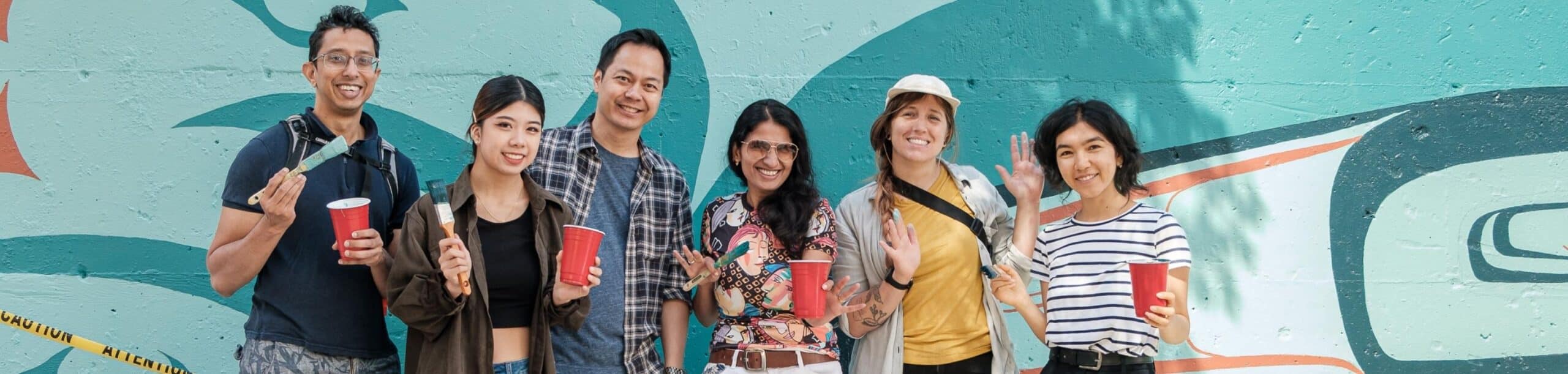
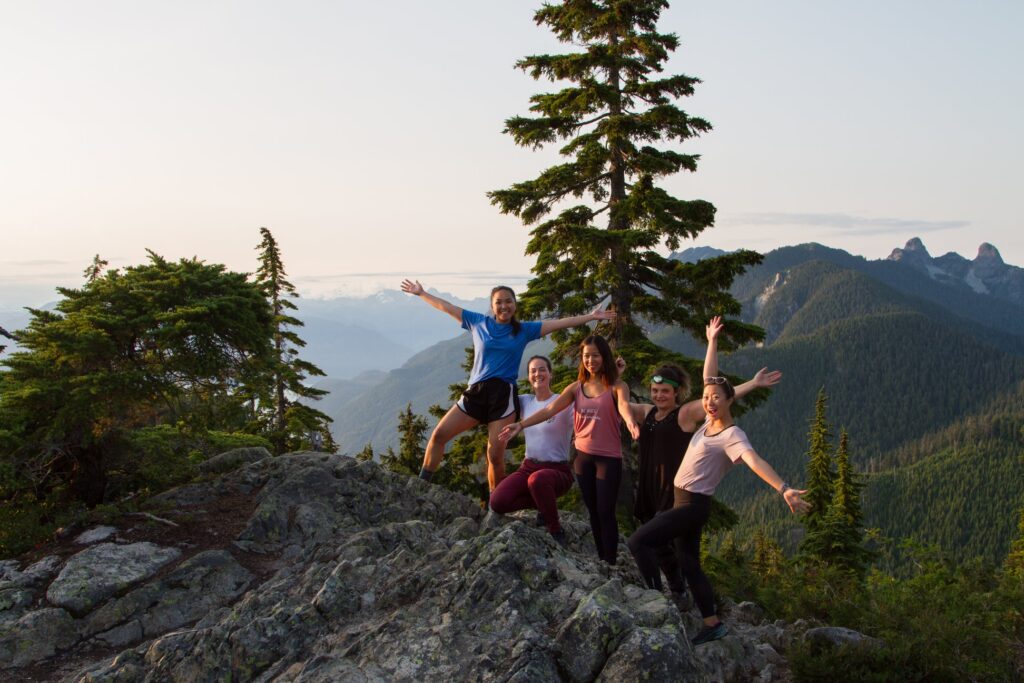
CPAWS-BC staff and board help paint murals ahead of Van Mural Fest 2022. Photo: Sabrina Miso Creative
Painting the town blue for ocean conservation
Find out where you’ll find these ocean-inspired murals in Downtown Vancouver as part of Van Mural Fest 2022
Looking for fun things to do in Vancouver this summer? If you love the ocean – we’ve got two special treats for you this summer! Through lunchtime strolls and cycling commutes to our downtown office, the CPAWS-BC team started dreaming up ways to splash Nature art on the blank city walls about five years ago. This year, we’re thrilled to connect with Vancouver Mural Festival (VMF) and three Indigenous artists to create two massive ocean-inspired murals in Downtown Vancouver.
The artists have woven their culture and shared values to depict stories from the Salish Sea, along the Central Coast and up to Haida Gwaii and the North Coast. Both murals celebrate that while we may come from different places, it’s our shared responsibility to come together as one to protect our ocean and the coast for all life that depends on it. You can read more about the artists and the mural statements below.
The marine waters depicted in these murals have important conservation initiatives in progress. In the Salish Sea there is a proposed National Marine Conservation Area reserve for the Southern Strait of Georgia, learn more about the importance of this region by visiting Home of the Orcas. And in the waters around Haida Gwaii and along the BC coast from the Alaskan border to Northern Vancouver Island there is a process to create a network of marine protected areas. Learn more about the Great Bear Sea and how you can help support protecting these waters for future generations.
Thank you to the entire team at Vancouver Mural Festival for your support and guidance to bring these murals to life. These murals were made possible by generous support of the Doherty Family, BIA Vancouver, and IMPAC5.
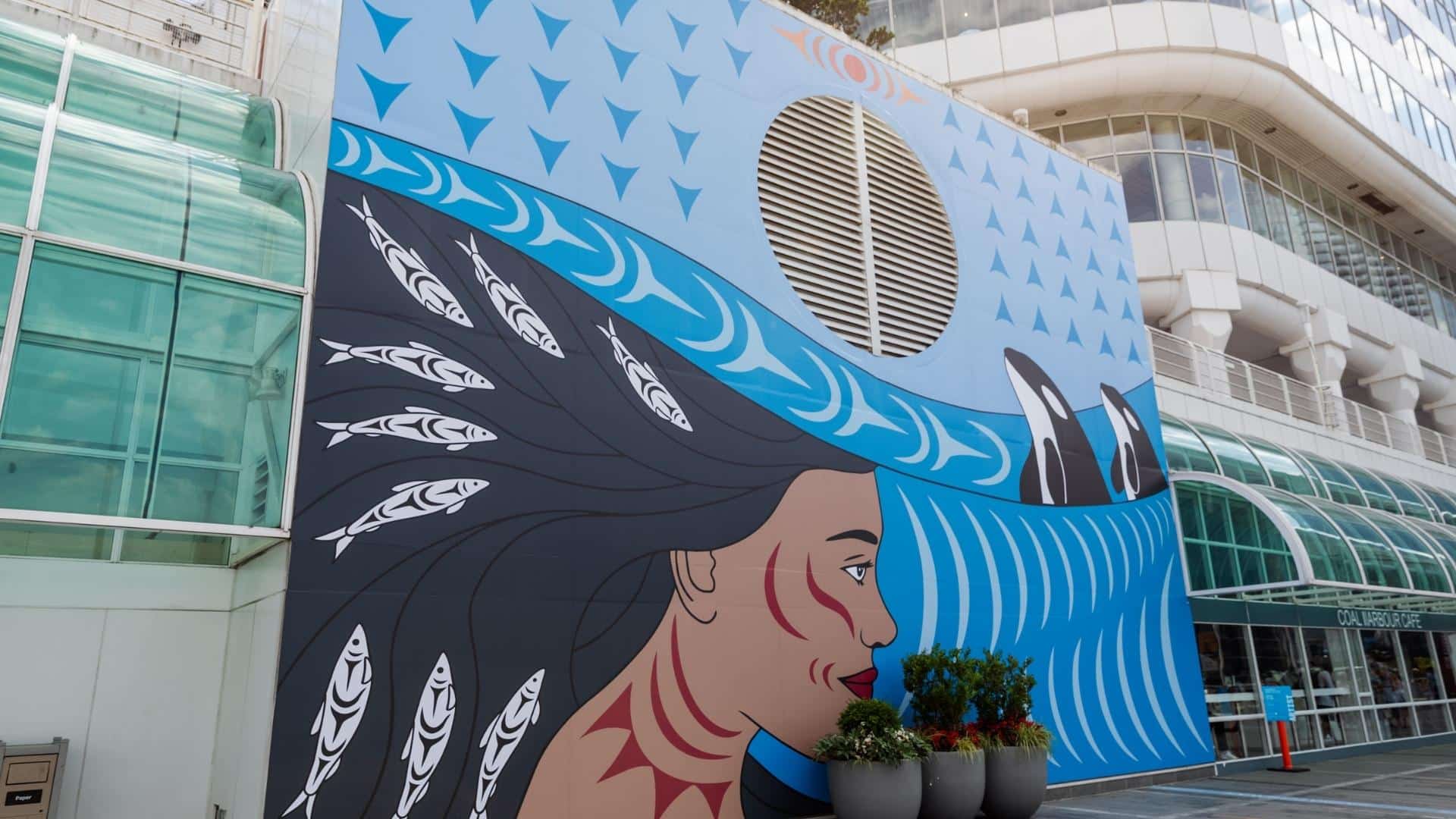
The winds and the waters will always call us home
Photo: Mavreen David
The winds and the waters will always call us home
By: Ocean Hyland/ shḵwen̓/ ts;simtelot
Printed vinyl located on lands and waters of the xʷməθkʷəy̓əm (Musqueam), Sḵwx̱wú7mesh (Squamish), Sel̓íl̓witulh (Tsleil-Waututh) Nations at 999 Canada Place in Downtown Vancouver, BC.
Herring lines the hair of the being connected to the sea. The visual representation of the changing tides is seen in front of her using Coast Salish elements, and an orca can be seen dancing in the current above.
Pacific herring are a staple food source for many inhabitants of the Salish Sea, including orcas and people. It is important to maintain a balance among the many species that live in the ocean. Our environment has looked after us, and although it remains generous, our relationship with it must be reciprocal. As much as we take, we must also give back.
Above the water line, droplets of the Salish Sea are absorbed by the sky so they can transform and make their way down as rain. Trigons represent the space where the water is called up to the sky and sent back down to water the plants, trees, and streams where the salmon are called to return. The moon sits high in the sky, and the Coast Salish eye mimics the sun and oversees the work done in our world. All life is connected: as the moon travels the sky, the tides flow, the wind blows, rain falls, the orcas are fed, and our people are happy. This reciprocal relationship ensures the well-being of us all.
Ocean Hyland is an artist who works in the realms of painting and digital design. Along with her practices, she enjoys participating in language revitalization of Coast Salish languages. Ocean currently lives in Qualicum Bay on Vancouver Island.
As a young woman, Ocean received the ancestral name ts;simtelot, which was shared with her by her Mother. This name has been passed down through her family on her Cheam side. On her matrilineal side, she is Tsleil-Waututh, Squamish, Cheam, Hawaiian, and Chinese. Through her father, she is Scottish and Irish. The richness and diversity of her cultural heritage is what inspires Ocean in her many art practices.
Ocean has studied at both Native education college specializing in NWC jewelry arts, and at Simon Fraser University, focusing on the sḵwx̱ wú7mesh sníchim, building up her proficiency in one of her mother tongues. She has also gained valuable knowledge apprenticing with creators Zachary George and Aaron Nelson Moody.
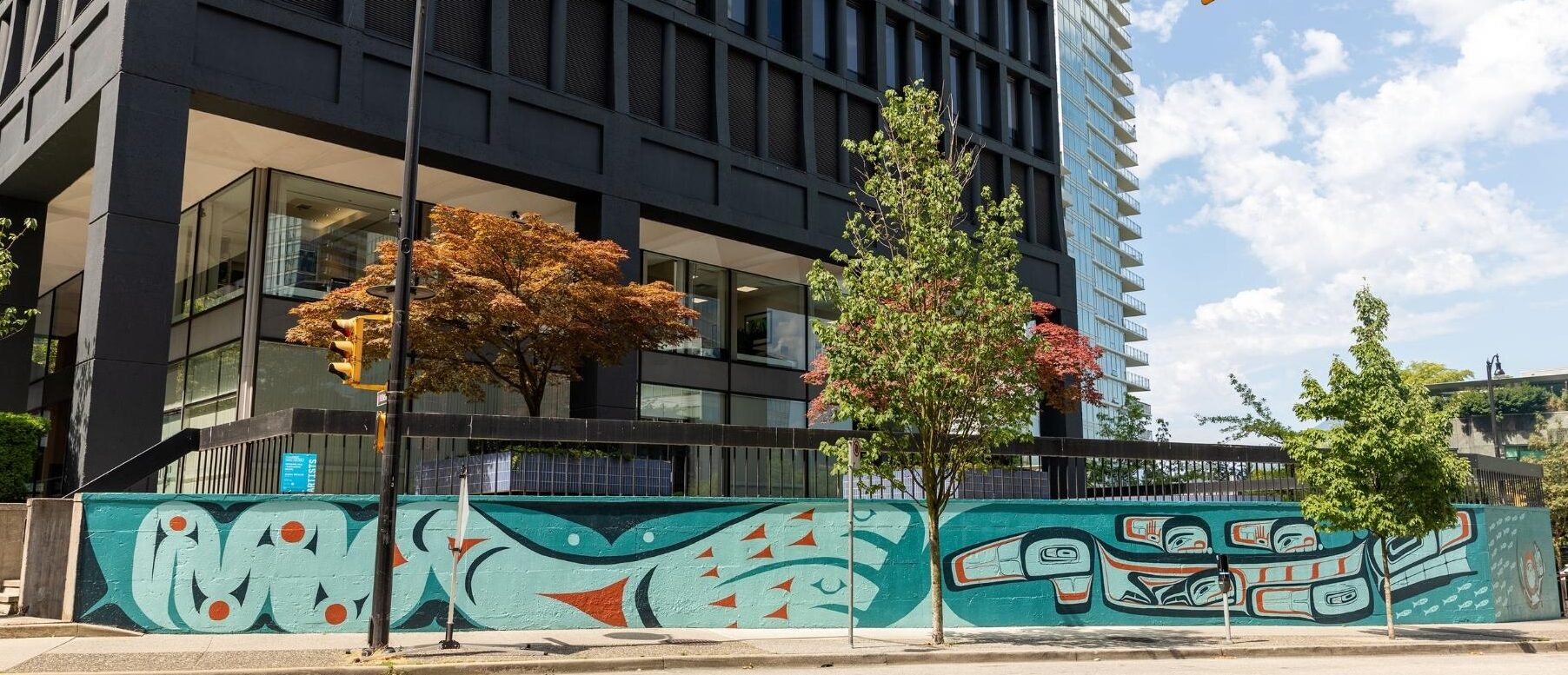
Gud Gad iis & Nucama:t
Photo: Sabrina Miso Creative
Gud Gad iis & Nucama:t | Coming Together & Working as One
By: SGidGang.Xaal / Shoshannah Greene and Jessie Recalma/ Xwulqsheynum
Located on the lands and waters of the xʷməθkʷəy̓əm (Musqueam), Sḵwx̱wú7mesh (Squamish), and Sel̓íl̓witulh (Tsleil-Waututh) Nations at 1111 Hastings Avenue in Downtown Vancouver.
The Haida word, “Gud Gad iis” translates to “Coming Together”, with the meaning behind it being “Meeting people to discuss and talk”.
Inspired by the efforts to bring Indigenous leadership together for ocean conservation, this mural by SGidGang.Xaal / Shoshannah Greene and Jessie Recalma/ Xwulqsheynum reflects the collaborative approach to strengthen our combined efforts in working together to protect our home.
The design depicts a SGaana Saahlan Sdings, a Two-Fin killer whale. Inside the body are human figures, one in each dorsal fin and one in the belly. Together, they are traveling south from Haida Gwaii into Salish waters.
Welcoming them is their host, a two-headed sea serpent, sʔi:ɬqəy̓, who guides them through the mouth of the Fraser River.
A school of oolichon, an anadromous species of smelt, swims through the waters. A sea otter playfully holds the artist’s names like a sea urchin.
Learn more about how you can support a network of marine protections for the Great Bear Sea on the North and Central Coasts.
Shoshannah Greene was born and raised on Haida Gwaii, on the traditional Territory of her paternal ancestors. She was adopted into the Cumshewa Eagle Clan and given the Haida name SGid Gang.Xaal, meaning wild rose.
An appreciation of her culture and art came from an amalgamation of watching her father carve jewellery, attending local art classes, and being inspired daily by the natural surroundings.
Since childhood, Shoshannah loved to share stories and express her thoughts visually. Following graduation, she chose to pursue a Bachelor’s of Media Arts with a major in Animation at Emily Carr University of Art + Design. Today, her work focuses on combining hand-drawn animation with watercolour backgrounds, centering on the Super Naturals within Haida culture. Connecting the physical experience of the natural surroundings with Haida Supernaturals, thereby establishing a perspective on the juxtaposition of her natural world with Haida cosmologies. From what she sees around her, plants and animals, she draws a connection to what she feels and believes: everything has power and flowing energies. Having studied animation, she is using computer software to extend the ideas of supernaturals inhabiting the natural world with movement and character traits. This allows her to explore movement within natural cycles; her work concentrates on using light as a structural element in both animation and watercolor painting she is inviting viewers of her work to view natural elements as more than just representation, and to allow for the possibility of a deeper connection to their surroundings nourishing mind, body and spirit.
Jessie Recalma is a Coast Salish artist and a member of Qualicum First Nation. Jessie is a self-taught artist who learned watching and listening to the stories of his grandfather. One day Jessie had come across a carving knife in his grandfather’s desk and was given the knife to take home to try. This knife would be the first of many carving tools that are now used to create a unique blend of art that has a contemporary feel to it with a significant influence from the older generations. While carving is one of Jessie’s favourite mediums to work with, he also devotes his time to painting, Indigenous languages, and digital design. Jessie currently works privately out of his studio in his private studio in his house.
The name Saatlam Arts is rooted in one the name of an old village site “Saatlam” or “Place of Green Leaves”. Jessie felt it suitable to connect this old place name to his work as a nod to the ancestors of his home Territory.
Sign up to learn more about how you can help protect the Salish Sea, the Great Bear Sea and more.
Xʷməθkʷəy̓əm (Musqueam), Sḵwx̱wú7mesh (Squamish) and səlilwətaɬ (Tsleil-Waututh) Territories / Vancouver, BC – As hot and sunny weekends arrive across the province, Canadian Parks and Wilderness Society, British Columbia Chapter (CPAWS-BC) surveyed British Columbians about what their expectations are as they visit BC provincial parks this summer. The results illustrated an enthusiasm to get out into nature this summer, as well as concerns about overcrowding and not enough staff in provincial parks.
“We share the concerns of park users. A long-term lack of resources for BC Parks has created problems with accessibility, wildlife conflicts, and failing infrastructure inside our parks,” said Kristina Charania, Conservation Coordinator at CPAWS-BC. “Nature supports our health in every way, and it should be made a priority in every corner of the province.”
Despite the immense popularity of parks during the COVID pandemic, 82.8% of respondents said they still expected provincial parks to be busier this summer than the previous two summers. When asked about what concerns them about their visits to provincial parks, their top concerns were:
– Inadequate parking (62.8% of respondents were at least somewhat concerned) – Limited enforcement of park rules (59.4% of respondents were at least somewhat concerned) – Not enough staff or park rangers (54.5% of respondents were at least somewhat concerned – The top improvement respondents recommended for BC’s provincial parks was more staff in parks (42.9%)
The jury was still out on the day-pass program that limits the daily number of people that can enter three of BC’s busiest parks: Garibaldi, Golden Ears, and Joffre Lakes. When asked whether the program effectively addresses park impacts like crowded trails, packed parking lots, and impacts on wildlife during peak periods, many respondents (44.0%) said they weren’t sure. However, a majority of British Columbians (52.1%) said they supported the program and only 16.9% opposed it.
The survey results also reiterated how much British Columbians value nature. 93.9% of respondents agreed that provincial parks were important or very important to protecting nature in the province. 84.4% said they’d like to see more provincial parks created in the future.
“Our parks have been short-changed for decades, and park users are feeling the effects of that more and more every year,” said Kristina Charania, Conservation Coordinator at CPAWS-BC. “It is time to address the cracks in the system. We need to increase staff presence, park maintenance, and ecosystem monitoring to improve recreation experiences and protect the diverse nature in parks.”
Half of those who answered the survey said they planned to visit a provincial park at least once a month, with 8.0% of respondents saying they planned on multiple trips to parks each week. The most popular provincial parks amongst respondents were Golden Ears, Strathcona, Manning, and Goldstream.
The survey was completed by 905 British Columbians, with a margin of error of 3.26% and confidence level of 95%.
The Canadian Parks and Wilderness Society (CPAWS) is Canada’s only nationwide charity dedicated solely to the protection of our public land, ocean, and freshwater, and ensuring our parks and protected areas are managed to protect nature. Since 1963, CPAWS has played a leading role in protecting over half a million square kilometers. Our vision is to protect at least half of Canada’s public land and water in a framework of reconciliation – for the benefit of wildlife and people.
The CPAWS British Columbia chapter (CPAWS-BC) works to protect wilderness in every corner of BC and deep into the ocean. We have been defending BC since 1978, and are dedicated to keeping BC’s natural environment thriving forever. Nature is BC’s best hope.
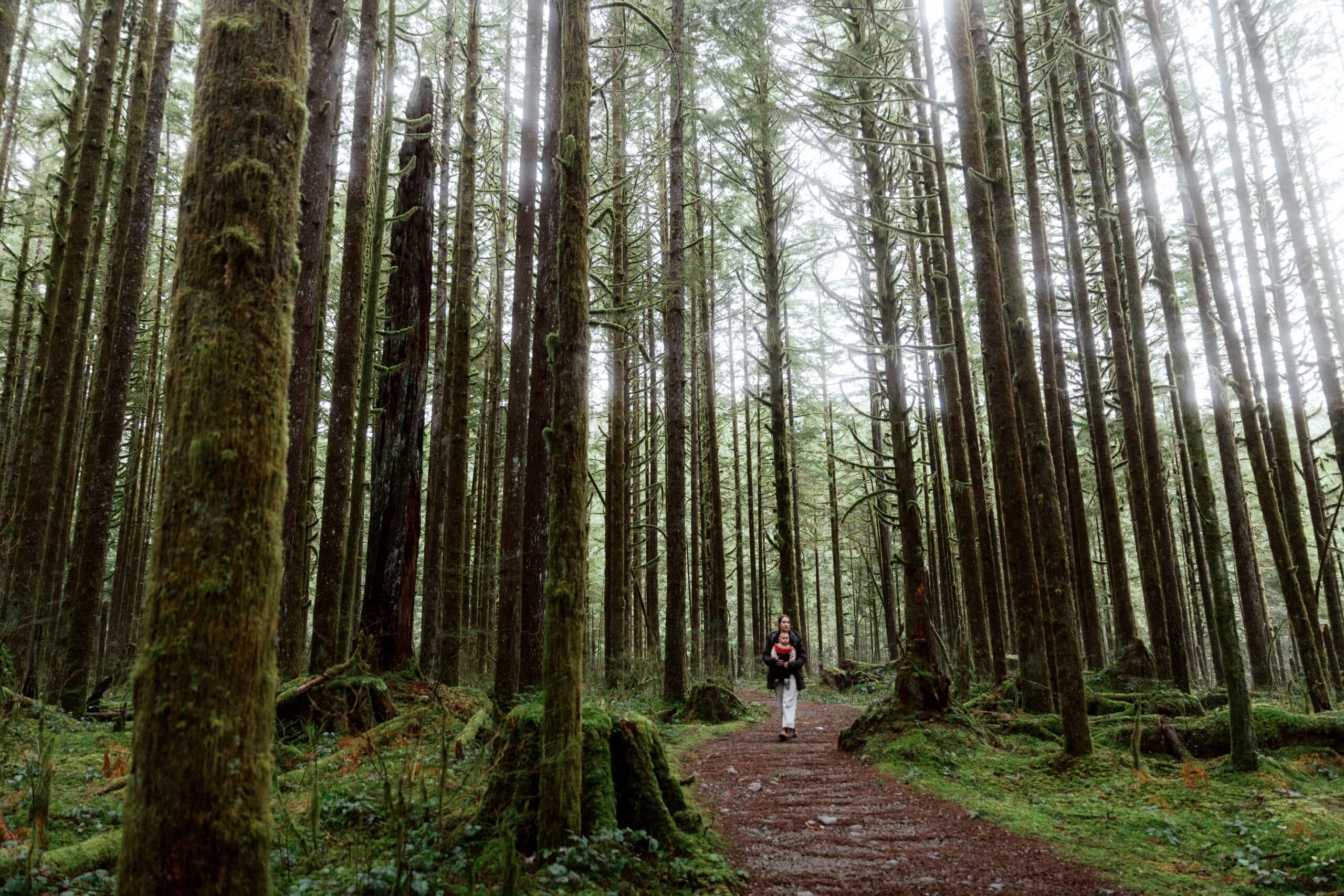
Golden Ears Provincial Park, 2022. Photo by staff photographer Adam Combs.
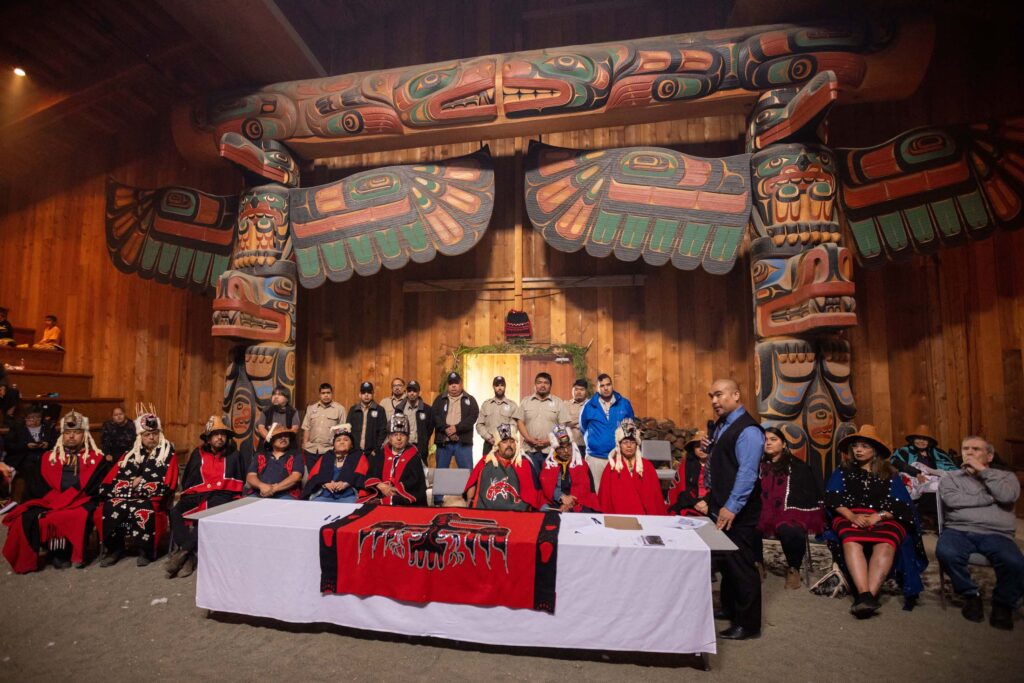
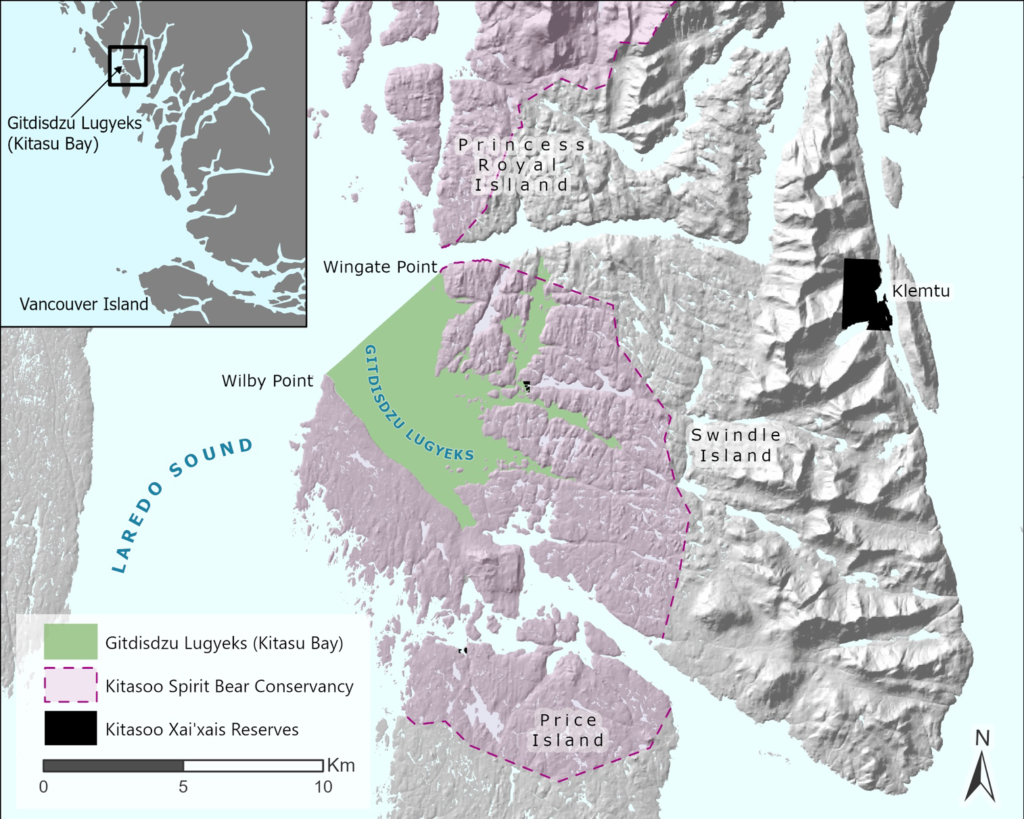
Klemtu, June 21 2022. The Kitasoo Xai’xais Nation declare a new Marine Protected Area (MPA) in Gitdisdzu Lugyeks. Credit: Tavish Campbell/Moonfish Media (CNW Group/ Kitasoo Xai’xais Stewardship Authority
New Protected Area: Kitasoo Xai’xais Nation Declares Gitdisdzu Lugyeks (Kitasu Bay) Marine Protected Area on the central coast
Canadian Parks and Wilderness Society – British Columbia (CPAWS-BC) celebrates the announcement by the Kitasoo Xai’xais Nation last week on the establishment of a new marine protected area (MPA), Gitdisdzu Lugyeks (Kitasu Bay).
Nestled along the coast of the Great Bear Rainforest, this new MPA will protect 33.5 km2 of the ocean. The Gitdisdzu Lugyeks MPA includes essential marine ecosystems such as tidal lagoons, estuaries, and kelp forests. Seabirds, whales, salmon, herring, and shellfish depend on the area for food and shelter.
“We know these waters better than anyone, Kitasu Bay has been part of our home for thousands of years through to the present day,” says Hereditary Chief Nies’los (Kelly Robinson).
The draft management plan for the MPA outlines the stewardship vision for this marine area to ensure environmental, community, and cultural sustainability.It weaves together traditional Kitasoo Xai’xais knowledge and management practices, and the latest science-based marine research. The waters will continue to be monitored and cared for by the Kitasoo Xai’xais Watchmen, which recently announced a pilot program with BC Parks recognizing guardians with the same legal authority as BC park rangers. The Kitasoo Xai’xais Watchmen continue the work of their ancestors in protecting and managing coastal territories through stewardship, monitoring, and sustainable management.
The Kitasoo Xai’xais Nation is advancing Indigenous-led conservation by protecting these marine waters within their territory, which means they are also protecting their culture and heritage for generations to come. The Gitdisdzu Lugyeks MPA announcement brings renewed hope for growing marine protection coverage while nurturing Indigenous reconciliation through conservation.
A network of MPAs is also underway in the Great Bear Sea, officially known as the Northern Shelf Bioregion. This network would connect new and existing protections along the north and central coast.
Kate MacMillan Ocean Conservation Manager, CPAWS-BC
To learn more about Kitasoo Xai’xais First Nation, visit www.klemtu.com
Kitasoo Xai’xais Nation announces the Gitdisdzu Lugyeks (Kitasu Bay) MPA.
Background:
An MPA network in the Great Bear Sea will connect new and existing protections. All of these sites will contribute to the ongoing development of the MPA network, working together to safeguard ocean biodiversity:
The Kitasoo Xai’xais, Nuxalk, Heiltsuk, Wuikinuxv First Nations, Parks Canada, and the BC government are conducting a joint feasibility study for a National Marine Conservation Area Reserve (NMCAR) on the central coast.
However, the next phase of development for the MPA network is unclear without a clear timeline for the next critical phase, public consultation. It is vital that a public consultation takes place and British Columbians are given a clear and transparent timeline to have their voices heard. With the dual crises of climate catastrophes and species die-off, the Fisheries and Oceans Canada (DFO) and the provincial government must continue to work with coastal First Nations to complete the network.
lək̓ʷəŋən (Lekwungen), ɪˈskwaɪmɔːlt (Esquimalt), and Songhees Territories / Victoria, BC – The Canadian Parks and Wilderness Society British Columbia (CPAWS-BC) celebrates Johnny Mikes, recipient of his year’s Elders Recognition Award at Government House in Victoria, BC on June 14. The Elders Council for Parks in British Columbia bestows this award on individuals for devoting much of their lives to parks and nature protection in BC.
Johnny Mikes use of maps and getting people out to see and experience these landscapes for themselves helped elevate BC’s protected area advocacy to a higher level of success – resulting in the establishment of such iconic protected areas as the Tatshenshini-Alsek, Stikine River, Ne’ah – Horseranch Range and the Muskwa Kechika Management Area. He continues to support Indigenous-led proposals for large, connected protected areas including the Kaska’s magnificent Dene K’éh Kusan Indigenous Protected and Conserved Area (IPCA).
“The Elders Council for Parks in British Columbia created its Elders Recognition Award to recognize individuals who have made significant contributions over several years to BC’s park system. We are delighted to be able to honor Johnny Mikes for his dedication and commitment,” says Bob Peart, Chair – Elders Council for Parks in British Columbia Nominations Committee.
“Johnny Mikes quiet persistence, knowledge of place, singular approach to ‘on-the-ground conservation’ and ‘getting big green blobs on maps’ has been fundamental in getting landscapes set aside both for their natural wild value and the recreational experience they offer – particularly across northern BC,” adds Peart.
Mikes represented environmental interests in the regional land use plan in the Sea to Sky area. He currently also serves as the Field Director for the Coast to Cascades Grizzly Bear Initiative, which is spearheading efforts to protect and recover threatened grizzly bears and safeguard critical habitats in southwest BC.
“We’re delighted to see Johnny recognized by the The Elders Council for Parks,” says Tori Ball, Terrestrial Conservation Manager at CPAWS-BC. “His tireless work throughout northern BC has ensured that key conservation areas are being safeguarded for generations to come.”
-30-
For more information, please contact: Rippon Madtha Communications Manager rippon@cpawsbc.org 604-685-7445 (x23)
About CPAWS-BC The Canadian Parks and Wilderness Society – British Columbia (CPAWS-BC) is part of one of Canada’s oldest non-profit conservation groups. We protect wilderness in every corner of BC and deep into the ocean. We have been defending BC since 1978, and are dedicated to keeping BC’s natural environment thriving forever. Our work to safeguard large parks, protected areas and wildlife corridors has been instrumental in protecting precious places across the province.
June 16, 2022
Xʷməθkʷəy̓əm (Musqueam), Sḵwx̱wú7mesh (Squamish) and səlilwətaɬ (Tsleil-Waututh) Territories / Vancouver, BC —
Proposals for land protection—many of which are Indigenous-led—could add nine percent to BC’s protected landbase and help slow the roll on climate change and species loss, according to a new Canadian Parks and Wilderness Society (CPAWS) report1.
The report lays the path for BC to protect at least 30% of lands and waters by 2030. Indigenous Protected and Conserved Areas (IPCAs), provincial parks, and conservancies offer a long-term solution to protect nature and people.
“The math is simple: by upholding proposals for Indigenous-led protection today, the BC Government could secure protection for 30% of its landbase,” says Kevin Barlow, Executive Director at CPAWS-BC. “Indigenous Peoples are still working hard to care for their Territories. It’s time for the BC Government to sit down with First Nations and recognize their conservation visions as a way to move forward on climate and extinction mitigation.”
The report calculates that existing protected area proposals cover 85,000km2, or nine percent, of the province, over two and half times the surface area of Vancouver Island. These proposals include Dene K’éh Kusān—a 39,136km2 wildlife haven in northern BC—as well as the Nuu-Chah-Nulth’s Salmon Parks, which will restore and protect critical wild salmon habitat in Nootka Sound.
In addition, the report makes recommendations to the BC Government to accelerate high-quality land conservation, including committing to 25% and 30% global land protection targets, upgrading BC’s other conserved areas2,3, and developing a legal framework for IPCA recognition and support.
“At their current rate of protection, it will take 145 years for the BC Government to protect 30% of the province,” says Jessie Corey, National Senior Manager, Terrestrial Conservation at CPAWS. “Already, climate events are causing more disease, damage, and death than ever. Nature—and British Columbians—can’t wait that long.”
1 Canadian Parks and Wilderness Society. (16 June 2022). Roadmap to 2030: Delivering on Canada’s Land and Ocean Protection Targets[Report]. Retrieved from: www.cpaws.org/roadmapto2030
2 Business in Vancouver. (17 February 2022). B.C. flouting Canadian, international standards on protected areas, says report. [News]. Retrieved from: https://biv.com/article/2022/02/bc-flouting-canadian-international-standards-protected-areas-says-report
3 Canadian Parks and Wilderness Society British Columbia. (February 2022). An Honest Accounting: Improving BC’s Approach to Claiming Other Conserved Areas [Report]. Retrieved from: https://cpawsbc.org/wp-content/uploads/2022/02/22-02-04-OECM-report-%C6%92-reduced-1.pdf
An offering for Indigenous History Month. Sign-up to CPAWS-BC for the latest BC conservation news, updates and action alerts to your inbox.
Sage smoke softly rises, delicately piercing the warm sun rays of spring as I smudge in mindful reverence, offering gratitude to my fellow Indigenous communities across Canada. June is National Indigenous History Month – an opportunity to celebrate contributions of First Nations, Inuit and Métis Peoples to nature stewardship in so-called Canada.
The conservation movement has a history of erasure and exclusion of Indigenous Peoples. Early settlers created an unnatural dichotomy between uninhabited wilderness and settlements that included the forcible removal of Indigenous People from the land. Alongside the loss of language, stories and experience on the land we’ve lost how to live in balance with Mother Earth. Healthy Nature provides everything we need: food, shelter, and medicine. It’s up to all of us together, to return the favour as caretakers of the lands and waters. Indigenous-led conservation has a role to play not only in reconciliation and healing, but also in building a stronger future together.
It is ironic that those who have played the least role in causing climate change, namely Indigenous People, are the ones who are being affected the most by it.
Many species have been vastly reduced because of the human footprint. We clear cut trees, which then affects the salmon and other life. The soil no longer has anything to hold it together, and so we see mudslides in the heavy rain season.
With your support, CPAWS has been defending lands and waters in BC for over 30 years. Our work to protect lands and waters has been shouldered by Indigenous Peoples for thousands of years. Since time before memory, Indigenous Peoples lived in balance with Mother Earth –taking only what’s needed and taking care of Nature in return for the gifts of food, water and medicine.
I believe we must bring our voices together and uplift Indigenous Knowledge as a solution. What CPAWS-BC does is for the benefit of all walks of life, humans, animals, birds, plants, forests and the list goes on.
A double whammy of climate change and accelerated species loss threatens our survival and of Nature we love. Despite all odds, new models of Indigenous-led conservation are already underway that can protect us all as Nature copes with the rising tide of development.
As the sound of singing and drums ring across ancestral lands and waters, I invite you to join us throughout June in celebrating and supporting Indigenous Peoples in their pursuit of preserving their Territories, and culture and in healing nature and humanity. It is not too late to do something, as we saw through the pandemic, when industries were forced to shut down or scale back, air quality improved in many of the most polluted cities in the world, people could see the tops of the Himalayas previously not possible due to pollution. Birdsongs and wildlife reclaimed city streets. So we can change what we are doing and minimize our impact on the wild places we depend on.
Thank you for being here. I am confident that we are on a solid path together to ensure that lands, waters and wildlife we all share a connection with will be protected now and forever.
Yours in conservation,
Kevin Barlow (Mi’kmaw) Executive Director, CPAWS-BC
Community Events and Happenings:
Meet the Matriarchs: Squamish Nation Knowledge Sharers. Join three generations of Squamish Nation knowledge keepers: Kultsia Barbara Wyss, T’uy’t’tanat Cease Wyss and Senaqwila Wyss Friday June 3 at the Museum of North Vancouver.
Reframing our Worldview – Honouring Indigenous History and Experience. Join Kevin Barlow, Executive Director of CPAWS-BC on 20 June at 6 pm (PDT) for tools and strategies that non-Indigenous people may use to self-assess possible biases and gain a stronger understanding of the richness of Indigenous history in Canada.
Tune in: APTN Indigenous Day 2022 Live in Winnipeg or check out your local Cultural Center or Friendship Center volunteer opportunities, supports and celebrations on National Indigenous People’s Day this June 21, 2022.
For more information, please contact: Rippon Madtha Communications Manager rippon@cpawsbc.org 604-685-7445 (x23)
May 04, 2022
Young British Columbians make bold entrance in parliament, sound alarm for urgent action on climate and nature
Youth are asserting their right to a just and livable future, with some of the first in-person provincial parliament meetings since the beginning of the COVID-19 pandemic
Xʷməθkʷəy̓əm (Musqueam), Sḵwx̱wú7mesh (Squamish) and səlilwətaɬ (Tsleil-Waututh) Territories / Vancouver, BC – On Wednesday, 20 young British Columbians—from Coast Salish (Lower Mainland, Vancouver Island) to Ktunaxa territory (West Kootenays)—are congregating in Victoria’s parliament building to demand action on one of the top issues affecting young Canadians today: climate change, and its threat to nature.
Throughout the day, the youth are meeting with Cabinet ministers, Members of the Legislative Assembly (MLAs), and other government officials to express their concerns on the dire state of global warming and species extinction in BC, and demand swift action to halt the twin crises. Their visit includes meetings with the new Minister of Land, Water, and Resource Stewardship, the Honourable Josie Osborne, the leader of BC’s Green Party, Sonia Furstenau, and several other key elected officials.
With nearly 18% of BC’s population between the ages of 15 and 29, it’s critical that youth—especially those from underrepresented communities, or visible minorities—are included in provincial decision-making. Of these youth, many are also not eligible to vote; yet, their lives will be disproportionately impacted by climate change events relative to older generations. Already, 71% of young Canadians agree that they will suffer from more environmental health problems than their parents.
“As we’re seeing in Victoria today, youth are hungry to have their voices heard. Decisions made by government today will impact their futures for decades to come,” says Brynna Kagawa-Visentin, Youth Engagement Coordinator with CPAWS-BC. “It’s crucial that youth—who belong to BC’s mosaic of underrepresented communities and include visible minorities—are invited into rooms where climate and biodiversity decisions are made. Diversity is the hinge on many doors that could open if youth are actively invited into decision-making spaces.”
Youth advocating for youth—and pushing for environmental protections—carves space out for future conservation leaders to uplift the community’s voices and build careers that support conservation initiatives. With Canada’s commitment to protecting 25% of lands and waters by 2025 and 30% by 2030, and an effective Nature Agreement to be signed between the federal and provincial governments, strong voices for nature are needed more than ever. BC is home to over 1900 species-at-risk, and both Indigenous Knowledge and western science agree that safeguarding more habitat for BC’s biodiverse plant and animal life is key to slowing down climate change.
“My hope is that these meetings set a precedent by showing other civically-interested youth that your voices won’t reverberate in an empty room. Leaders are listening for your fresh ideas and input to help protect BC’s incredible wildlife and landscapes, and build a better future for all,” says Kagawa-Visentin. “We look forward to seeing government officials further engage with young British Columbians on future biodiversity and climate change projects, including those informed by the upcoming Nature Agreement.”
-30-
For more information, contact: Rippon Madtha Communications Manager 604-685-7445 (x23) rippon@cpawsbc.org
Background and Key Facts:
70% of the youth lobbying in parliament today identify as part of an underrepresented group or visible minority
According to Ipsos polling, 4 in 10 young Canadians state that they have been impacted by climate change
In 2020, the youth unemployment rate was 15.5%—more than the US or UK. Real life experience and training opportunities—like advocating for conservation in government meetings—are key to elevating youth out of unemployment and into green careers that address climate change and biodiversity loss
In February 2021, the BC and Canadian governments announced the development of a Nature Agreement. Negotiations have been underway since then. The agreement is expected to act as a framework for bi-lateral collaboration, and include recovery measures for at-risk species including Spotted Owl and caribou
Xʷməθkʷəy̓əm (Musqueam), Sḵwx̱wú7mesh (Squamish) and səlilwətaɬ (Tsleil-Waututh) Territories / Vancouver, BC — The Canadian Parks and Wilderness Society – British Columbia (CPAWS-BC) celebrates the BC government’s announcement to implement the Declaration Act Action Plan to fulfil the UN Declaration on the Rights of Indigenous Peoples (UNDRIP) commitments.
This historic announcement further bolsters the provincial governments’ efforts in reconciling with Indigenous Peoples in BC. Premier John Horgan took an empowering step in November 2019 by adopting the Declaration on the Rights of Indigenous Peoples Act (DRIPA) into law, making BC the first Canadian jurisdiction to implement the UN Declaration through legislation.
The plan outlines 89 measurable actions every ministry in the BC government will undertake to create a more inclusive province for all Indigenous Peoples in British Columbia. Indigenous leadership and meaningful collaboration outlined in the plan supports a bright oath for lands and water conservation. Created in consultation with First Nations, Métis, and Inuit Peoples, the plan claims to reflect the priorities and aspirations of all Indigenous Peoples living in BC.
“This important announcement ushers in renewed hope for Indigenous communities in British Columbia, knowing that the provincial government is taking a step in the right direction to correct historical injustices, facilitate self-determination, and ensure Indigenous Territories are brimming with healthy landscapes, waters, and biodiversity. These places have been thriving for millennia under Indigenous stewardship,” says Kevin Barlow, Executive Director of CPAWS-BC. “We hope that this significant step-change also looks to fast track conservation projects on the ground and in the ocean, while recognizing unilaterally-declared Indigenous Protected and Conserved Areas (IPCAs) as part of this reconciliatory action plan.”
We acknowledge that reconciliation and decolonization is an ongoing process that requires all of us to be actively involved. As we work toward the protection of diverse ecosystems, CPAWS-BC will do so in the spirit of decolonization, recognizing the essential leadership of the Indigenous stewards who have cared for these lands and waters since time immemorial. We are committed to deepening our relationships with Indigenous partners and we recognize that it is our responsibility to support Indigenous Peoples to safeguard their land and water.
As a team, we are advancing awareness, knowledge, and capacity on our staff and board by providing cultural competency learning opportunities and workshops with Indigenous speakers, Elders, storytellers, and facilitators.
Report: BC government is putting nature at risk by labelling lands open for industrial development as “protected”
The province’s rich biodiversity is in danger without government action, a new report from CPAWS-BC and Ecojustice reveals
Traditional unceded Coast Salish Territory / Vancouver, BC – A new report from the Canadian Parks and Wilderness Society – British Columbia (CPAWS-BC) and Ecojustice exposes troubling flaws in BC’s accounting for its protected and conserved areas.
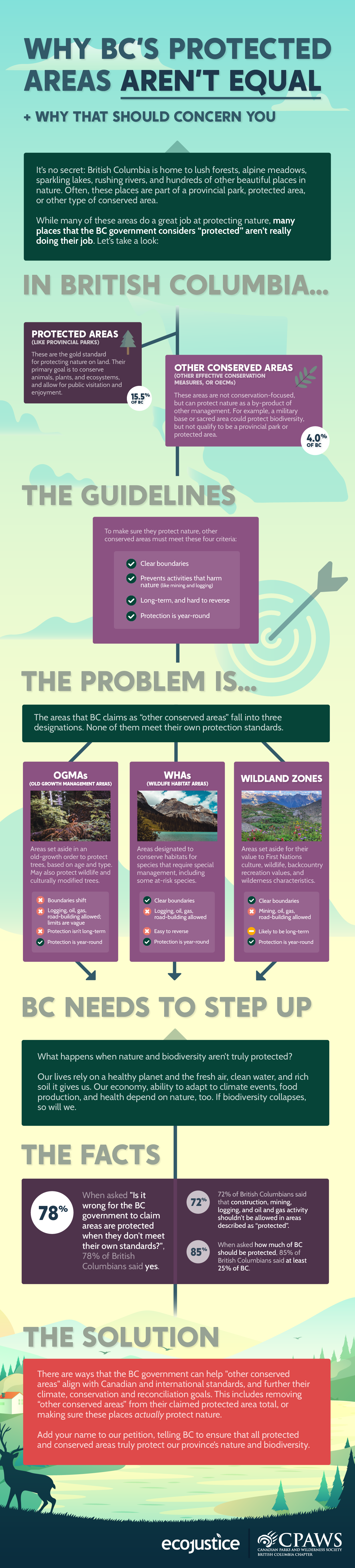
Right now, 15.5 per cent of the province’s landbase is protected in robust designations such as provincial parks and conservancies. However, the BC government has been reporting an additional four per cent as “other conserved” areas for a claimed total of 19.5 per cent. Unfortunately, BC’s claimed other conserved areas do not meet Canadian standards. On paper, this additional four per cent promotes BC’s progress towards Canada’s goal of protecting 25 per cent of lands and waters by 2025, but these designations fail at what they’re meant to do: defend biodiversity.
“Biodiversity is the backbone that our economy, health, and climate resiliency are built upon,” says Tori Ball, Terrestrial Conservation Manager (Acting) at CPAWS-BC. “The world is driving towards ambitious biodiversity conservation targets right now. We need to ensure that all the tools in our toolbox, including other conserved areas, will deliver on our shared goal to protect biodiversity.”
The report provides examples of these faulty designations, including Wildland Zones—some of which are in southern BC’s renowned Sea-to-Sky area. Though these places are managed with conservation in mind, they still permit mining, oil, gas, and other industrial activity that harms at-risk species like grizzly bears, marbled murrelets and spotted owls. According to the international and Canadian standards that BC has adopted, harmful industrial activities must be prohibited in all areas set aside for conservation.
“The BC government is misleading the public into thinking biodiversity is protected in large areas of the province when in fact, it is not,” says Sean Nixon, lawyer at Ecojustice. “The province still allows harmful industrial activities like logging, oil and gas, and mining in BC’s ‘conserved’ areas, which threatens wildlife and natural habitats. BC needs to change its flawed accounting to avoid undermining its present and future conservation efforts.”
How BC can clean up its protected area accounting and conserve 25% of its landbase by 2025: 1. Remove BC’s claimed “other conserved” areas from Canada’s protected area database. Protected areas are meant to safeguard ecosystems and the species they contain. When areas are included in protected area totals that don’t actually accomplish this, it artificially inflates the province’s estimates of its protected land and stunts support for protected area expansion, including Indigenous-led conservation proposals. 2. Upgrade the protection in other conserved areas to match international and Canadian standards. Depending on the area, this could include creating firm boundaries, barring industrial activity that harms biodiversity, and ensuring protection is long-term. 3. Invest in legislated protected areas and support Indigenous-led conservation proposals. Dozens of proposals from First Nations have been put forward to protect natural and cultural values. Supporting these proposals would advance the government’s goals to conserve biodiversity and further reconciliation.
— 30 —
For more information, or to arrange an interview, please contact:
About CPAWS-BC and Ecojustice The Canadian Parks and Wilderness Society – British Columbia (CPAWS-BC) is part of one of Canada’s oldest non-profit conservation groups. We protect wilderness in every corner of BC and deep into the ocean. We have been defending BC since 1978, and are dedicated to keeping BC’s natural environment thriving forever. Our work to safeguard large parks, protected areas and wildlife corridors has been instrumental in protecting precious places across the province.
Ecojustice uses the power of the law to defend nature, combat climate change, and fight for a healthy environment. Its strategic, public interest lawsuits and advocacy lead to precedent-setting court decisions and law and policy that deliver lasting solutions to Canada’s most urgent environmental problems. As Canada’s largest environmental law charity, Ecojustice operates offices in Vancouver, Calgary, Toronto, Ottawa, and Halifax.
Right now, the BC government is claiming to “protect” nature in areas that allow mining, logging, and more. To make sure nature truly thrives for future generations—and forever—this needs to change. Read more about BC’s other conserved areas below (or read our report), and add your name to the petition telling the BC government to protect nature and clean up their protected area accounting.
Do you feel that its wrong for the provincial government to claim that areas are protected when they don’t meet the government’s own minimum standards? 78% of British Columbians would agree. Add your name to the petition telling the BC government to protect nature and clean up their protected area accounting:
We use cookies and other similar technologies such as pixels and web beacons (“Cookies”) for various purposes, such as to ensure our website functions properly, enhance your browsing experience by remembering your preferences and provide personalized content and advertisements.
Functional
Always active
The technical storage or access is strictly necessary for the legitimate purpose of enabling the use of a specific service explicitly requested by the subscriber or user, or for the sole purpose of carrying out the transmission of a communication over an electronic communications network.
Preferences
The technical storage or access is necessary for the legitimate purpose of storing preferences that are not requested by the subscriber or user.
Statistics
The technical storage or access that is used exclusively for statistical purposes.The technical storage or access that is used exclusively for anonymous statistical purposes. Without a subpoena, voluntary compliance on the part of your Internet Service Provider, or additional records from a third party, information stored or retrieved for this purpose alone cannot usually be used to identify you.
Marketing
The technical storage or access is required to create user profiles to send advertising, or to track the user on a website or across several websites for similar marketing purposes.