Home » conservation » Page 4
Oceans Wise report recommends implementation of full protection for all of Howe Sound’s glass sponge reefs
For interview, please contact:
Ross Jameson, Ocean Conservation Manager
Canadian Parks and Wilderness Society-British Columbia
778-953-2372
ross@cpawsbc.org
Oceans Wise report recommends implementation of full protection for all of Howe Sound’s glass sponge reefs
September 1, 2020
Unceded Coast Salish Territory/Vancouver, BC — A new report from Ocean Wise has updated the health status of Howe Sound for 2020. While there is cautious optimism with some health ratings improving, the Ocean Wise report still has many labelled as critical or cautious, including glass sponge reefs which “remain vulnerable to mechanical damage and climate change.” The report recommends implementing full protection of glass sponge reefs throughout all of Howe Sound.
Long thought extinct, glass sponge reefs mainly grow off BC’s coast. Not only do these reefs provide important habitat for ocean life such as prawns and rockfish, they also filter ocean water, provide fertilizer for plankton, and store carbon.
Glass sponge reefs are particularly vulnerable to shattering from bottom contact fishing such as prawn traps as they are composed of the same material that makes glass. A DFO survey, in cooperation with the Marine Life Sanctuaries Society, not only discovered a dead reef near Ellesmere Creek at the north end of Howe Sound, but found historical damage from fishing activities in all of the surveyed reefs.
Climate change poses an urgent and even larger problem. A study cited by the Ocean Wise report included observation of glass sponge reef mortalities associated with the El Niño climate events of 2009/2010 and 2015/2016. Additionally, a study from UBC found that warming ocean temperatures and acidification drastically reduce the skeletal strength and filter-feeding capacity of glass sponges.
In March 2019, DFO announced the closure of the nine documented glass sponge reef complexes to bottom-contact fishing. A DFO report published earlier this year confirmed five more living glass sponge reefs in Howe Sound. However, these reefs are still open to bottom-contact fishing such as prawn trapping. Even if reefs are damaged, there are no threats of fines or legal recourse for the harmful activity.
Glass sponges are under siege from multiple threats. Without the chance to grow and expand, glass sponges will lock away less carbon, exacerbating the effects of climate change. “By removing the threat of bottom-contact fishing, glass sponges will be better able to adapt to a changing ocean,” says Ross Jameson, Ocean Conservation Manager for Canadian Parks and Wilderness Society British Columbia Chapter. We need the immediate designation of fishing closures for all of Howe Sound’s glass sponge reefs to protect these rare creatures for generations.
-30-
For interview, please contact:
Ross Jameson, Ocean Conservation Manager
Canadian Parks and Wilderness Society-British Columbia
778-953-2372
ross@cpawsbc.org
Resources
Miller A, Chapman J, Dearden A, Ross P (Editor). 2020. Ocean Watch Átl’ḵa7tsem/Txwnéwu7ts/Howe Sound Edition 2020. Ocean Wise Research Institute, Ocean Wise Conservation Association, Vancouver, B.C., Canada. 388 pp. ISBN: 978-1-7772408-2-0 available online at:https://ocean.org/wp-content/uploads/OceanWatch-HoweSoundReport2020-online.pdf
For Immediate Release
June 26, 2020
Unceded Coast Salish Territory/Vancouver, BC – A new study led by Angela Stevenson at the University of British Columbia indicates that ongoing climate change is a serious and immediate threat to BC’s ancient glass sponge reefs. The Canadian Parks and Wilderness Society – British Columbia (CPAWS-BC) calls for the urgent establishment of marine protected areas (MPAs) for glass sponge reefs in BC.
Glass sponge reef ecosystems shelter rockfish and prawns and are efficient filter feeders. Healthy glass sponge reef marine protected areas can filter out up to 90% of bacteria from ocean water and work to keep carbon locked in the seafloor.
Fisheries and Oceans Canada (DFO), along with the Marine Life Sanctuaries Society (MLSS), recently verified five new living glass sponge reefs and one dead reef during scientific surveys in Howe Sound. These reefs need urgent protection if they are to adapt and survive against threats from climate change and human activity.
“Marine protected areas will not only protect glass sponge reefs from physical damage caused by bottom-contact fishing, they will also act as natural climate solutions,” says Ross Jameson, Ocean Conservation Manager for CPAWS-BC. MPAs offer long term protection, prevent further damage and absorb carbon to help beat back climate change.
For two decades, CPAWS-BC has worked to establish stronger protection for BC’s known glass sponge reefs. In 2017, Hecate Strait/Queen Charlotte Sound Glass Sponge Reefs Marine Protected Area protected over 2000 km2 of glass sponge reefs off BC’s north and central coast. 17 fisheries closures protect reefs in Howe Sound and the Strait of Georgia. Unprotected glass sponge reefs in Howe Sound and Chatham Sound need urgent attention.
This new study underscores the pressure glass sponges face to adapt quickly to survive in a changing ocean. Protecting these unique biological treasures will not only safeguard economically important marine life, but also ensure the reefs can remain a source of awe and wonder for generations to come.
-30-
For interview, please contact:
Ross Jameson, Ocean Conservation Manager
Canadian Parks and Wilderness Society-British Columbia
778-953-2372
ross@cpawsbc.org
Resources
We would like to recognize the many other organizations who have worked tirelessly to conserve this unique habitat: Marine Life Sanctuaries Society, David Suzuki Foundation, Coastal Ocean Research Institute, Subsea Society of Howe Sound, Canadian Marine Environment Protection Society, and Sunshine Coast Conservation Society.
Stevenson, A., Archer, S.K., Schultz, J.A. et al. Warming and acidification threaten glass sponge Aphrocallistes vastus pumping and reef formation. Sci Rep 10, 8176 (2020). https://doi.org/10.1038/s41598-020-65220-9
 Media Release PDF here.
Additional Images here.
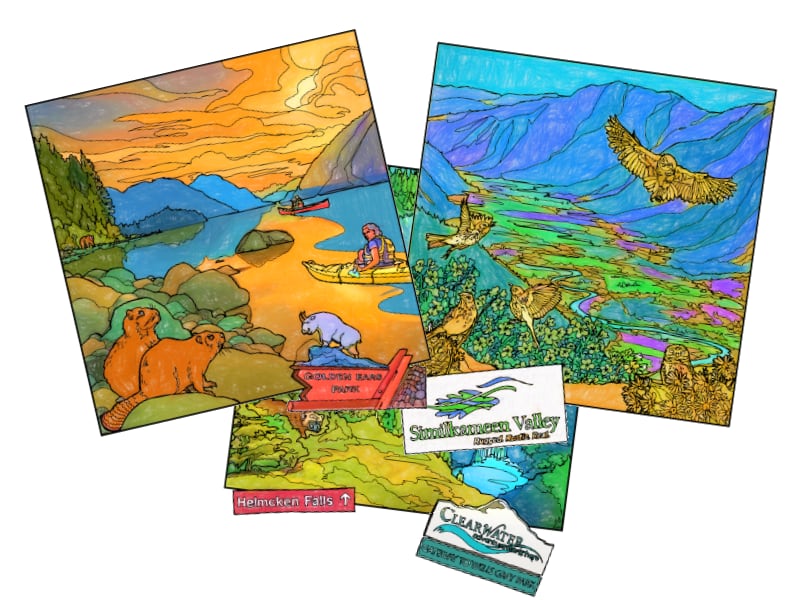
As the weather warms, we’re dreaming of getting back into BC’s parks. It may be a while before our boots hit the trails so we’ve created four stunning colouring pages to remind you of the beauty that awaits.
The pages, with scenes from stunning BC parks, are designed with beginner and expert artists in mind. Enjoy bringing these lively scenes and creatures to life:
Golden Ears Provincial Park – The traditional territories of the Katzie, S’ólh Téméxw (Stó:lō) and Kwantlen peoples, this park is home to black bears, beavers and mountain goats.
Wells Gray Provincial Park – The traditional territory of the Secwepemcúl’ecw (Secwépemc) peoples, this park is home to the elusive wolverines and mighty grizzly bears.
Grasslands of Similkameen Valley – The traditional territory of the Syilx peoples, the grasslands of the Similkameen Valley are home to rare species like burrowing owls and sage thrashers.
Strathcona Provincial Park – The traditional territories of the nuučaan̓uuɫɁatḥ nism̓a (Nuu-chah-nulth), K’ómoks, Kwakwaka’wakw nations, Strathcona Provincial Park is home to Roosevelt elk and endangered Vancouver Island marmots.
Enter your contact details to download and print your colouring pages. Share your creations on Facebook and Instagram with the hashtag #colouringBCParks.
For immediate release
February 21, 2020
Unceded Coast Salish Territory/Vancouver, BC – Today, a historic collaboration reached a critical point with the signing of a partnership agreement regarding the recovery of southern mountain caribou.
Saulteau and West Moberly First Nations announced they have negotiated a partnership agreement with B.C. and Canada to protect and recover caribou in the Peace Region. Part of the Partnership Agreement between the four governments includes the creation of an important new protected area in critical caribou habitat on West Moberly and Saulteau territories, near Chetwynd, BC.
“We are encouraged by this significant agreement to recover one of Canada’s most iconic species,” said Bruce Passmore, Executive Director of CPAWS-BC, “we applaud West Moberly and Saulteau First Nations, who have demonstrated incredible leadership, working with the provincial and federal governments towards protection of wildlife and species at risk in their traditional territories.”
This agreement includes new protected areas, that will expand the Klinse-za Provincial Park as well as restoration measures, access management, habitat recovery and restoration, and an Indigenous Guardian Program. A full, collaborative suite of measures sets the best chance at success for recovery while furthering Indigenous-led conservation models. Such models are critical to upholding the culture, stewardship and traditional knowledge of the original caretakers of the land.
“Support for Indigenous-led land and wildlife conservation efforts is crucial if we are to stem the global biodiversity and climate crisis,” said Passmore. “This historic collaboration between four governments demonstrates a new way forward for conservation in BC to preserve important species before it is too late.”
-30-
For interview, please contact:
Skye Vallance, Communications and Development Coordinator
Canadian Parks and Wilderness Society, BC Chapter
604-685-7445 x 22
skye@cpawsbc.org
February 6, 2020
Unceded Coast Salish Territory/Vancouver, B.C. – The Canadian Parks and Wilderness Society – British Columbia (CPAWS-BC) welcomes the conviction of illegal fishing in the Hecate Strait and Queen Charlotte Sound Glass Sponge Reefs Marine Protected Area (Hecate MPA).
Illegal commercial groundfish harvesting was found to have occurred in the marine protected areas. A fine of $20,000 for illegal activity prohibited under the Hecate MPA Regulations, the first conviction under the Oceans Act nationwide. An additional fine, under the Fisheries Act, of $25,000 for possessing illegally caught fish was ordered to be paid.
“We would like to thank Fisheries and Oceans Canada for enforcing MPA regulations under the Oceans Act and protecting B.C.’s glass sponge reefs,” says Ross Jameson, Ocean Conservation Manager for CPAWS-BC.
Located in the Hecate Strait and Queen Charlotte Sound off B.C.’s north and central coasts, the Hecate MPA glass sponge reefs are a world treasure. Once thought extinct for millions of years, glass sponge reefs are now known only to live in the northeast Pacific Ocean, mainly off B.C.’s coast.
CPAWS-BC has been working since the early 2000s to protect B.C.’s glass sponge reefs. After years of pushing for protection, we celebrated when the Hecate MPA was created by Fisheries and Oceans Canada in 2017. CPAWS-BC continues to work with First Nations and the Government of Canada to protect other vulnerable glass sponge reefs in B.C. Enforcement of these Oceans Act MPA regulations will help ensure these rare ecosystems are not destroyed due to human activities.
Glass sponges are filter feeders. They do this so efficiently that 95% of bacteria are filtered out, cleaning the water. In fact, a single small reef can filter enough water to fill an Olympic-sized swimming pool in less than 60 seconds! Glass sponge reefs provide shelter for bottom-dwelling creatures such as rockfish and prawns.
Fishing activity can cause severe harm to these fragile habitats. Prawn and crab traps drop down and crush glass sponge reefs. Bottom trawling of heavy nets dragged along the seafloor destroy everything in their path while kicking up clouds of disturbed sediment, that prevent the sponges from feeding.
While this conviction means that the Hecate MPA is being enforced, more work needs to be done. Jameson says, “Now we need a management plan for this MPA with effective education, outreach, and additional protections to prevent these offences from occurring in the future.”
-30-
For interview, please contact:
Ross Jameson, Ocean Conservation Manager
Canadian Parks and Wilderness Society, BC Chapter
604-685-7445 x 29
ross@cpawsbc.org
Resources
Fisheries and Oceans Canada. (2020, January 20). Safeguarding our future through the Oceans Act [News Release]. Retrieved https://www.canada.ca/en/fisheries-oceans/news/2020/01/safeguarding-our-future-through-the-oceans-act.html