The close of the year — the cooler weather, shorter days and darker nights — always feels to me like nature’s personal invitation to pause and reflect. And as I consider all that was accomplished in 2025, my first year as Executive Director, one thing is crystal clear: we can’t do this work, the vital work of protecting water, land and wildlife, without you. Your generous support, your voice, and your actions help safeguard the wild places that we all love, and I am so grateful for each and every one of you.
This has been a remarkable year for conservation in British Columbia, with a lot to celebrate. Together, we’ve made meaningful progress for nature all across the province.
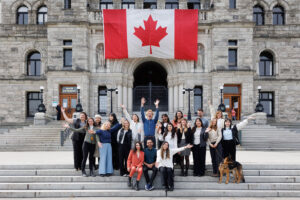
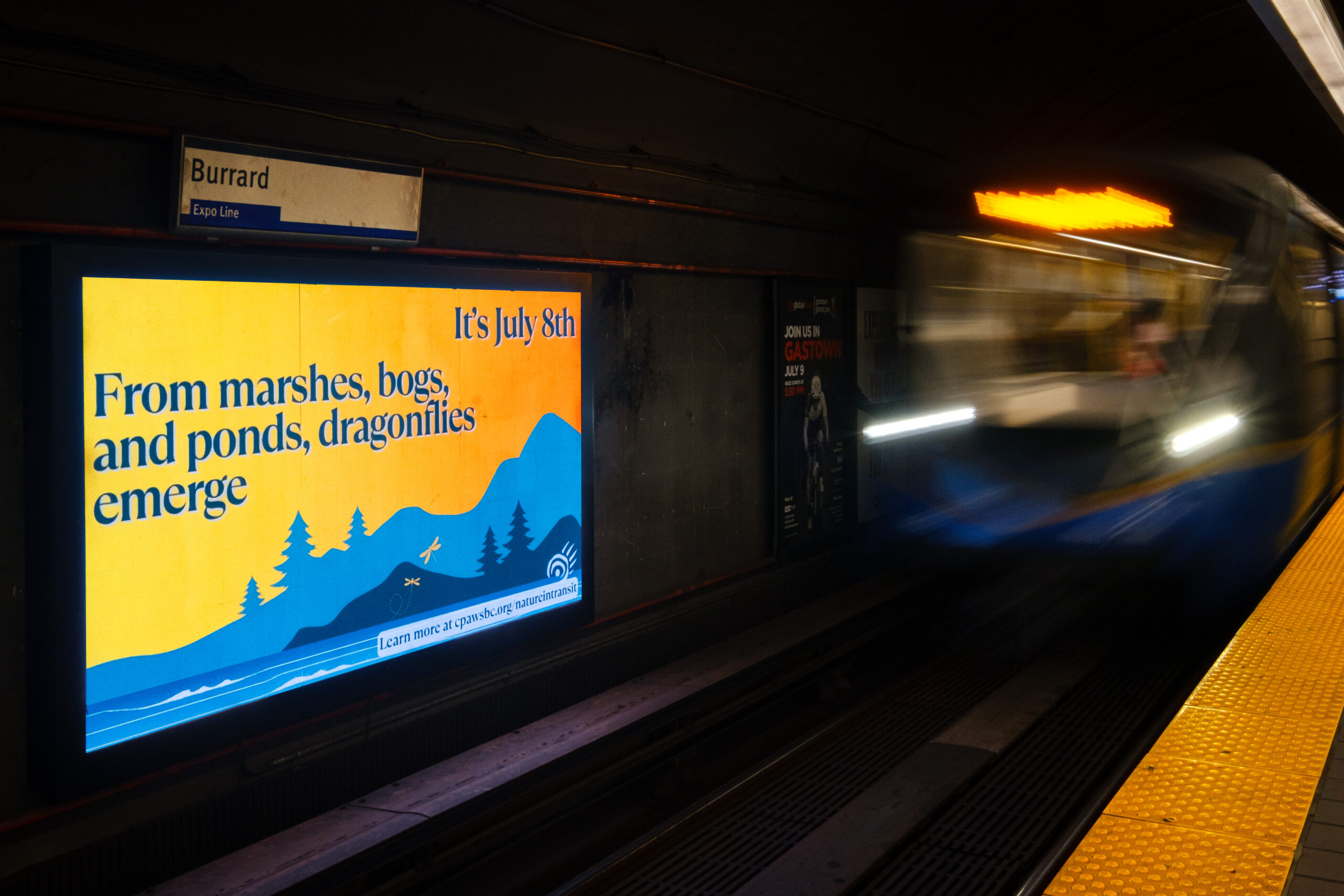
In April, we took 25 young people to Victoria to meet with key decision makers, including multiple Ministers and the opposition caucus, to speak up for nature. It was the culmination of months of training through our Young Leaders in Conservation Program, which equips youth with skills in conservation advocacy, including government relations, communications, and strategic campaigning. These same youth went on to lead a host of projects through the summer and fall, including local community events and a Nature in Transit installation in Metro Vancouver.
In June, we cheered the launch of four concurrent land use planning processes in northwest BC, including a region that holds Dene K’éh Kusān, the Kaska Nation’s proposed Indigenous Protected and Conserved Area (IPCA). Modernized land use planning, done in partnership with First Nations, can provide certainty for communities and for nature by laying out a clear path for land management. The areas identified this summer offer an incredible opportunity to safeguard up to six million hectares of wilderness. If successful, these processes would not only serve as a template for joint land use planning with Indigenous Nations, they’d provide connectivity over an expansive area, one that protects watersheds and safeguards critical habitat for species like woodland caribou, grizzly bears and wolverine. Our team has attended virtual and in-person stakeholder engagements for three of the four land use planning processes so far, and continues to work alongside First Nations, government, and other environmental groups to ensure that land, water, and wildlife are represented.
And just a few weeks ago, we celebrated an endorsement by the Union of BC Municipalities (UBCM) of a motion to call on the province to enact a law to support the Coastal Marine Strategy. This motion from local governments is the culmination of years of work to safeguard coastal waters and the communities that rely on them. Back in 2019, we launched a campaign with our partners at West Coast Environmental Law to support the creation of a provincial strategy to coordinate management, policy and legislation along the BC Coast, and after five years of advocacy by First Nations and concerned residents, the BC government released its Coastal Marine Strategy in 2024. However, in the year since the strategy’s release, little progress has been made towards implementation, and government continues to dodge questions about timelines and next steps. We were honoured to work with coastal communities including the District of Saanich and City of Langford to secure a resolution for UBCM, and are grateful to local governments across the province for their support for the coast.
There is so much more to celebrate from 2025. CPAWS-BC launched reports on progress towards 30×30, land use planning best practices, and species at risk. You, our supporters, wrote letters and sent messages to the government to support a national park in the South Okanagan-Similkameen, and protect the coast from oil tankers. We visited coastal and interior communities to meet with First Nations, partners, and government. I am particularly grateful for all the time we spent together, at film screenings and festivals, community workshops, paint nights and on the beach.
There are real challenges in front of us in 2026. The northwest land use planning processes have been hindered by lack of capacity within government and delays due to the public service strike, and it will take a real push from people like you to keep things on track. It certainly wasn’t in our plans to be fighting a lift of the oil tanker ban on the north coast, a battle we already fought and won nearly a decade ago. But I am also hopeful, because this year has shown the power of our collective action, and I know that we can rely on each of you in the weeks and months to come. Thank you for protecting nature with us. We’re grateful for your trust and your support, and I look forward to connecting with more of you in 2026. Wishing you a safe and joyful festive season, and a very happy new year.
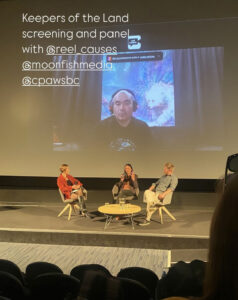
Panel discussion post-film. Photo courtesy of event attendee, @nicolevan.zutphen.
YLICPers outside the Legislature after a successful day lobbying!
Nature in Transit installation in Metro Vancouver
Nature in Transit installation in Metro Vancouver
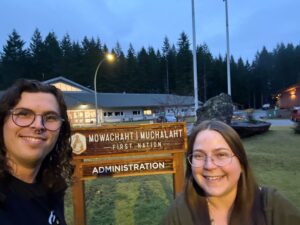
Aleesha and Jacob at the Salmon Parks IPCA Declaration Feast
December 16, 2025 – by Aleesha Switzer
Hey everyone, it’s Aleesha! Welcome to my first blog post for CPAWS-BC. I started here just about nine months ago and there were a lot of questions swirling around, like when will land use planning launch? What areas will be considered? What will the timeframe look like? Can I be honest with you for a second, CPAWS-BC supporters? I didn’t really know what a land use planning process was! If you’d asked me then what being part of land use planning in Northwest BC would feel like, I’m not sure I could have answered. Technical? Important? Complex? All true. But now that I’m in it, I can also say it has been inspiring, and has changed the way I view my work and how important it is that we continue to have the support of folks like you.
This post is a behind‑the‑scenes check‑in on my experience so far—how this work came together, why it matters, and what it’s been like to show up as a voice for nature in a process that’s shaping the future of the northwest.
Why the Northwest, and Why Now?
In May 2025, Premier David Eby announced the Northwest Strategy, an ambitious commitment to advance reconciliation, conservation, and economic development together. The goal was not to choose one over the other, but to move them forward hand‑in‑hand. Land use planning, as I have since discovered, is a process that defines what can and cannot take place on the land, and where.Zones are defined that make it clear where industry can develop and to what extent, and where protected areas are set aside. The northwest contains some of the most significant potential for mining projects in BC, and is a critical component of the Province’s economic strategy. In this part of BC, many existing land use plans were created without First Nations’ input, or did not meaningfully consider First Nations’ rights. Launching land use planning processes that include First Nations as government-to-government partners is an act of reconciliation. In terms of conservation, the opportunity for protection is the biggest we will see in a generation, and the significance cannot be understated.
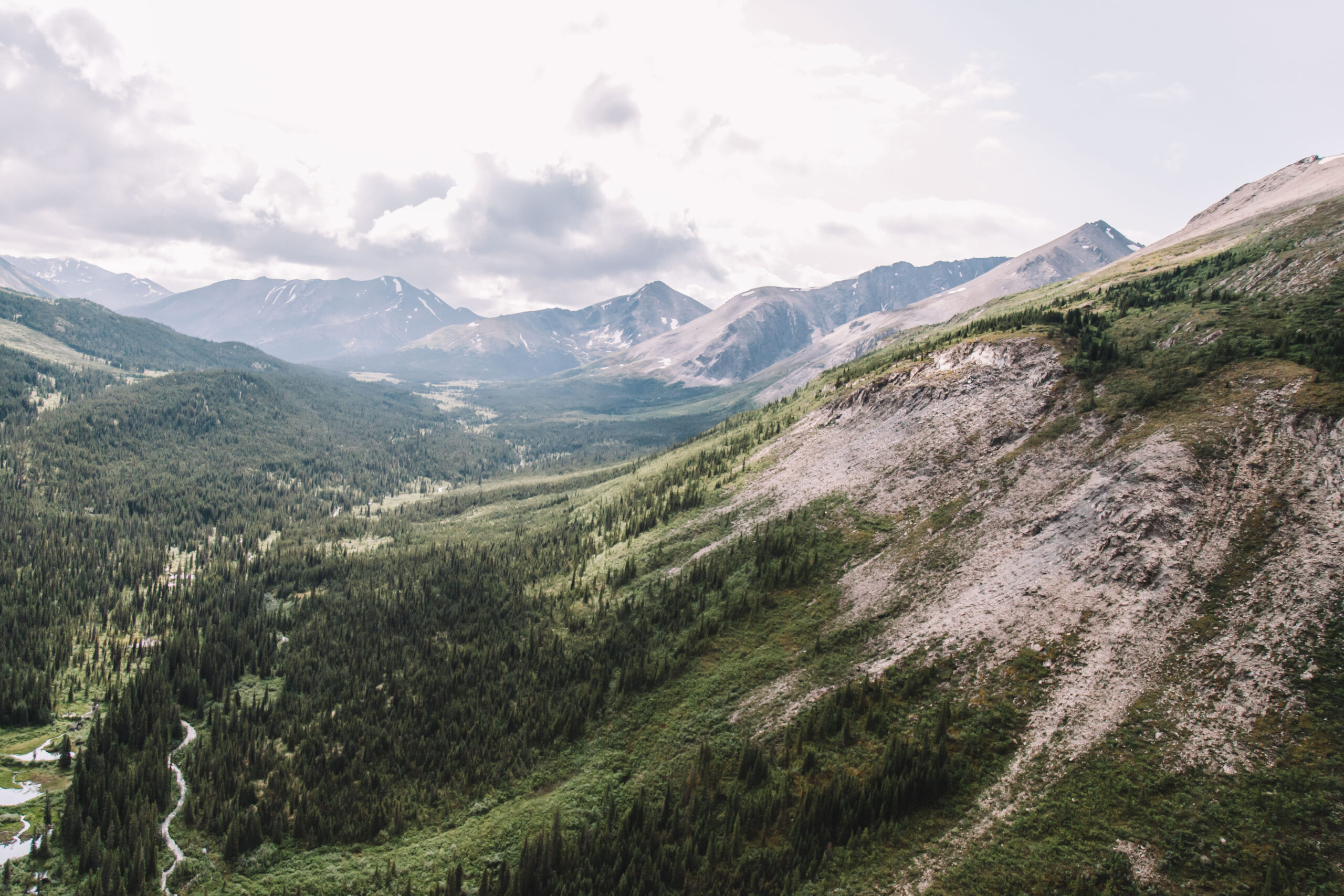
What makes the northwest so remarkable is its wilderness. These are some of the largest, most intact, and truly wild landscapes left in British Columbia. The northwest is a place of extraordinary beauty and ecological value, supporting healthy salmon populations, species at risk like Caribou, and a whole host of interconnected plants and animals. We know that setting aside protected areas for nature is critical to maintain healthy biodiversity and ecosystems, and is an important part of responding to the urgent realities of climate change. Responding to this, the BC government joined Canada and nations around the world in the goal to protect 30% of our land and freshwater by 2030. The potential for protection in the northwest is staggering. More than 4% of the entire province could be protected through this work alone. At the end of 2025, 15.9% of BC is protected, with another 4% only partially protected. Being part of conversations that could help protect these places has been a tremendous privilege.
Early Stages – the First 5 Months
As a CPAWS‑BC staff member, most of my day‑to‑day work happens remotely from my home in Abbotsford, BC, on the traditional territories of the Stó:lō people. The first few months of work after the land use planning projects in the northwest were announced was largely virtual. Working alongside CPAWS-BC’s trusty Conservation Specialist Johnny Mikes, (honestly, folks, with the lifetime of experience in the north he brings to the team he has been a lifesaver) we learned about the planning areas, built campaigns for public engagement, and, overall, worked to figure out where and how CPAWS‑BC could best contribute.
CPAWS‑BC has a long‑standing relationship with the Kaska Dena First Nation, and we’ve advocated for the protection of their Indigenous Protected and Conserved Area (IPCA) Dene K’eh Kusan (DKK) for many years. The northwest land use planning marked a pathway for provincial law to finally recognize DKK as a protected area. I have been engaging with the Kaska Dena team to better understand how we can support their vision for Dene K’eh Kusan, while also advocating for nature across the broader northwest planning areas.
A few things have made these land use planning processes different from what has been done in the past. First, four separate land use planning processes were launched simultaneously, each with their own government-to-government agreements between BC and First Nations. That means each process has its own engagement plans, phases, goals, etc. Second, a timeline of 12 months was established for the four plans to go from launch to final product approval. In the 1990s and 2000s, land use planning processes across the province often took several years (sometimes more than 10!) to reach completion. This accelerated timeline reflected two key aspects of the process: 1) The desire to have certainty for economic development quickly, and 2) The extensive preparation already done by the Nations. A critical piece of this work is the inclusion of IPCAs. Many First Nations have spent years—sometimes decades—developing stewardship visions for their territories. These visions are articulated through IPCA declarations and brought into the land use planning process as essential guiding documents.
These land use planning processes are taking place during a serious time and budget crunch in BC. We knew from the start that we would need to adapt and respond quickly when opportunities arose. What we didn’t expect was a BC GEU strike to take place for a record-breaking 8 weeks, cutting that time available for the already-ambitious 12 month processes even shorter. While we waited for updates week over week, I wondered what role CPAWS-BC could play in land use planning.
The Voice for Nature
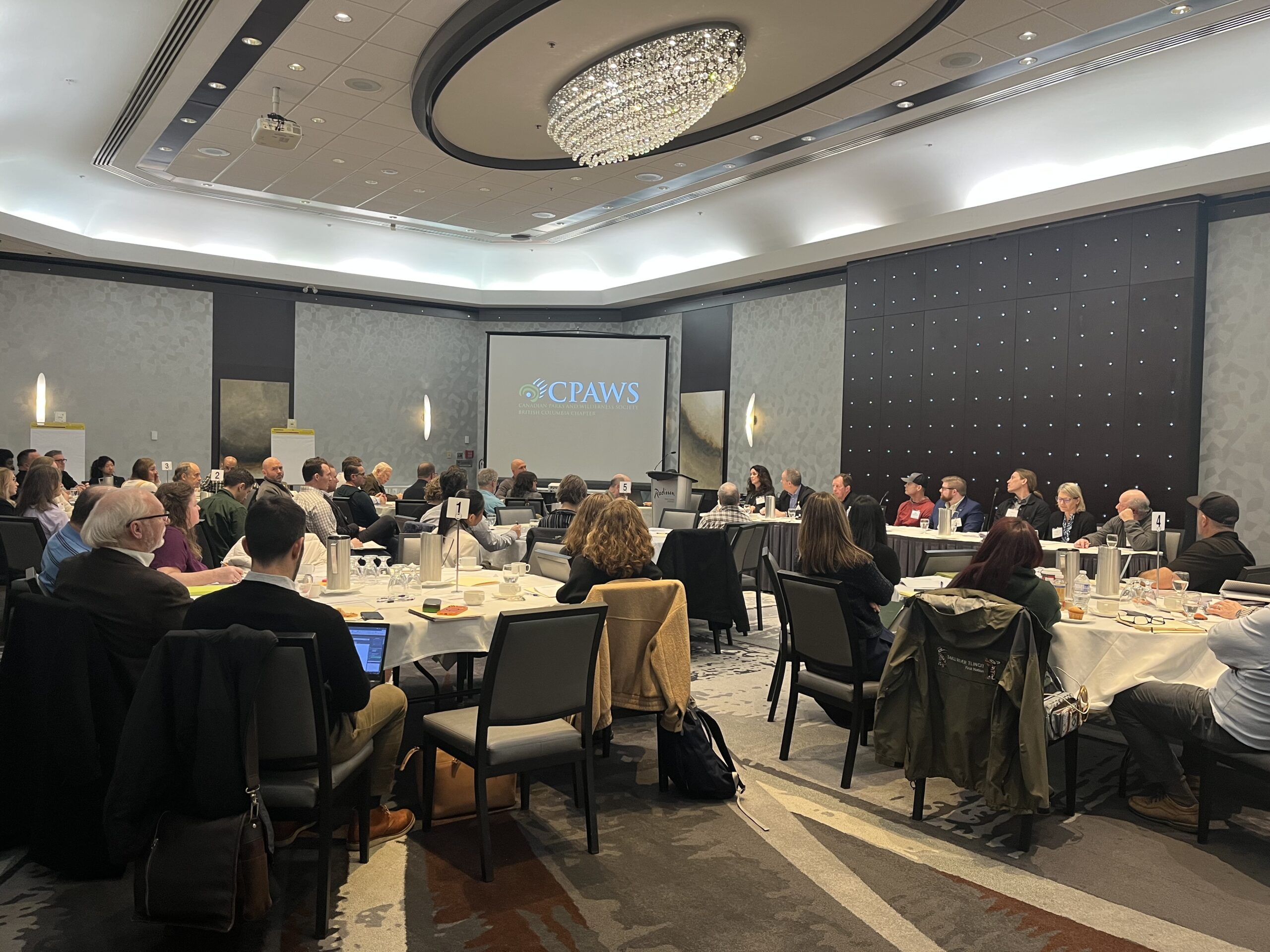
This idea of CPAWS‑BC as a voice for nature is something I had heard, but it wasn’t until the land use planning engagement sessions began in earnest this November that the role really came into focus. I attended sessions for the three largest planning processes in the northwest, the Kaska-BC project, Tahltan-BC project, and the Taku River Tlingit First Nation-BC project. In each scenario, the BC government staff and First Nations leadership invited “stakeholders” to share their values and interests regarding these places. Stakeholder, in my opinion, is a rather dated term here, meant to include anyone who has a direct interest in the outcomes of the process. These sessions, both online and in-person, brought together a wide range of participants to hear updates from the BC government and First Nations about the goals, visions, and direction of the land-use planning process. Stakeholders were then invited to share their own perspectives—what mattered to them in these landscapes and how they hoped the planning process would move forward. The room included representatives from many sectors and industries, all with strong opinions about how these vast areas of the northwest should be managed.
Looking around the rooms, I was pleased to see some familiar faces – groups like the BC Wildlife Federation, Outdoor Recreation Council, and Wilderness Tourism Association were also present as stakeholders. These organizations spoke about how their respective industries benefitted from healthy ecosystems in the planning areas. Seeing that overlap and shared commitment to protecting nature was genuinely encouraging.
Conversely, the majority of participants in the room were representatives of extractive industries – primarily the mining industry. These folks were advocating for more exploration, more mining, and less protected areas across the board. Now, I want to make the record clear for a moment – we support the Northwest Strategy’s three pillar approach of reconciliation, conservation, and economic development needing to occur hand-in-hand. The land use planning areas needed to contain space and opportunity for all aspects of the strategy to be realized. What surprised me the most about these stakeholder engagement sessions was not the diversity of viewpoints, but the absence of voices.
Given how ecologically significant these areas are, their importance for biodiversity, for species at risk like northern caribou, for headwater streams that support abundant populations of salmon, for climate mitigation and refugia, and for protecting some of the last truly wild landscapes in the province, I expected to see dozens of environmental organizations from across BC and Canada lined up to participate. Instead, when it came to simply being there to speak for nature, CPAWS-BC was often one only of a small handful of organizations in the room. By sheer numbers, industry, particularly the mining sector, had the strongest presence in every room. It struck me then why the role of CPAWS-BC being the “voice for nature” matters so much in these processes.
I left those sessions feeling incredibly proud of the role we’re playing, and deeply grateful to you, our supporters. Your support is what allows CPAWS-BC to show up in these spaces, to advocate for Indigenous-led conservation, to speak about the importance of connecting and protecting adjacent landscapes, and to ensure that the ecological value of the northwest is not overlooked. These stakeholder engagement sessions were a powerful reminder of how conservation advocacy actually happens, not just through reports and campaigns, but by being present, prepared, and willing to speak up when it matters most. As this work continues into the new year, there will be more opportunities for engagement and for supporters like you to add your voice alongside ours. I now understand more clearly than ever how essential that collective voice for nature truly is.
Thank you for standing with us, and for helping make this work possible. Stay tuned for more updates in 2026!
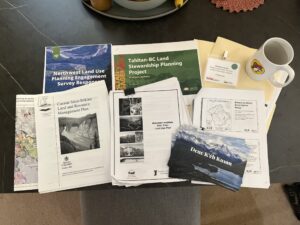
Aleesha’s kitchen table: If your kitchen table doesn’t look like this… are you even doing land use planning??
Aleesha at the in-person stakeholder engagement session in Vancouver
Thursday July 10, 2025, Unceded territories of the Coast Salish Peoples/Vancouver, BC – The Canadian Parks and Wilderness Society – British Columbia (CPAWS-BC) is thrilled to announce a creative collaboration with local brewery Container Brewing: a custom-labeled beer in support of wildlife, species at risk, and BC’s commitment to protect 30% of lands and waters by 2030.
Launching July 17, 2025 at a special nature-themed trivia night at Container Brewing, DILF Lager (Dude, I Love Forests)—features a limited-edition label inspired by iconic wildlife and ecosystems in BC. This unique partnership blends conservation with craft beer culture to bring environmental advocacy into new spaces—and to new audiences.
“This collaboration is about bringing people together in a fun, creative way,” says Brynna Kagawa-Visentin, Campaigner with CPAWS-BC. “We want to reach people who care about nature but might not yet feel connected to conservation efforts. This beer is an invitation to learn more, take action, and be part of a growing movement to protect what makes BC unique and beautiful—and with partial proceeds supporting our conservation work, every sip makes a difference.”
“As a brewery founded by people who spend as much time as possible outdoors—on the trails, in the forests, along the rivers—we understand how much wild spaces in BC give back to us,” says Dan Webster, Cofounder of Container Brewing. “Partnering with CPAWS-BC to help protect those same lands and waters just made sense. We take pride in brewing with purpose, and this collaboration lets us raise a glass to the places we love while helping ensure they’re still here for the next generation to enjoy.”
Launch Event Highlights:
Venue: Container Brewing, 1216 Franklin St, Vancouver, BC V6A 1K1
Date: July 17, 2025, 7 PM (limited capacity, arrive early to secure your spot)
Partial proceeds from each beer sold go directly to CPAWS-BC’s conservation efforts
Can’t make it? Starting July 17, DILF Lager will be available at Container Brewing—while supplies last. Every can helps protect the lands, waters, and wildlife that make BC so special. Ten percent of all beer sales on launch day will be donated to CPAWS-BC, along with 10% of all future DILF Lager sales.
This initiative directly supports CPAWS-BC’s goal to see at least 30% of land and water in BC protected by 2030. In 2023, the BC government, First Nations, and the federal government, committed to this goal of 30% protection in a shared agreement. Protecting large, connected, high-quality habitats is critical to sustaining biodiversity, supporting healthy ecosystems, and strengthening partnerships with First Nations who steward these lands.
“From old-growth forests to salmon-bearing rivers, BC is home to some of the most spectacular ecosystems on Earth,” says Kagawa-Visentin. “But they’re at risk. Today, nearly 1,900 species, sub-species and ecosystems are at risk of disappearing. With community support, we can protect these places, not just for wildlife, but for future generations.”
Whether you’re a long-time supporter or new to the cause, this is your chance to raise a glass for nature and be part of the solution. Because in BC, protecting biodiversity isn’t just good for the planet—it’s essential for our shared wellbeing, economy, and future.
The Province, the Tahltan, Taku River Tlingit, Kaska Dena, Gitanyow and Nisga’a Nations will undertake expedited planning to secure long-term ecosystem health and economic prosperity.
Tuesday, June 3, 2025, Unceded territories of the Coast Salish Peoples/Vancouver, BC – The Canadian Parks and Wilderness Society – British Columbia (CPAWS-BC) is welcoming the launch of land use planning processes, jointly announced by the BC Government, the Kaska Dena, Tahltan, Taku River Tlingit, Gitanyow, and Nisga’a Nations. These processes provide a pathway to achieving the shared commitment to protecting 30 percent of lands and waters as well as advancing reconciliation and responsible development in Northwest BC.
“We’re thrilled to see the next step in the long-awaited launch of land use planning to bring different voices to the table and decide on a pathway to protecting the ecosystems that underpin our cultures, health and economies,” says Sarah McNeil, Executive Director at CPAWS-BC. “If done well, land use planning has the power to meet the moment of ecological crisis and economic uncertainty by moving forward to a healthy and secure future for British Columbians.”
The announcement includes three pillars previously outlined in a shared vision for the region: conservation, reconciliation and responsible development. To provide security while land use planning is launched and carried out over the coming 12 months, the province is putting a pause on new mining tenure registration in the area over a third of the planning area. This is an essential step to help governments, communities, and all interested parties move forward together.
“We thank the leadership of the Kaska, Taku River Tlingit, Tahltan, Gitanyow and Nisga’a for their ongoing stewardship and commitment to conservation, and the dedication of the BC government to move conservation forward in a respectful way,” said Aleesha Switzer, Acting Conservation Director – Lands & Freshwater Program at CPAWS-BC. “This ambitious timeline calls for dedication from all, and we hope to see additional capacity from the province to make sure these processes can advance our shared goals of bringing back healthy wildlife populations, securing a climate-safe future and responsible development.”
This process will bring together communities from the shadow of the Coast Range at the border with Alaska right across to the Continental Divide in the remotest parts of the Rocky Mountains, showcasing a tremendous variety of landscapes, ecosystems, and numerous pristine free-flowing rivers. The region is home to strongholds for many of the most iconic species found in BC, including powerful runs of salmon and teeming herds of elk.
“The territories of the five Nations include large unlogged and unroaded watersheds that are increasingly rare in BC, and significant on a global scale. Not only would land protections in this region help enable Indigenous peoples to maintain their powerful cultural connections to their land, they would also provide a stunning wild legacy for all British Columbians,” says Johnny Mikes, Conservation Specialist with CPAWS-BC.
The announcement of land use planning in the Northwest comes after many years of hard work by the Kaska, Taku River Tlingit, Tahltan, Gitanyow and Nisga’a First Nations to identify areas of ecological, cultural, and economic importance across their territories. Thanks to their efforts, we will see the land use planning process move quickly, and communities, stakeholders, industry, recreation users, and conservation organizations will soon be invited to provide their input. By working together, we can create a sustainable future where fish and wildlife thrive, alongside healthy communities.
–30–
For interviews, contact:
Aleesha Switzer
Acting Conservation Director – Lands & Freshwater Program
In 2022, the BC government recognized the need for better protection of nature and committed to protecting 30 percent of lands and waters in BC by 2030, in partnership with First Nations. The January 2025 mandate letters outlined land use planning as the pathway to advance this goal, alongside resource development focused on the exploration and mining of critical minerals.
For more information on land use planning in British Columbia, visit the BC government planning partnerships website: https://planninginpartnership.ca/
We use cookies and other similar technologies such as pixels and web beacons (“Cookies”) for various purposes, such as to ensure our website functions properly, enhance your browsing experience by remembering your preferences and provide personalized content and advertisements.
Functional
Always active
The technical storage or access is strictly necessary for the legitimate purpose of enabling the use of a specific service explicitly requested by the subscriber or user, or for the sole purpose of carrying out the transmission of a communication over an electronic communications network.
Preferences
The technical storage or access is necessary for the legitimate purpose of storing preferences that are not requested by the subscriber or user.
Statistics
The technical storage or access that is used exclusively for statistical purposes.The technical storage or access that is used exclusively for anonymous statistical purposes. Without a subpoena, voluntary compliance on the part of your Internet Service Provider, or additional records from a third party, information stored or retrieved for this purpose alone cannot usually be used to identify you.
Marketing
The technical storage or access is required to create user profiles to send advertising, or to track the user on a website or across several websites for similar marketing purposes.