CPAWS-BC stands with Coastal First Nations, opposes Federal Government’s reported pipeline deal
The Canadian Parks and Wilderness Society – British Columbia stands with First Nations leaders, scientists, and the provincial government against a tanker ban exemption for a northwest coast pipeline.
November 26, 2025, Lands and waters of the Coast Salish Peoples/Vancouver, BC – The Canadian Parks and Wilderness Society – British Columbia (CPAWS-BC) supports Coastal First Nations in their denouncement of a reported Memorandum of Understanding between the federal government and Alberta to build a new pipeline and provide exemptions from the project from the Oil Tanker Moratorium Act.
The Pacific north coast is a vital marine ecosystem, rich in biodiversity and of deep cultural and economic significance. Indigenous Nations have stewarded these waters since time immemorial, helping to safeguard an ocean that teems with life and sustains the livelihoods and well-being of coastal communities.
“This move is another signal that the federal government is no longer committed to protecting nature, which is a core value not just in British Columbia but across the country,” says Sarah McNeil, CPAWS-BC Executive Director. “The Oil Tanker Moratorium Act was introduced as part of Canada’s Ocean Protection Plan, and is absolutely necessary to safeguard the north Pacific from potential disaster. Poking holes in the tanker ban would recklessly expose coastal communities, food systems and fisheries, and ecosystems to catastrophic risk. An oil spill, even once, would cause harm no cleanup plan, financial guarantee or regulatory oversight could repair.”
Earlier this month, Coastal First Nations and the Province of British Columbia reaffirmed their shared vision through the North Coast Protection Declaration, committing to safeguard the coast. This declaration recognizes what the Great Bear Rainforest and Great Bear Sea agreements have already proven: conservation doesn’t hinder the economy, it builds economies. British Columbians expect the same principled leadership from Ottawa.
While CPAWS-BC recognizes the need for economic stability during these uncertain times, expanding fossil fuel infrastructure while risking the coast is not the path forward — it takes the country backward when we must be looking ahead.
“Coastal waters are not industrial highways,” says Natalie Groulx, Conservation Director with the Ocean Program at CPAWS-BC, “they are home, heritage, and the lifeblood for communities and wildlife. The tanker ban isn’t about stifling opportunity; it’s about refusing to place an irreversible, all-or-nothing bet with stakes Coastal First Nations and BC never agreed to gamble.”
CPAWS-BC urges the federal government to prioritize projects that are truly nation-building: those that can provide jobs and prosperity through clean energy and clean growth, increase the supply of housing, and improve food security and affordability for millions of Canadians.
“Even during these challenging times, Canadians overwhelmingly believe in climate action and nature protection,” says Groulx. “Smart teams play strong defense when the stakes are so high and when it comes to risking the coast, this is a line that simply cannot be crossed.”
-30-
For interviews, contact:
Natalie Groulx, Conservation Director, Ocean Program, CPAWS-BC
natalie@cpawsbc.org
604-685-7445 x 6
NANAIMO, BC / Unceded territories of the Snuneymuxw, Snaw-naw-as, and Stz’uminus, and Qualicum First Nations
Today, the Association of Vancouver Island and Coastal Communities passed a resolution calling on the Province to legislate the BC Coastal Marine Strategy. This resolution was championed by the District of Saanich and the City of Langford. Legislating the provincial Coastal Marine Strategy will ensure the strategy is successfully brought to life.
“British Columbia’s coast is a global treasure, vital to our environment, culture, and economy,” stated Saanich Councillor Teale Phelps Bondaroff. “By enshrining the Coastal Marine Strategy into law, we can ensure that its vision of a diverse and resilient coastal marine environment is protected for generations, regardless of shifting political priorities.”
The BC Coastal Marine Strategy is an intersectional plan aiming to boost biodiversity, tackle marine pollution, and recover nearshore habitats with nature-based solutions – all the while advancing Indigenous coastal management, building up resilience to climate change, and working to revitalize coastal communities and economies. The release of BC’s first Coastal Marine Strategy in July 2024 was a significant accomplishment, but there is a need for an accompanying legal framework to see this strategy succeed within its 20-year vision and beyond.
“Legislation is key to strong, integrated coastal management,” said Erin Gray, Staff Lawyer at West Coast Environmental Law. “An accompanying legal framework will ensure the important policies outlined in the Coastal Marine Strategy are prioritized, long-lasting, and able to withstand changes in the political landscape. Without a legal framework, the strategy risks falling short of meeting its critical goals.”
The BC coast is a lifeline for those who live, work, and visit. Across the province, ocean-based activities contribute $21 billion annually and directly employ 131,000 people full-time.1 Coastal communities also depend on a healthy, thriving ocean for food security, recreation, culture, and spiritual connection. A healthy coastline helps these communities mitigate the impacts of climate change by absorbing waves, reducing erosion, and providing refuge for wildlife.
“We cannot afford for BC’s Coastal Marine Strategy to fail,” added Phelps Bondaroff. “Ultimately, when our oceans thrive, so do we.”
“As a long-time Vancouver Island resident, and through conversations with people in the City of Langford, the impact of declining fish populations like salmon, polluted waters, and degraded shorelines is clear,“ shared Langford Councillor, Mary Wagner. “The Coastal Marine Strategy is a real opportunity to support my community and others across BC by making decisions now that will benefit everyone who depends on the coast.”
With the passing of this resolution at the Association of Vancouver Island and Coastal Communities, it will next be brought forward at the Union of BC Municipalities (UBCM) in September.
For more information, please contact:
Erin Gray (she/her), Staff Lawyer, West Coast Environmental Law egray@wcel.org, 604-684-7378 ext. 234
Teale Phelps Bondaroff (he/him), Ph.D., Councillor, District of Saanich teale.phelps.bondaroff@saanich.ca
*Teale est disponible pour des interviews en français
Mary Wagner (she/her), Ph.D., Councillor, City of Langford mwagner@langford.ca
—– 1Big River Analytics Ltd. (2021). Economic Contribution Analysis: For the Economic Contribution of the Oceans Sector in Coastal BC. Unpublished and prepared privately for the governments of British Columbia and Canada.
Since their discovery in 1987, glass sponge reefs have been thought of as the delicate treasure of BC’s coast. Glass sponge reefs were thought to have gone extinct 40 million years ago, and their discovery has been likened to finding a herd of dinosaurs. Glass sponge reefs are only found in BC and Alaska, forming intricate and towering formations deep on the ocean floor. These reefs form oases amidst the otherwise barren seafloor, attracting numerous species of rockfish, prawns, and sharks. Sadly, these vital ecosystems are vulnerable to damage by sedimentation.
Grant’s findings show glass sponge reefs may be even more sensitive to sedimentation than we had thought.
Glass sponges are filter feeders, getting food and oxygen by pumping water through their body, filtering out bacteria and other organic material. Sponges can filter up to 900 times their body volume every hour. When sediment is suspended in the water it can clog or damage the sponge’s delicate pumping system, while large grains could even block the incurrent openings.
Grant’s research shows that in response to suspended sediment, glass sponges begin to “cough”, or arrest the flow of water through their body. While this may protect the sponges from damage by the sediments, it reduces the amount of food and oxygen the sponge can obtain. Much like in humans, a lack of food or oxygen can lead to slower growth or even death in the glass sponge reefs.
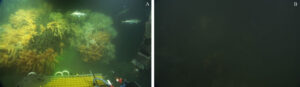
Photos of glass sponge reef (A) before and (B) after sedimentation. Photos from Grant et al. MER with permission of the author.
Unfortunately, the danger of sedimentation is not only an academic concern, it is affecting reefs throughout BC. A recent video of a glass sponge reef in the Broughton Archipelago shows the effect of waste and sediment on a glass sponge reef located below an open net-pen salmon farm. In this instance, sediment turned a vibrant and diverse glass sponge reef into a desolate wasteland.
While glass sponge reefs form over thousands of years, sedimentation can rapidly destroy these delicate reefs. After seeing the video, Dr. Leys observed that the sensitive sponges “likely died soon after the first masses [of sediment] hit them”.
To make matters worse, Grant’s research observed coughing fits in glass sponges at levels of sedimentation far below what would be caused by activities such as bottom trawling. Grant concludes that sediment concentrations at the level generated by trawling activities could be catastrophic for glass sponge reefs. In the recent paper, Grant writes that their “data suggest that the sponges’ arrests and coughing behaviours would become frequent if not incessant, and smothering would be likely.”
This would almost certainly spell death for sponges caught in trawling sediment plumes.
The majority of glass sponge reefs in BC have no permanent protection and are vulnerable to destruction and sedimentation.
In 2017, after more than a decade of campaigning by CPAWS, the Hecate Strait and Queen Charlotte Sound Reefs were designated as a marine protected area, protecting them from damage and sedimentation. However, most glass sponge reefs in BC have no permanent protection and are at risk from sedimentation and other damage.
While processes are underway to protect additional reefs in BC, these protection measures may take years if not decades to implement, leaving glass sponge reefs vulnerable to damage in the interim. Due to the rare and fragile nature of glass sponges, a system for the immediate assessment and interim legislated protection of reefs as soon as they are discovered is absolutely necessary.
Without protection, these rare glass sponge reefs will continue to cough and choke on sediment, until they are eventually lost, perhaps forever.
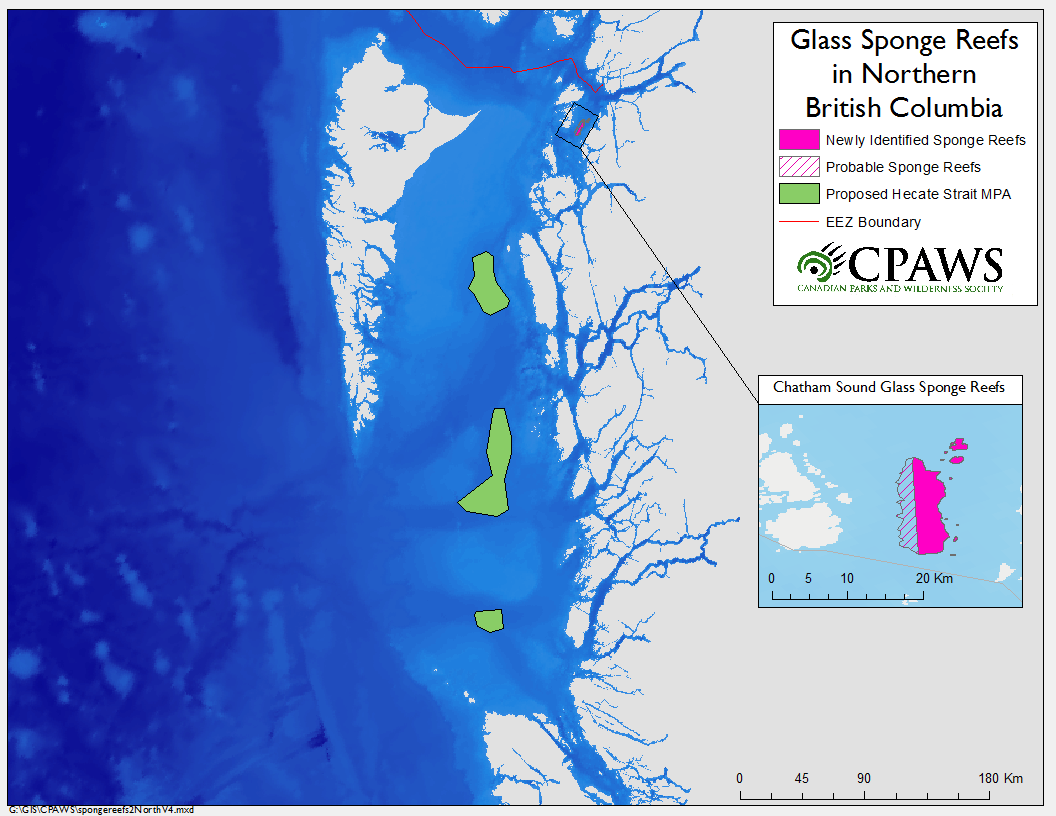
A new 12 kilometre long glass sponge reef has been discovered near Prince Rupert in Chatham Sound making it one of the largest glass sponge reefs discovered in BC making it a very significant discovery and a very important ecosystem. The reef is in the potential pathway of a number of proposed industrial developments so it needs to be protected, and quickly!
The reef was discovered by a team of scientists conducting an environmental assessment for a Spectra Energy underwater LNG pipeline route back in 2013. Unfortunately the discovery was buried in the mountain of documentation for the environmental assessment and was only brought to the attention of conservationists in early 2016.
The reef was detected in much the same way that the Hecate Strait reef complexes were discovered; using soundwaves to survey the seabed they discovered a mysterious ghostly mounds rising off the seafloor. The team then sent down an ROV to conduct a video inspection and discovered the reefs. The team that discovered the reef only surveyed the portion of it that fell into the proposed project. Based on the topography of the seafloor the reef is likely to be much larger.
Full surveys are needed to map and measure the full extent of the reefs, determine their health and condition and survey other species that are found on the reefs.
The proximity of the reefs to areas of proposed industrial development and undersea pipelines, major shipping lines, and a major fishing port is a concern for conservationists. As one of the largest glass sponge reefs ever discovered, the Chatham Sound reefs are an incredibly important ecosystem and one that needs to be fully protected as quickly as possible.
In June 2015, Fisheries and Oceans Canada published the draft regulations for the proposed Hecate Strait and Queen Charlotte Sound MPA for public review. CPAWS, alongside other conservation groups, 40 leading international marine scientists and almost 2000 Canadians say that the proposed regulations are not good enough.
In the draft regulations Fisheries and Oceans Canada allowed for some fishing activities including bottom trawling to continue around the reefs, and other types of fishing to continue above them, while they conduct monitoring and research. Cable laying and anchoring within the MPA are also permitted according to the draft regulations.
CPAWS was joined by WWF Canada, Living Oceans Society, David Suzuki Foundation and BC Nature, as well as 40 leading international marine scientists and almost 2000 Canadians, in expressing our concern over the risks that these permitted activities will pose to the reefs and asking Fisheries and Oceans Canada to amend the regulations and prohibit all potentially harmful activities from the MPA.
As yet, we do not know the outcome of the public consultation, a final decision has not been made on the MPA.
Vancouver, BC – 5 June 2015 – Local and national conservation groups are welcoming today’s announcement by the federal government of fishing closures for the Strait of Georgia’s glass sponge reefs – a global treasure found nowhere else in the world.The fishing closures will prohibit all bottom contact fishing over the reefs themselves and 150 metre wide buffer around them, to ensure that the reefs are not accidentally damaged by fishing gear and to protect them from sedimentation. DFO established voluntary closures last year in order to protect the reefs while consultation was underway. The closures come after months of consultation and discussions among DFO, the conservation groups, the commercial and recreational fishing sectors, and First Nations. The conservation sector was represented by CPAWS, David Suzuki Foundation, Marine Life Sanctuaries Society, Sunshine Coast Conservation Association, and the Vancouver Aquarium.“For more than six years the Canadian Parks and Wilderness Society (CPAWS) has been leading a concerted effort to convince Fisheries and Oceans Canada (DFO) to protect these reefs. They are a global treasure found nowhere else in the world. The reefs are thousands of years old and they are incredibly fragile,” said Sabine Jessen, National Oceans Program Director at CPAWS.“Glass sponge reefs were only discovered recently; they are usually found more than 100ft deep so most of the reefs are very hard to observe and study,” said Jeff Marliave, Vice President of Marine Science at Vancouver Aquarium. “But the work that scientists have been able to do shows that they are tremendously important ecosystems; they filter large amounts of bacteria from seawater and they provide habitat for a host of other species including endangered rockfish and the much-loved BC spot prawns,” adds Marliave.
Fishermen targeting spot prawns drop their traps around the reefs and risk damaging the incredibly fragile glass sponges.
“Spot prawns are currently considered to be a sustainable seafood choice according to the SeaChoice ranking program. These fishing closures show a commitment by DFO to address the fleet’s habitat impacts to ensure the long term sustainability of BC spot prawns and our oceans,” said Scott Wallace, Senior Research Scientist at the David Suzuki Foundation and Science Coordinator for SeaChoice.
The Strait of Georgia glass sponge reefs were first discovered during seafloor mapping in 2001. There are reefs located near Galiano Island, Hornby Island, Parksville, Gabriola Island, the Sunshine Coast, West Vancouver, near the mouth of the Fraser, and in the middle of the Strait of Georgia and up into Howe Sound.
“On the Sunshine Coast, local citizens have been asking for many years for protection of our glass sponge reefs, so we are looking forward to our community taking a stewardship role and working with DFO staff and fishers to ensure the long term safety of these amazing ecosystems,” said Cindy Harlow of the Sunshine Coast Conservation Association.
“We have pointed out to DFO that there are more reefs in Howe Sound that were discovered after the initial proposal was made to protect these nine reefs. The Howe Sound reefs are currently at risk from prawn fishing, so it is urgent that DFO start the process to protect them too,” said Roy Mulder, President of the Marine Life Sanctuaries Society.
“Glass sponge reefs in BC are a globally unique treasure that we have an obligation to protect. If we destroy them, they could take hundreds of years to recover, if at all. Fishing closures are addressing one of the main threats to the reefs. However, they also need protection from other threats such as anchors, cables, and oil spills. After all, these are the only glass sponge reefs in the world!” said Alexandra Barron, Marine Conservation Coordinator at CPAWS.
We use cookies and other similar technologies such as pixels and web beacons (“Cookies”) for various purposes, such as to ensure our website functions properly, enhance your browsing experience by remembering your preferences and provide personalized content and advertisements.
Functional
Always active
The technical storage or access is strictly necessary for the legitimate purpose of enabling the use of a specific service explicitly requested by the subscriber or user, or for the sole purpose of carrying out the transmission of a communication over an electronic communications network.
Preferences
The technical storage or access is necessary for the legitimate purpose of storing preferences that are not requested by the subscriber or user.
Statistics
The technical storage or access that is used exclusively for statistical purposes.The technical storage or access that is used exclusively for anonymous statistical purposes. Without a subpoena, voluntary compliance on the part of your Internet Service Provider, or additional records from a third party, information stored or retrieved for this purpose alone cannot usually be used to identify you.
Marketing
The technical storage or access is required to create user profiles to send advertising, or to track the user on a website or across several websites for similar marketing purposes.