fbpx

Oceans Act enforces glass sponge reef marine protected area regulations

February 6, 2020

Unceded Coast Salish Territory/Vancouver, B.C. – The Canadian Parks and Wilderness Society – British Columbia (CPAWS-BC) welcomes the conviction of illegal fishing in the Hecate Strait and Queen Charlotte Sound Glass Sponge Reefs Marine Protected Area (Hecate MPA).

Illegal commercial groundfish harvesting was found to have occurred in the marine protected areas. A fine of $20,000 for illegal activity prohibited under the Hecate MPA Regulations, the first conviction under the Oceans Act nationwide. An additional fine, under the Fisheries Act, of $25,000 for possessing illegally caught fish was ordered to be paid.

“We would like to thank Fisheries and Oceans Canada for enforcing MPA regulations under the Oceans Act and protecting B.C.’s glass sponge reefs,” says Ross Jameson, Ocean Conservation Manager for CPAWS-BC.

Located in the Hecate Strait and Queen Charlotte Sound off B.C.’s north and central coasts, the Hecate MPA glass sponge reefs are a world treasure. Once thought extinct for millions of years, glass sponge reefs are now known only to live in the northeast Pacific Ocean, mainly off B.C.’s coast.

CPAWS-BC has been working since the early 2000s to protect B.C.’s glass sponge reefs. After years of pushing for protection, we celebrated when the Hecate MPA was created by Fisheries and Oceans Canada in 2017. CPAWS-BC continues to work with First Nations and the Government of Canada to protect other vulnerable glass sponge reefs in B.C.  Enforcement of these Oceans Act MPA regulations will help ensure these rare ecosystems are not destroyed due to human activities.

Glass sponges are filter feeders. They do this so efficiently that 95% of bacteria are filtered out, cleaning the water. In fact, a single small reef can filter enough water to fill an Olympic-sized swimming pool in less than 60 seconds! Glass sponge reefs provide shelter for bottom-dwelling creatures such as rockfish and prawns.

Fishing activity can cause severe harm to these fragile habitats. Prawn and crab traps drop down and crush glass sponge reefs. Bottom trawling of heavy nets dragged along the seafloor destroy everything in their path while kicking up clouds of disturbed sediment, that prevent the sponges from feeding. 

While this conviction means that the Hecate MPA is being enforced, more work needs to be done. Jameson says, “Now we need a management plan for this MPA with effective education, outreach, and additional protections to prevent these offences from occurring in the future.”


-30-

For interview, please contact:

Ross Jameson, Ocean Conservation Manager

Canadian Parks and Wilderness Society, BC Chapter

604-685-7445 x 29 

ross@cpawsbc.org


Resources

Fisheries and Oceans Canada. (2020, January 20). Safeguarding our future through the Oceans Act [News Release]. Retrieved https://www.canada.ca/en/fisheries-oceans/news/2020/01/safeguarding-our-future-through-the-oceans-act.html
CPAWS welcomes protection of Howe Sound glass sponge reefs

March 6th, 2019

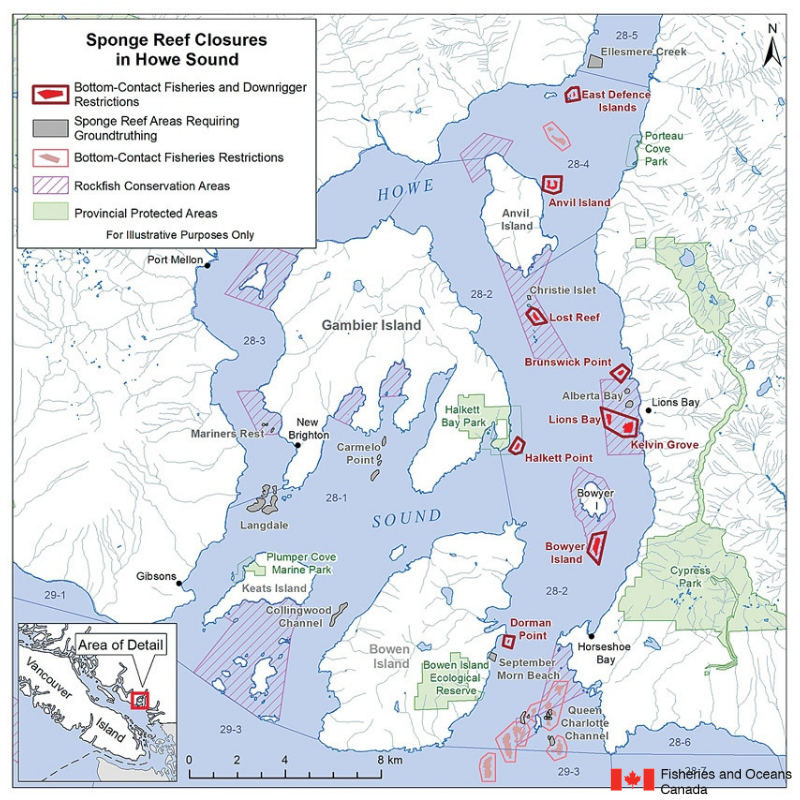
Vancouver, BC – The Canadian Parks and Wilderness Society is very pleased to see the eight new marine refuges announced today, protecting nine of Howe Sounds newly discovered Glass Sponge Reefs from all bottom-contact fishing, by the Minister of Fisheries and Oceans, and the Canadian Coast Guard.

“The Howe Sound glass sponge reefs are an ecological treasure on the door step of one of Canada’s largest cities. They are a very important ecological feature in Howe Sound, that provide both habitat for many species and ecological services including filtering of ocean water,” said Sabine Jessen, National Director of the Ocean Program for CPAWS.

Nine Howe Sound glass sponge reefs are now protected from bottom-contact fishing with eight marine refuges. The reefs are located near Vancouver, BC. Photo credit: Fisheries and Oceans Canada (DFO).

“CPAWS has been involved in the protection of glass sponge reefs on the BC coast for almost two decades, since the first reefs were discovered in Hecate Strait in the late 1980s,” said Jessen. “Living glass sponge reefs date back to the Jurassic era, and are living dinosaurs on our Pacific Coast. We have a global responsibility to ensure their long-term survival.”

“In order to ensure their survival, we are pleased to see that the Minister has announced a number of protection measures, including a 150 metre buffer zone to prevent bottom trawling from both destroying the reefs and from smothering them with sediment, as well as prohibitions on all bottom contact fishing, which can have a severe impact on fragile glass sponges,” noted Ross Jameson, Ocean Conservation Manager, CPAWS-BC.

“We remain concerned that anchoring has still not been addressed in the protection measures for these reefs, and the previous nine glass sponge reefs in the Strait of Georgia that were previously protected,” noted Jessen. “CPAWS will continue to work with DFO and other agencies to ensure that all threats to the reefs are addressed.”

“CPAWS would also like to take this opportunity to recognize the efforts of local groups in Howe Sound who have worked tirelessly to document the Howe Sound glass sponge reefs and to advocate for their long-term protection,” noted Jessen. “We would especially like to recognize Glen Dennison for his many years of work, and to commit to him to assisting with the protection of the additional glass sponge reefs that he has identified in Howe Sound.”

“While we are pleased to see the glass sponge reefs in Howe Sound, like those before them in the Strait of Georgia, being designated as marine refuges, we hope that in future they will form the backbone for a network of MPAs in this region,” added Jameson.

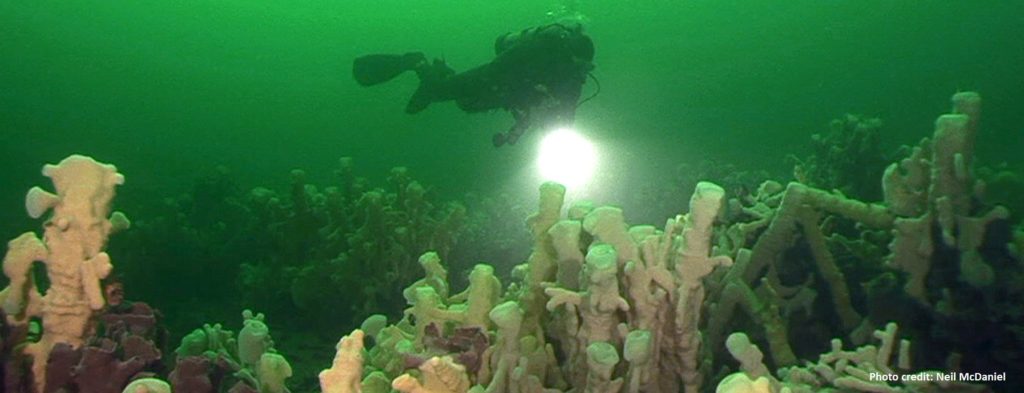
A diver floats above a glass sponge reef in Howe Sound. Photo credit: Neil McDaniel

-30-