What’s next after IMPAC5? Highlights and Reflections
Written by Debra Sinarta
My Highlights and Reflections from IMPAC5
When I joined CPAWS-BC at the start of the new year, I knew I was getting the chance to put my passion and skills for marine research into action. Little did I know, in my first month, I’d get to attend a Congress gathering with the world’s top thought leaders and marine guardians and have the opportunity to learn, connect and share solutions for marine conservation.
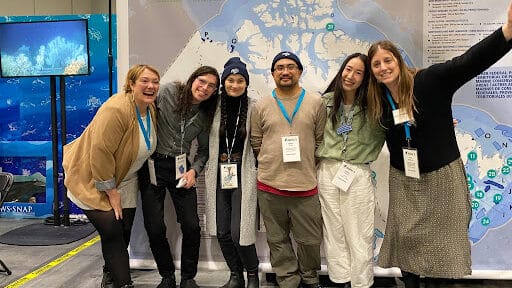
CPAWS-BC ocean conservation team at IMPAC5. (From left to right: Meaghen McCord, Jacob Chila, Alicia Elgert, Carlo Acuña, Debra Sinarta, and Kate MacMillan).
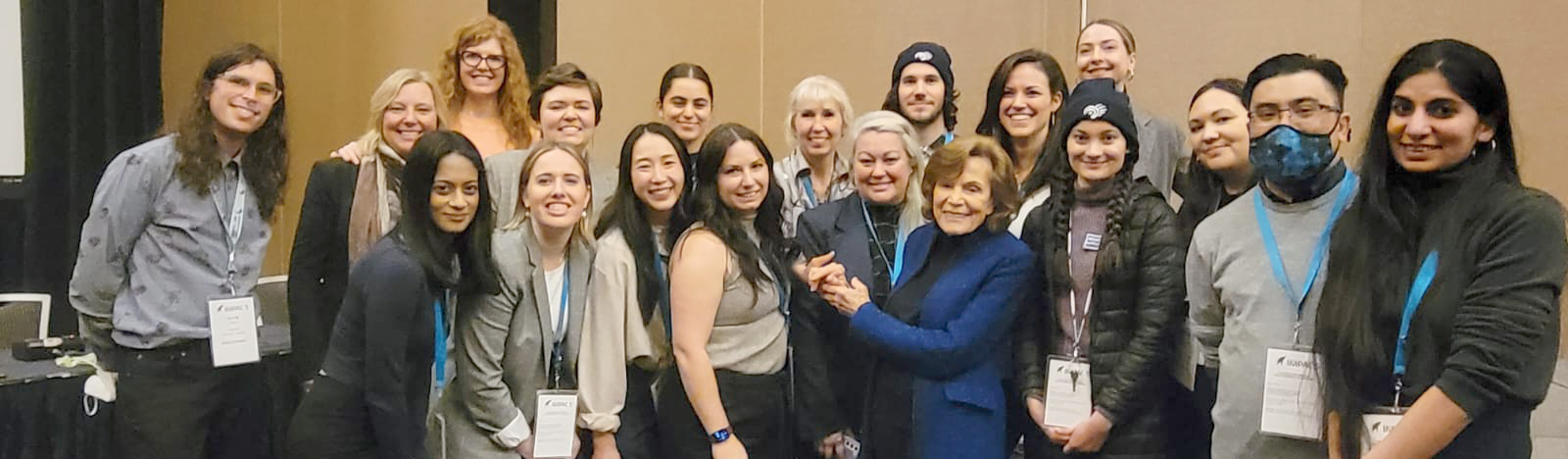
The 5th International Marine Protected Area Congress (IMPAC5) marked my first month working with CPAWS-BC and my first experience attending a Congress of this scale. While these firsts sparked excitement, they simultaneously cast shadows of doubt and nerves. It’s a feeling I know many of my peers experience too. It’s not always comfortable to enter spaces where youth and others haven’t always been invited into or included. I feared being trivial and inconvenient in rooms full of important decision-makers, leaders, and ocean champions who I look up to. I’m happy to say my experience at IMPAC5 proved those apprehensions wrong. In contrast to the pressures of formal meetings and tense negotiations, the congress space welcomed honest conversations and meaningful connections. Day by day, my anxieties lifted and, in turn, uncovered such an empowering and memorable week.
IMPAC5 took place February 5-9, 2023, on the lands and waters of the Coast Salish Peoples in Vancouver. CPAWS-BC’s ocean conservation team joined Indigenous knowledge holders, policymakers, scientists, youth, and community leaders for a week of expert presentations, workshops, family festival activities, and critical conservation commitments. The perspectives and collective voices of the global ocean community helped shape a bright path toward advancing marine conservation both here in BC and beyond.
Here are three highlights from my time at IMPAC5:
1. Celebrating Conservation Wins!
Marine conservation work fully embodies the sentiment, “it’s a marathon not a sprint”. It can take years, sometimes decades, of planning and meaningful consultation before introducing a new marine protected area (MPA) in BC. At IMPAC5, we had the special opportunity to celebrate several exciting announcements:
These milestones signal a hopeful course toward stronger ocean protection. We’re celebrating these ‘wins’ thanks to the leadership of Indigenous Nations, collaboration between governments, and community voices like you who took action to speak up for the ocean we love and depend on. I’m encouraged by the work that’s been done and feel motivated that together we can move forward on these commitments.
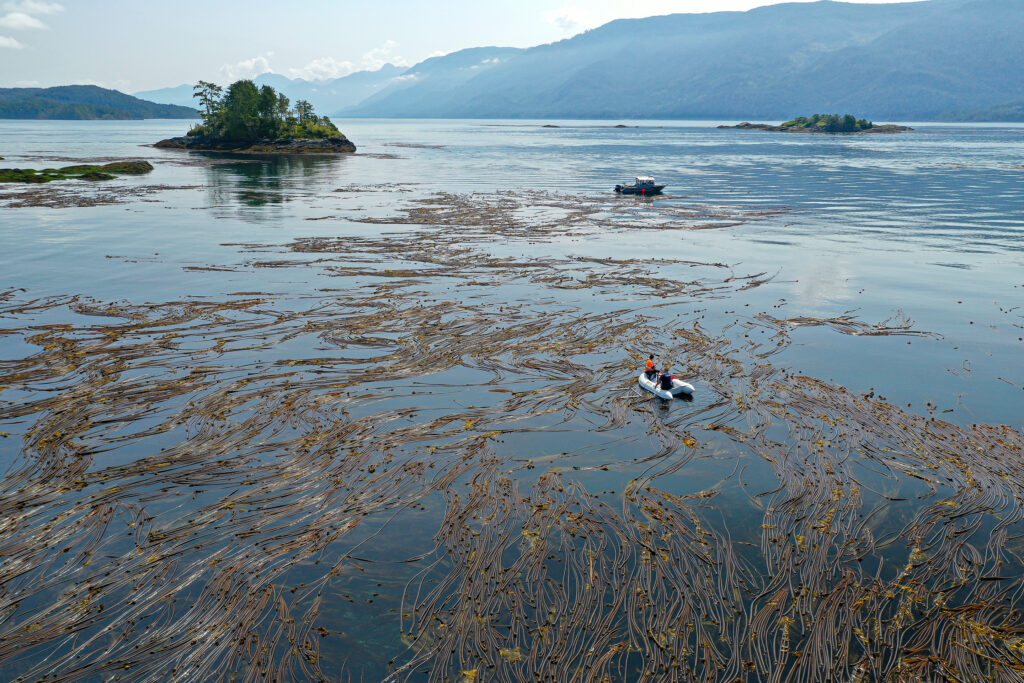
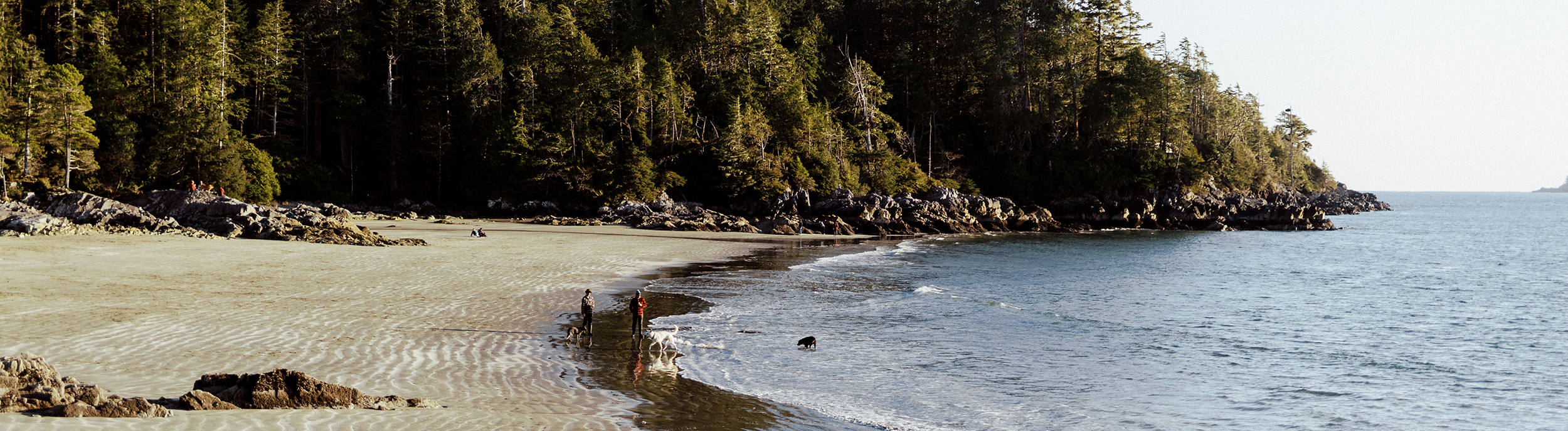
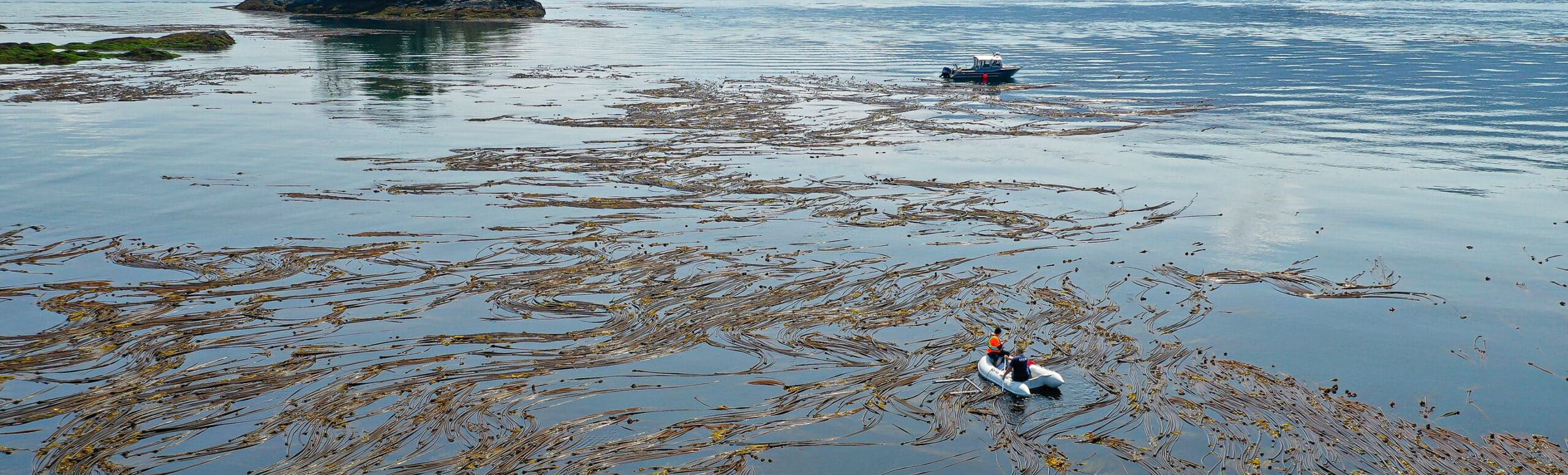
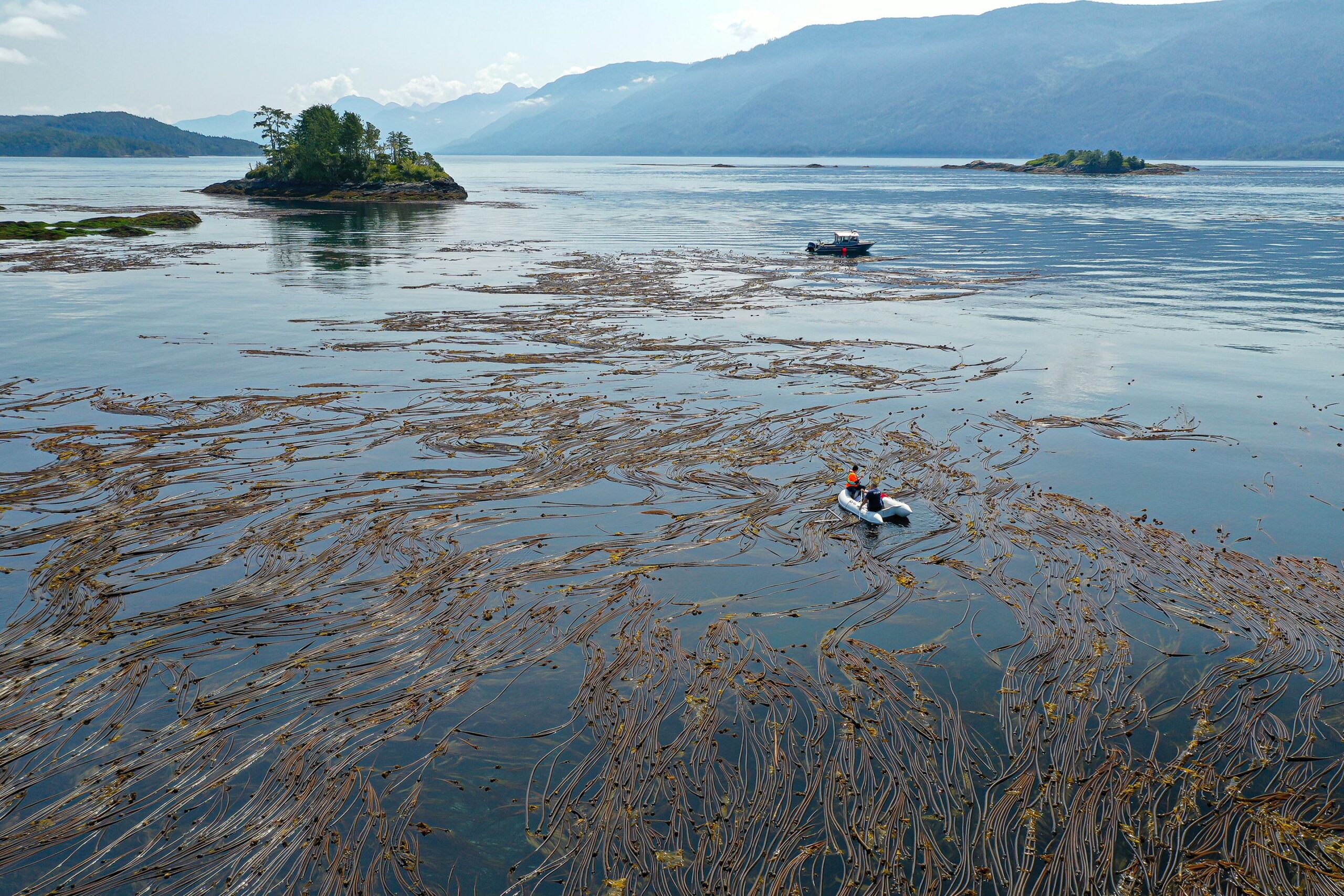
Photo by Markus Thompson, Thalassia Environmental
2. Reflecting on JEDI Knowledge-Sharing Sessions
Each day at IMPAC5 introduced an incredible series of keynote speakers, symposiums, poster presentations, and knowledge-sharing sessions. The presenters and panellists explored timely themes, including managing MPAs, addressing the climate crisis, and advancing the blue economy. In between jumping from session to session, I found myself especially moved by conversations of justice, equity, diversity, and inclusion (JEDI).
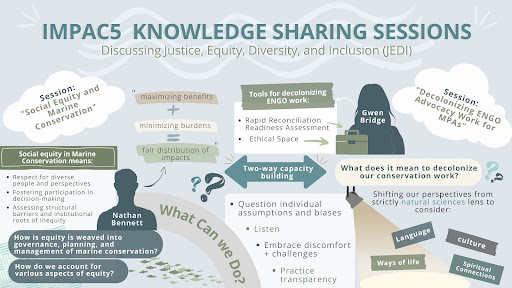
Notes, quotes, and reflection questions I captured from two knowledge-sharing sessions.
I enjoyed the “Social Equity and Marine Conservation” session with Nathan Bennett, Aulani Wilhelm, Natalie Ban, Danika Klieber, María José Barragán, Elise Huffer, and Philip Akins. The panellists shared valuable insight and guidance on how organizations can equitably pursue marine conservation. Our conversation highlighted the gaps and structural barriers to integrating equity in conservation actions while envisioning ways to spotlight the human dimensions of marine conservation.
Kate MacMillan, Ocean Conservation Manager (CPAWS-BC), joined Natalie Groulx (CPAWS), Véronique Bussière (CPAWS/SNAP-QC) and Gwen Bridge to unpack how and what it means to decolonize conservation and advocacy work within the environmental non-governmental organizations(ENGOs). This session was a meaningful opportunity to reflect as an organization and exchange perspectives with other ENGOs around the world.
3. IMPAC5 Ocean Fest: Clay Herring Workshop with Clare Wilkening
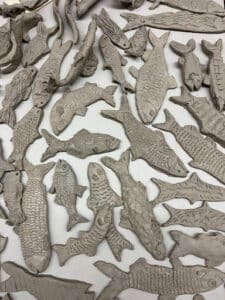
Clay herring creations made by participants at the workshop.
While sessions were happening inside, IMPAC5 Ocean Fest also turned up across Downtown Vancouver. CPAWS-BC hosted a series of events, including a Speaker Series, an interactive Festival Tent, and a photo contest. Our final Ocean Fest event was a ceramic clay herring workshop at the Massy Art Gallery led by local ceramic artist, Clare Wilkening.
This workshop was a welcomed break from the buzzing conference, and a perfect excuse to get my hands dirty. Artists, scientists, families, and community members filled the space. A calming and grounding energy filled the room. Together, we spent the afternoon molding clay herring—each uniquely beautiful— and sharing chatting about artistic practices, community, and conservation. There are deep connections between art and conservation. Bridging these parallels can be a powerful tool to convey important messages of biodiversity loss, evoke feelings of empathy towards nature, and catalyze action for conservation issues.
The clay creations from this workshop will find a home in Clare’s upcoming art installation that celebrates the importance of herring.
Coming out of IMPAC5, I feel heartened and encouraged by our new and renewed commitments to implementing stronger protection standards for MPAs. I’m hopeful that by working together with Indigenous leadership and supporting Indigenous-led conservation efforts, Canada can protect 30% of the ocean by 2023 and more. Everyone has a voice of belonging in shaping the future. And while it’s important to diversify the voices in the room, the voices outside count too. I’m excited to dive deeper into my staff role and build a global network of ocean protection.
The CPAWS-BC’s ocean team will continue doing what we do best. We’re focusing on the best ways to support Indigenous partners as they chart a new path forward for land and water conservation on their territories. We’ll keep bringing our extensive expertise in science communication, map-making and GIS analysis, and community engagement to local areas where big conservation gains are possible. With your continued support, we’ll amplify the stories and voices of people protecting nature in every corner of the province and all along the coastline.
We can’t do this without you. It’s more important than ever that your voice for nature is included in decision-makers’ vision for the future. With your support, we’ll work to ensure these commitments for ocean conservation are fulfilled.
– Will you join me?Subscribe for the latest action alerts, conservation news, events and more right to your inbox.
The 2023 BC Budget was released on Tuesday, February 28. In the weeks leading up to the budget announcement, BCer’s sent messages to BC leaders urging them to increase funding for nature protection. While nature didn’t see the big boost we all hoped for, CPAWS-BC welcomes the positive moves for BC’s parks and the coast.
The budget sets out a vision for collaborative stewardship of lands, waters and marine ecosystems. We’re excited to see the budget build on BC’s recent policy commitments and IMPAC5 announcements to prioritize ecosystem health, protect 30% of lands by 2030 and advance Indigenous-led conservation.
Want to know how the new budget will invest in lands, waters and ocean conservation action in BC?
Here are our top 10 nature notes in the BC Budget:
1) More funding for parks and recreation: $101 million will be provided to BC Parks and Recreation Sites and Trails over three years for capital and operating expenses. This means your favourite parks, trails and campsites will get the funding support they need to protect nature and be more accessible.
2) Co-developing an Indigenous Guardians training program: As part of a $480M three-year skills training plan, funding will be provided to support new Guardian training programs. This will be co-developed with Indigenous Peoples. Indigenous Guardians are the “eyes and ears on the ground” in traditional territories, honouring their stewardship responsibilities and strengthening the protection of land and waters across BC.
3) A commitment to implement the Together for Wildlife Strategy: This strategy aims to advance wildlife and habitat stewardship across BC in partnership with Indigenous Nations. BC has a wealth of biodiversity and this plan recognizes the need for a collaborative, adaptive approach to managing wildlife and habitat.
4) Additional regional Forest Landscape Planning tables: $21 million will be provided over three years to establish eight more regional Forest Landscape Planning tables to expand on the existing four. Forest Landscape Planning tables will be led by the province in partnership with Indigenous Nations to engage stakeholders and local community members. This builds on a suite of recently announced changes to shift forest management in BC to better prioritize ecosystem health, community resiliency and Indigenous values.
5) Jumpstarting a Watershed Security Fund: $100 million will go towards improving watershed security in BC by implementing a Watershed Security Fund. Watershed security is vital for strong communities and ecological health. Clean water is a growing concern within communities on the frontlines of climate change and extreme weather events. Healthy watersheds support climate resilience, reconciliation, local economies and all walks of life.
Photo by Lichen, Troy Moth on Nuchatlaht Traditional Territory.
6) Further investment in land-use planning: BC’s land-use planning budget received a slight boost to advance the modernizing of land-use planning and policy, in partnership with Indigenous Peoples. Additional resources will be necessary to reach the commitments to protect 30% of lands by 2030 and paradigm-shifting approaches to land and resource management are reaffirmed in the budget.
7) More funding for First Nations agreements: Nearly $75 million dedicated to supporting reconciliation initiatives with First Nations including the development of clean energy and natural resources, land purchases and emergency management. This investment bolsters efforts to support Indigenous management of their Traditional Territories and is key to the province’s commitment to protecting 30% of lands by 2030.
8) Additional financial investment in water, fisheries, and coastal policy and planning: The province has allocated $10,355,000 for water, fisheries, and coastal policy and planning, which is a slight increase from the 2022/2023 budget of $7,917,000. The exact distribution of this funding to the different programs is unknown, but CPAWS-BC supports an increase in financial investment towards marine conservation, planning, and stewardship in partnership with Indigenous Nations. The following initiatives are included in this boost:
9) Coastal Marine Strategy: The first BC Coastal Marine Strategy will be a cohesive plan co-developed with Indigenous Nations to ensure the health of marine ecosystems and coastal communities. The conservation outcomes of the Coastal Marine Strategy will reflect efforts to strengthen other provincial natural resource management strategies, such as the Watershed Security Strategy and Wild Salmon Strategy.
“We’re happy with the progress to co-develop the Coastal Marine Strategy, and the announcement today signals that the province remains committed to continuing this important work, ” said Kate MacMillan, Ocean Conservation Manager with CPAWS-BC. “We hope that once the strategy is completed, there will be a continued investment to ensure its delivery. We need to care for marine waters, to support thriving, healthy marine ecosystems and coastal communities for future generations.”
10) Marine Plan Partnership and the Great Bear Sea Marine Protected Area Network: BC and coastal First Nations are leading the Marine Plan Partnership and the implementation of Canada’s first Marine Protected Area Network in the Great Bear Sea. As of February 6, 2023, the implementation of the new MPA Network is within sight. Permanent protections here on the North and Central coasts will benefit marine life and communities now, and forever
Is the 2023 BC Budget everything we hoped for? Not quite, but it sets the stage for a vision we can build on.
It will take all of us together, to secure meaningful protections for nature on the path to 30×30. Thanks for adding your voice to the movement.
–
Take Action! Add your comments to the BC Coastal Marine Strategy questionnaire before April 14, 2023. Your feedback is important and will help shape a healthy coast for future generations.
For interviews, please contact: Skye Vallance – A/Communications Manager, CPAWS-BC skye@cpawsbc.org 604-685-7445 x 22
CPAWS-BC welcomes BC Budget conservation vision, BC Parks and coastal boost
Xʷməθkʷəy̓əm (Musqueam), Sḵwx̱wú7mesh (Squamish) and səlilwətaɬ (Tsleil-Waututh) Territories / Vancouver, BC – The Canadian Parks and Wilderness Society – British Columbia (CPAWS-BC) welcomes today’s crucial budget increase for BC Parks alongside continued investment in the Marine Coastal Strategy and land use planning. The BC Budget emphasizes a positive vision for the collaborative conservation of lands, waters and coastal communities.
“BC has committed to important conservation goals – such as protecting 30% of lands by 2030 – and this budget comes as a signal of hope for the path ahead. Continued investment and resources will be needed to reach these commitments, and work towards effectively protecting lands and waters in partnership with Indigenous Peoples,” said Tori Ball, Terrestrial Conservation Manager with CPAWS-BC.
Today’s budget announcement includes further investments for BC marine conservation. This funding maintains BC’s commitment to co-develop a Coastal Marine Strategy with Indigenous Nations by 2025 and realize Canada’s first marine protected area network for the Great Bear Sea along the Central and North Coasts.
“We’re happy with the progress to co-develop the Coastal Marine Strategy, and the announcement today signals that the province remains committed to continuing this important work, ” said Kate MacMillan, Ocean Conservation Manager with CPAWS-BC. “We hope that once the strategy is completed, there will be a continued investment to ensure its delivery. We need to care for marine waters, to support thriving, healthy marine ecosystems and coastal communities for future generations.”
This budget outlines a continued commitment to safeguard vital ecosystems and prioritize meaningful engagement with Indigenous Peoples, but it falls short of the sizable increase that many conservation groups were hoping for to accelerate climate and biodiversity action. Additional funding to support the protection and stewardship of lands is expected from an upcoming Nature Agreement with the federal government.
“A significant increase to the BC Parks and recreation budget will support beloved trails and campsites, and increase accessibility for people to connect with the lands and waters that make BC unique,” continued Ball. “Safe access to nature is integral to our well-being, as highlighted throughout the pandemic, and it’s encouraging to see this investment prioritized.”
Investing in nature is a direct investment in the well-being of communities and wildlife across BC. The 2023 BC Budget builds on recent policy and funding commitments to prioritize ecosystem health across the province, advance Indigenous-led conservation, and safeguard biodiversity for generations to come.
-30-
For interviews, please contact: Skye Vallance – A/Communications Manager, CPAWS-BC skye@cpawsbc.org 604-685-7445 x 22
About CPAWS-BC The Canadian Parks and Wilderness Society – British Columbia (CPAWS-BC) is part of one of Canada’s oldest non-profit conservation groups. We protect wilderness in every corner of BC and deep into the ocean. We have been defending BC since 1978, and are dedicated to keeping BC’s natural environment thriving forever. Our work to safeguard large parks, protected areas and wildlife corridors has been instrumental in protecting precious places across the province.
February 07, 2023
CPAWS-BC Celebrates Tang.ɢwan — ḥačxʷiqak — Tsig̱is Marine Protected Area Announcement at IMPAC5
Xʷməθkʷəy̓əm (Musqueam), Sḵwx̱wú7mesh (Squamish) and səlilwətaɬ (Tsleil-Waututh) Territories / Vancouver, BC – The Canadian Parks and Wilderness Society – British Columbia (CPAWS-BC) celebrates the memorandum of understanding (MOU) between the Haida Nation, Nuu-chah-nulth Tribal Council, Pacheedaht First Nation, Quatsino First Nation, and the Canadian government for the Tang.ɢwan — ḥačxʷiqak — Tsig̱is Marine Protected Area (MPA), announced today at the 5th International Marine Protected Area Congress.
“The signing of this MOU is an important step toward protecting this region, which is spiritually and culturally significant for the partner Indigenous Nations,“ said Kate MacMillan, Ocean Conservation Manager. “This agreement could be used as a template for future MOUs that partner First Nations and the federal government for conservation.”
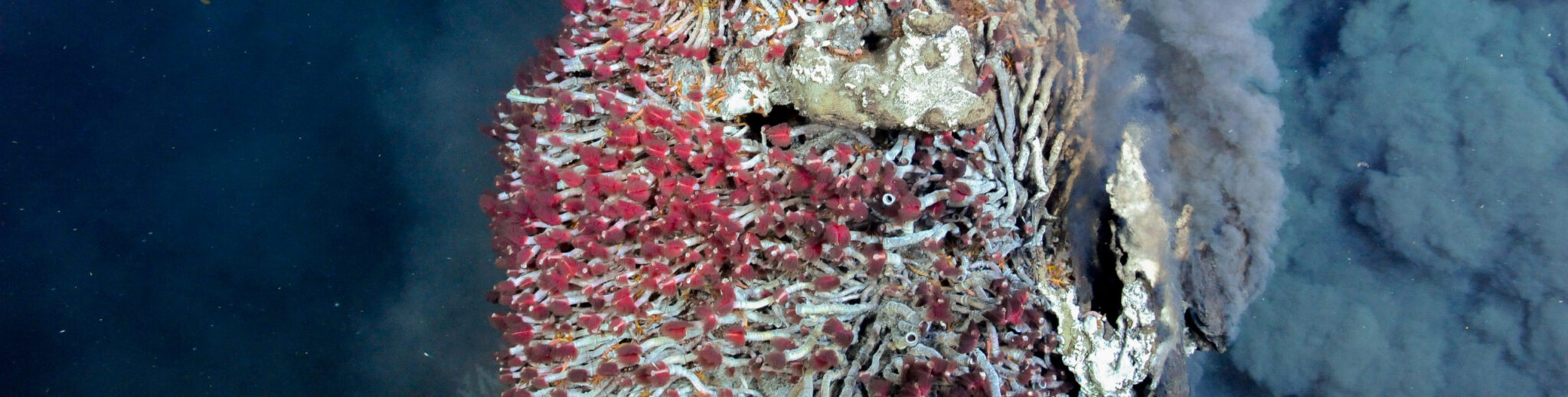
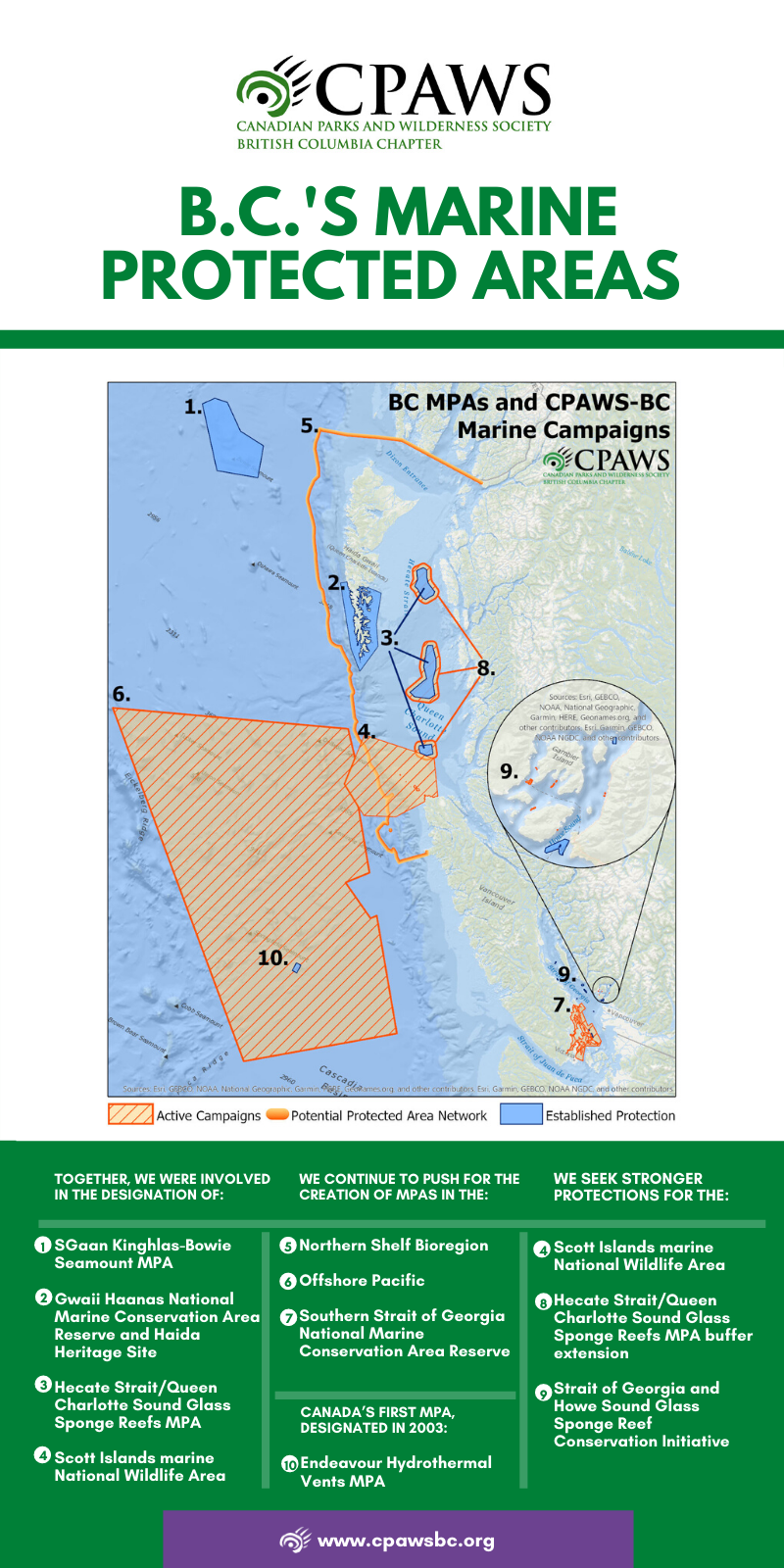
The Tang.ɢwan — ḥačxʷiqak — Tsig̱is MPA will cover 133,000 square kilometres, an area four times the size of Vancouver Island. The Endeavour Hydrothermal Vents MPA, now contained within Tang.ɢwan — ḥačxʷiqak — Tsig̱is was originally protected in 2003. This marked the first time Canada used the Oceans Act for MPA designation purposes. Now, twenty years later, more of this deepsea oasis that includes more hydrothermal vents and towering seamounts will be protected.
“These underexplored ecosystems, three kilometres beneath the ocean surface, are likely home to marine life found nowhere else in the world,” says MacMillan.
Since 2017, a large portion of the Tang.ɢwan — ḥačxʷiqak — Tsig̱is MPA footprint was closed to fishing and contributed to Canada’s 30 percent ocean protection target as an Other Effective Conservation Measure (OECM).
Once this MPA is legislated, Canada’s strict minimum protection standards will be applied, meaning bottom-trawling, dumping, oil and gas activities, and deep-sea mining will be prohibited. This will lead to stronger protection for this unique, deep-sea ecosystem.
”When the assessment tool MPA Guide was applied to the five existing Ocean Act MPAs, more than 60 percent of BC’s marine protected area waters are not effective at protecting biodiversity. We need these minimum standards applied to all new and existing MPAs to safeguard biodiversity and fight climate change.” says MacMillan.
CPAWS-BC and other conservation organizations have supported this work over the past few years. We congratulate the four First Nations for their leadership throughout this process, as well as the federal government, all stakeholders, and communities. CPAWS-BC looks forward to continuing to support the establishment to protect this important part of the ocean with a collaborative management structure.
Public consultation on the draft regulations, published in Canada Gazette 1, will begin on February 18, 2023, and extend for 30 days.
Kate MacMillan Ocean Conservation Manager, CPAWS-BC
Government of Canada and coastal First Nations announce progress to protect a large ecologically unique ocean area off the Pacific West Coast. Nuu-chah-nulth Tribal Council, Council of the Haida Nation, Pacheedaht First Nations, Quatsino First Nation, with Fisheries and Oceans Canada. Feb 07. 2023. News release. https://nuuchahnulth.org/sites/default/files/news/NR__ThT_IMPAC5.pdf
Backgrounder: Tang.ɢwan – ḥačxʷiqak – Tsig̱is Marine Protected Area. Fisheries and Oceans Canada. Feb 07, 2023. Retrieved from: https://www.canada.ca/en/fisheries-oceans/news/2023/02/tangwan–hacxwiqak–tsigis-marine-protected-area.html
CPAWS-BC Celebrates the Endorsement of the Marine Protected Area Network Action Plan Announced at IMPAC5
Xʷməθkʷəy̓əm (Musqueam), Sḵwx̱wú7mesh (Squamish) and səlilwətaɬ (Tsleil-Waututh) Territories / Vancouver, BC – The Canadian Parks and Wilderness Society – British Columbia (CPAWS-BC) congratulates First Nations, federal and provincial partners on announcing the endorsement of the Marine Protected Area (MPA) Network Action Plan for the Great Bear Sea at the 5th International Marine Protected Area Congress on February 5, 2023.
“After years of supporting this important initiative we’re thrilled to witness this announcement and critical milestone in the journey of the MPA network,” said Meaghen McCord, CPAWS-BC Executive Director, “endorsement of the Action Plan is the much-needed green light to now establish a network that includes new protected areas and stronger protection for some existing sites.”
The Great Bear Sea, also known as the Northern Shelf Bioregion, is a vast ocean area off the BC coast. The Great Bear Sea hugs the shores of the Great Bear Rainforest, starting at the northern tip of Vancouver Island, along the Central and North Coasts, and encompassing Haida Gwaii. This region is home to culturally and ecologically important wildlife, including humpback whales, sea otters, herring, salmon, and glass sponge reefs, and is central to the cultures and economies of communities who live there. The marine ecosystems along the coast have been protected and cared for by First Nations for millennia.
Previous delays in the establishment of the MPA Network have meant that overall ecological health and species population numbers have continued to decline. Federal and Indigenous governments were required to establish new fishing closures throughout the region to protect dwindling stocks, and climate change – resulting in devastating marine heatwaves – has exacerbated this.
Discussions and work to establish an MPA Network in this region have been underway for many years. Led by First Nations, in partnership with the Canadian and BC governments, this collaboration has created a conservation plan to protect the coastal ecosystems that communities depend on. Over the years, this plan has been shaped by frequent and detailed consultation with communities and stakeholders.
“Evidence clearly shows that Indigenous-led, strongly protected and effectively managed MPAs have many benefits for people, biodiversity and ecosystems,” says McCord.
Once completed, the MPA Network will cover around 30,000 km2. This Indigenous-led plan, which weaves Indigenous knowledge systems and western science, creates a pathway for future MPA network processes and is set to become a globally recognized initiative. CPAWS-BC congratulates First Nations for their leadership in the MPA Network process, as well as federal and provincial governments, and all stakeholders and communities involved to date. We look forward to continuing this work together, ensuring the health of these waters for generations to come.
Meaghen McCord CPAWS-BC Executive Director
For direct inquires about the MPA Network, please contact:
Bessie Brown – Communications Manager, Coastal First Nations – Great Bear Sea Initiative bbrown@coastalfirstnations.ca 604-696-9889
For all other inquiries: Skye Vallance – Communications Manager (Acting), CPAWS-BC skye@cpawsbc.org 604-685-7445 x 22
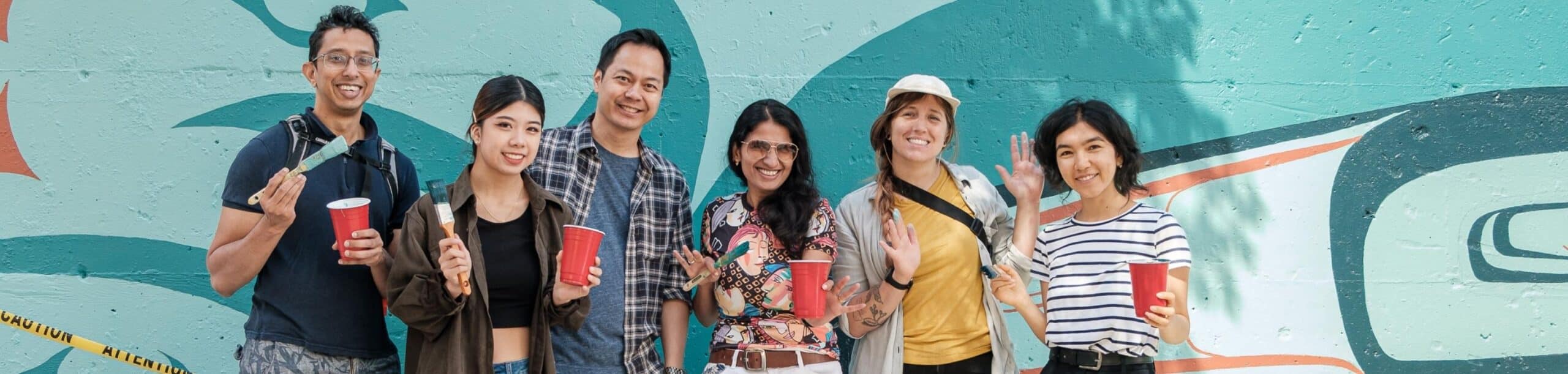
Photo: Mama Inlet by Markus Thompson, Thalassia EnvironmentalCPAWS-BC staff and board help paint murals ahead of Van Mural Fest 2022. Photo: Sabrina Miso Creative
Painting the town blue for ocean conservation
Find out where you’ll find these ocean-inspired murals in Downtown Vancouver as part of Van Mural Fest 2022
Looking for fun things to do in Vancouver this summer? If you love the ocean – we’ve got two special treats for you this summer! Through lunchtime strolls and cycling commutes to our downtown office, the CPAWS-BC team started dreaming up ways to splash Nature art on the blank city walls about five years ago. This year, we’re thrilled to connect with Vancouver Mural Festival (VMF) and three Indigenous artists to create two massive ocean-inspired murals in Downtown Vancouver.
The artists have woven their culture and shared values to depict stories from the Salish Sea, along the Central Coast and up to Haida Gwaii and the North Coast. Both murals celebrate that while we may come from different places, it’s our shared responsibility to come together as one to protect our ocean and the coast for all life that depends on it. You can read more about the artists and the mural statements below.
The marine waters depicted in these murals have important conservation initiatives in progress. In the Salish Sea there is a proposed National Marine Conservation Area reserve for the Southern Strait of Georgia, learn more about the importance of this region by visiting Home of the Orcas. And in the waters around Haida Gwaii and along the BC coast from the Alaskan border to Northern Vancouver Island there is a process to create a network of marine protected areas. Learn more about the Great Bear Sea and how you can help support protecting these waters for future generations.
Thank you to the entire team at Vancouver Mural Festival for your support and guidance to bring these murals to life. These murals were made possible by generous support of the Doherty Family, BIA Vancouver, and IMPAC5.
The winds and the waters will always call us home
Photo: Mavreen David
The winds and the waters will always call us home
By: Ocean Hyland/ shḵwen̓/ ts;simtelot
Printed vinyl located on lands and waters of the xʷməθkʷəy̓əm (Musqueam), Sḵwx̱wú7mesh (Squamish), Sel̓íl̓witulh (Tsleil-Waututh) Nations at 999 Canada Place in Downtown Vancouver, BC.
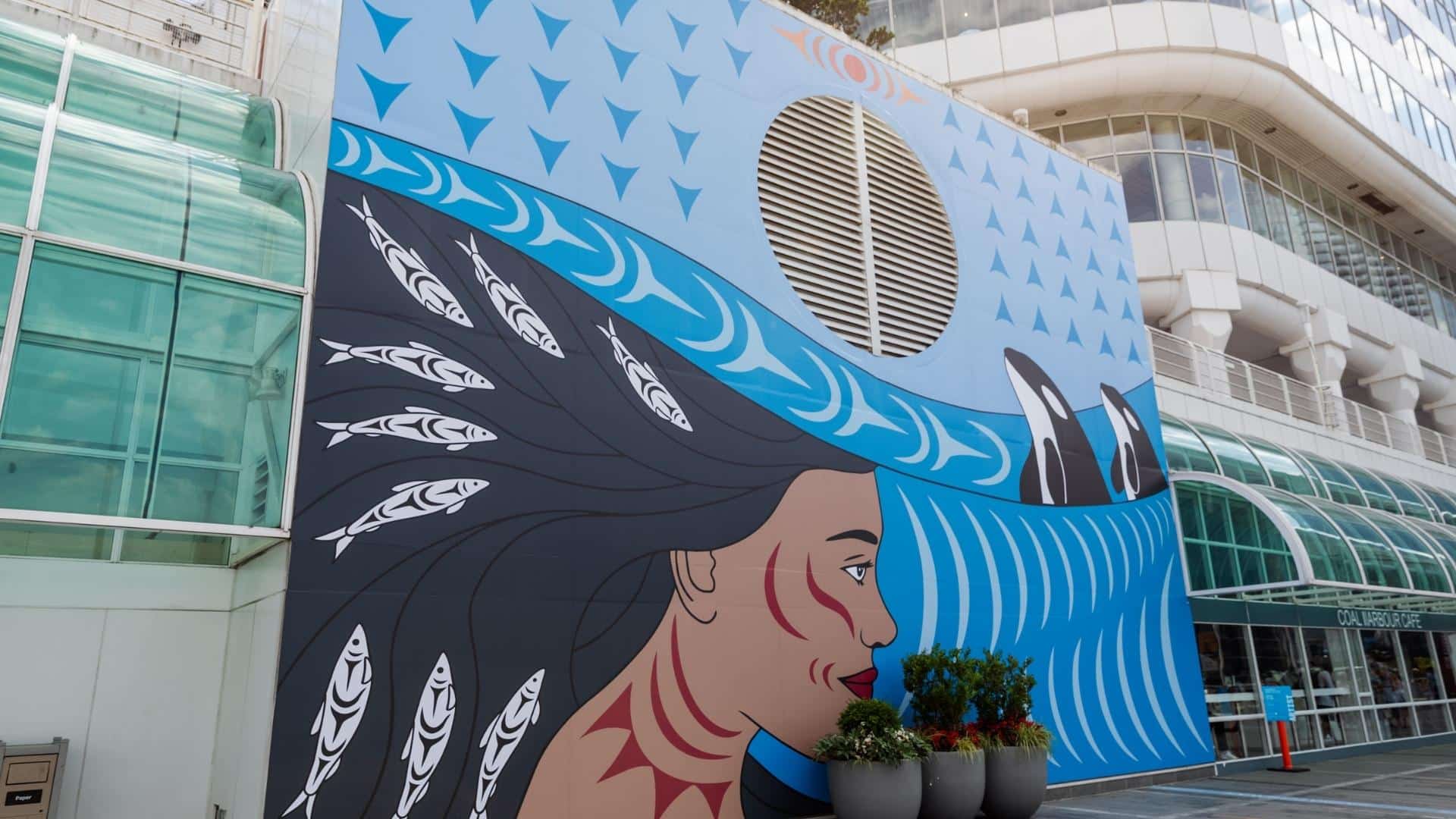
Herring lines the hair of the being connected to the sea. The visual representation of the changing tides is seen in front of her using Coast Salish elements, and an orca can be seen dancing in the current above.
Pacific herring are a staple food source for many inhabitants of the Salish Sea, including orcas and people. It is important to maintain a balance among the many species that live in the ocean. Our environment has looked after us, and although it remains generous, our relationship with it must be reciprocal. As much as we take, we must also give back.
Above the water line, droplets of the Salish Sea are absorbed by the sky so they can transform and make their way down as rain. Trigons represent the space where the water is called up to the sky and sent back down to water the plants, trees, and streams where the salmon are called to return. The moon sits high in the sky, and the Coast Salish eye mimics the sun and oversees the work done in our world. All life is connected: as the moon travels the sky, the tides flow, the wind blows, rain falls, the orcas are fed, and our people are happy. This reciprocal relationship ensures the well-being of us all.
Ocean Hyland is an artist who works in the realms of painting and digital design. Along with her practices, she enjoys participating in language revitalization of Coast Salish languages. Ocean currently lives in Qualicum Bay on Vancouver Island.
As a young woman, Ocean received the ancestral name ts;simtelot, which was shared with her by her Mother. This name has been passed down through her family on her Cheam side. On her matrilineal side, she is Tsleil-Waututh, Squamish, Cheam, Hawaiian, and Chinese. Through her father, she is Scottish and Irish. The richness and diversity of her cultural heritage is what inspires Ocean in her many art practices.
Ocean has studied at both Native education college specializing in NWC jewelry arts, and at Simon Fraser University, focusing on the sḵwx̱ wú7mesh sníchim, building up her proficiency in one of her mother tongues. She has also gained valuable knowledge apprenticing with creators Zachary George and Aaron Nelson Moody.
Gud Gad iis & Nucama:t
Photo: Sabrina Miso Creative
Gud Gad iis & Nucama:t | Coming Together & Working as One
By: SGidGang.Xaal / Shoshannah Greene and Jessie Recalma/ Xwulqsheynum
Located on the lands and waters of the xʷməθkʷəy̓əm (Musqueam), Sḵwx̱wú7mesh (Squamish), and Sel̓íl̓witulh (Tsleil-Waututh) Nations at 1111 Hastings Avenue in Downtown Vancouver.
The Haida word, “Gud Gad iis” translates to “Coming Together”, with the meaning behind it being “Meeting people to discuss and talk”.
Inspired by the efforts to bring Indigenous leadership together for ocean conservation, this mural by SGidGang.Xaal / Shoshannah Greene and Jessie Recalma/ Xwulqsheynum reflects the collaborative approach to strengthen our combined efforts in working together to protect our home.
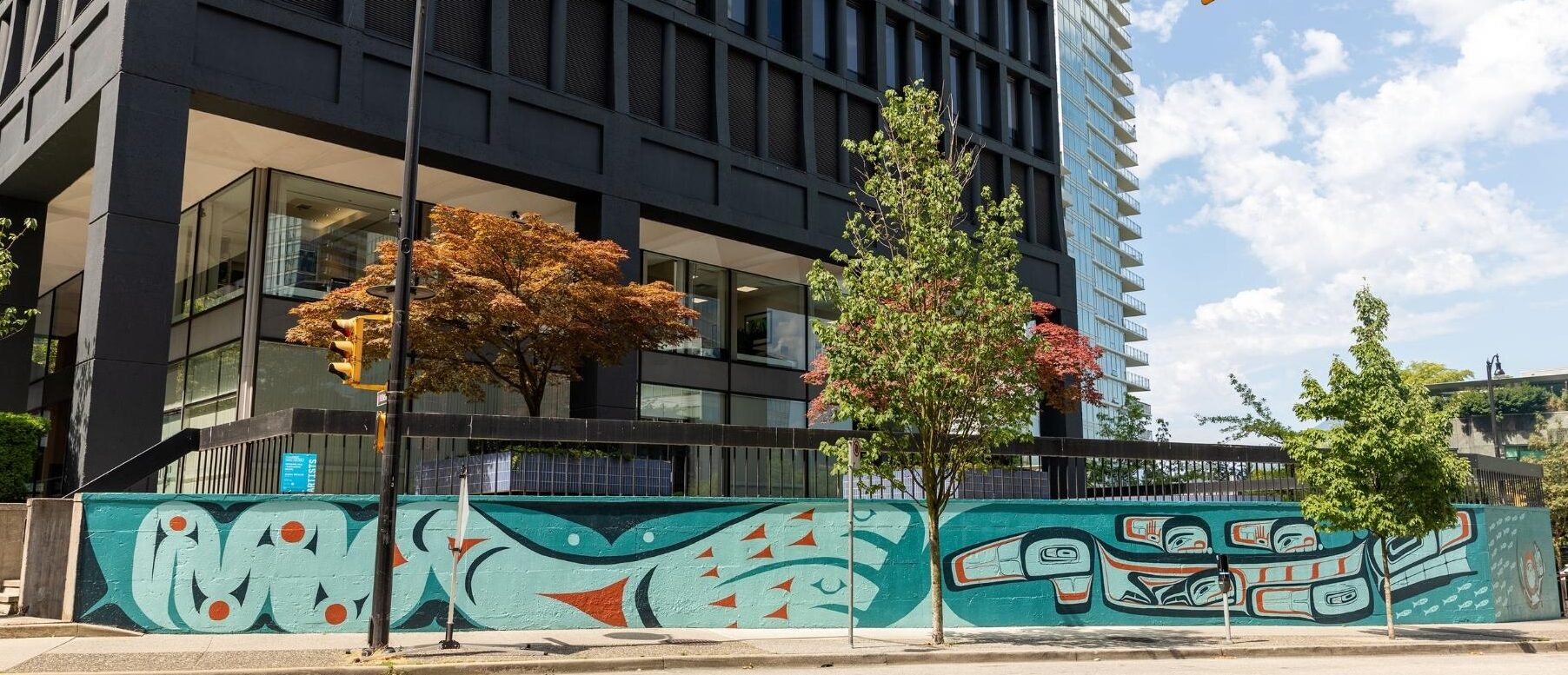
The design depicts a SGaana Saahlan Sdings, a Two-Fin killer whale. Inside the body are human figures, one in each dorsal fin and one in the belly. Together, they are traveling south from Haida Gwaii into Salish waters.
Welcoming them is their host, a two-headed sea serpent, sʔi:ɬqəy̓, who guides them through the mouth of the Fraser River.
A school of oolichon, an anadromous species of smelt, swims through the waters. A sea otter playfully holds the artist’s names like a sea urchin.
Learn more about how you can support a network of marine protections for the Great Bear Sea on the North and Central Coasts.
Shoshannah Greene was born and raised on Haida Gwaii, on the traditional Territory of her paternal ancestors. She was adopted into the Cumshewa Eagle Clan and given the Haida name SGid Gang.Xaal, meaning wild rose.
An appreciation of her culture and art came from an amalgamation of watching her father carve jewellery, attending local art classes, and being inspired daily by the natural surroundings.
Since childhood, Shoshannah loved to share stories and express her thoughts visually. Following graduation, she chose to pursue a Bachelor’s of Media Arts with a major in Animation at Emily Carr University of Art + Design. Today, her work focuses on combining hand-drawn animation with watercolour backgrounds, centering on the Super Naturals within Haida culture. Connecting the physical experience of the natural surroundings with Haida Supernaturals, thereby establishing a perspective on the juxtaposition of her natural world with Haida cosmologies. From what she sees around her, plants and animals, she draws a connection to what she feels and believes: everything has power and flowing energies. Having studied animation, she is using computer software to extend the ideas of supernaturals inhabiting the natural world with movement and character traits. This allows her to explore movement within natural cycles; her work concentrates on using light as a structural element in both animation and watercolor painting she is inviting viewers of her work to view natural elements as more than just representation, and to allow for the possibility of a deeper connection to their surroundings nourishing mind, body and spirit.
Jessie Recalma is a Coast Salish artist and a member of Qualicum First Nation. Jessie is a self-taught artist who learned watching and listening to the stories of his grandfather. One day Jessie had come across a carving knife in his grandfather’s desk and was given the knife to take home to try. This knife would be the first of many carving tools that are now used to create a unique blend of art that has a contemporary feel to it with a significant influence from the older generations. While carving is one of Jessie’s favourite mediums to work with, he also devotes his time to painting, Indigenous languages, and digital design. Jessie currently works privately out of his studio in his private studio in his house.
The name Saatlam Arts is rooted in one the name of an old village site “Saatlam” or “Place of Green Leaves”. Jessie felt it suitable to connect this old place name to his work as a nod to the ancestors of his home Territory.
Sign up to learn more about how you can help protect the Salish Sea, the Great Bear Sea and more.
Unceded Coast Salish Territory/Vancouver, BC – Today, the Minister of Fisheries, Oceans and the Canadian Coast Guard, the Honourable Bernadette Jordan, announced that Canada has joined the United Kingdom and other countries in the Global Ocean Alliance. Canadian Parks and Wilderness Society – British Columbia (CPAWS-BC) applauds Canada’s active role in the protection of at least 30 percent of the global ocean through the establishment of marine protected areas (MPAs) and other effective area-based marine conservation measures by 2030.
In partnership with Indigenous Peoples, provinces and territories, and environmental and industry organizations, the Canadian government has made huge strides to protect almost 14 percent of our ocean. The bigger task remains to reach their goal of 25 percent ocean protection by 2025 and 30 percent by 2030.
“This is a pivotal moment for Canada as a global leader for ocean action” says Ross Jameson, Ocean Conservation Manager for CPAWS-BC. “We look forward to working with the Minister to help Canada reach 30 percent ocean protection by 2030 with effective marine protected areas in BC and beyond.”
Decades of harmful human practices including overfishing, oil and gas activities, pollution (including noise, chemicals, and plastics), and physical disturbance such as ship strikes and bottom trawling threaten ocean life and human well-being. MPA’s offer a natural solution to prevent further destruction and support a healthy ocean that will provide for us for generations to come.
By protecting entire ecosystems, MPAs can protect the full diversity of marine life and their habitats. MPAs can help depleted ocean life recover, and support sustainable fisheries. Kelp forests, eelgrass and other shoreline ecosystems can protect coastal communities and shorelines from erosion and sea-level rise.
BC has been at the forefront of establishing Canada’s MPAs. The Endeavour Hydrothermal Vents MPA west of Vancouver Island was the first MPA created under the Oceans Act in 2003. The Gwaii Haanas National Marine Conservation Area Reserve and Haida Heritage Site is a prominent example of Indigenous-led, cooperatively managed MPAs in Canada.
We also have a large part to play in getting Canada to our 30 percent ocean protection by 2030 target with several MPAs in the planning process. The Offshore Pacific Area of Interest or Deepsea Oasis off the west coast of Vancouver Island will protect unique deep sea ecosystems and cover almost 2.5% of Canada’s ocean. The proposed Southern Strait of Georgia National Marine Conservation Area Reserve will safeguard important feeding waters for the critically endangered Southern Resident killer whales. Led by Indigenous communities, Canada’s first MPA network along BC’s north and central coasts will protect whales and other migrating ocean animals while also ensuring healthy coastal communities for generations.
-30-
For interview contact Ross Jameson, Ocean Conservation Manager Canadian Parks and Wilderness Society – British Columbia 778-953-2372 ross@cpawsbc.org
We use cookies and other similar technologies such as pixels and web beacons (“Cookies”) for various purposes, such as to ensure our website functions properly, enhance your browsing experience by remembering your preferences and provide personalized content and advertisements.
Functional
Always active
The technical storage or access is strictly necessary for the legitimate purpose of enabling the use of a specific service explicitly requested by the subscriber or user, or for the sole purpose of carrying out the transmission of a communication over an electronic communications network.
Preferences
The technical storage or access is necessary for the legitimate purpose of storing preferences that are not requested by the subscriber or user.
Statistics
The technical storage or access that is used exclusively for statistical purposes.The technical storage or access that is used exclusively for anonymous statistical purposes. Without a subpoena, voluntary compliance on the part of your Internet Service Provider, or additional records from a third party, information stored or retrieved for this purpose alone cannot usually be used to identify you.
Marketing
The technical storage or access is required to create user profiles to send advertising, or to track the user on a website or across several websites for similar marketing purposes.