New survey finds winter won’t be putting a chill on recreation for British Columbians
For Immediate Release December 14, 2020
New survey finds winter won’t be putting a chill on recreation for British Columbians
Survey shows enthusiasm for winter activities but concerns about park preparedness.
Traditional territories of the Coast Salish Peoples/Vancouver, BC — A new online survey from the Canadian Parks and Wilderness Society – BC Chapter (CPAWS-BC) found that British Columbians expect busier parks and trails as more people head outdoors this winter. This new survey draws out concerns around long-standing issues created by years of underfunding coupled with increasing visitor numbers in BC’s provincial parks.
“This past summer we saw a spike in the demand for outdoor adventures, and all signs point to outdoor enthusiasts across the province keeping the good times outside rolling this winter,” says Tori Ball, Terrestrial Campaigner with CPAWS-BC. “It’s essential that we make sure people can access parks and trails safely as the outdoors continue to provide comfort and joy through a challenging holiday and winter season.”
Key findings of CPAWS-BC’s new survey include:
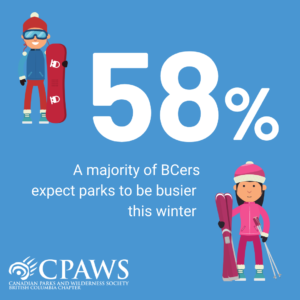
People expect busier parks this winter: A majority (58%) of people anticipate parks will be busier this season
24% of respondents said that, given travel restrictions, they’re going to try a new winter activity this season. The most popular new activities were cross-country skiing and snowshoeing.
Respondents said they were either somewhat, quite or extremely concerned about these top issues:
70% of people were concerned about their fellow park visitors being underprepared for winter conditions.
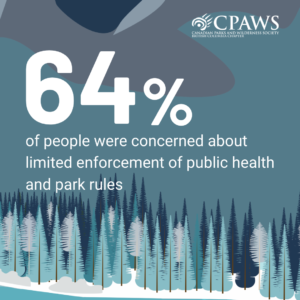
64% of people were concerned about limited enforcement of public health and park rules.
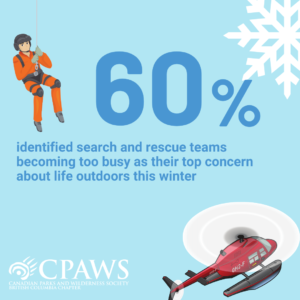
60% of people were concerned about search and rescue teams becoming too busy.
More education and information are key to success: Among the top recommendations to improve safety are more staff in parks, better signage and more education to the general public about conditions, risks and proper gear.
Winter brings shorter days, avalanche risk, as well as cold and quickly changing temperatures, which means that recreation comes with considerably more risk to unprepared visitors than summer adventures.
Ball continues, “long term lack of funding of our parks has left them ill-equipped to handle crowds at the best of times. It is critical that we get more staff into parks to promote safety and make sure visitor infrastructure is in place, and avoid putting more pressure on volunteer search and rescue teams.”
This survey was conducted online between December 2 and 6. Responses were collected from 1058 British Columbians, with a 95% confidence level and a margin of error of plus or minus (±) 3%.
CPAWS-BC continues to advocate for increased funding to improve the management and increase staffing essential to a robust and healthy provincial park system.
– 30 –
For interviews, contact: Tori Ball, Terrestrial Campaigner, CPAWS-BC tori@cpawsbc.org (604) 685-7445 x24
Resources
About CPAWS
The Canadian Parks and Wilderness Society (CPAWS) is Canada’s only nationwide charity dedicated solely to the protection of our public land, ocean, and freshwater, and ensuring our parks and protected areas are managed to protect nature. Since 1963, CPAWS has played a leading role in protecting over half a million square kilometers. Our vision is to protect at least half of Canada’s public land and water in a framework of reconciliation – for the benefit of wildlife and people.
The CPAWS British Columbia chapter (CPAWS-BC) works to protect wilderness in every corner of BC and deep into the ocean. We have been defending BC since 1978, and are dedicated to keeping BC’s natural environment thriving forever. Nature is BC’s best hope. Visit: cpawsbc.org | Follow: @CPAWSbc
For interviews, contact: Tori Ball, Terrestrial Campaigner Canadian Parks and Wilderness Society, BC Chapter tori@cpawsbc.org (604) 685-7445 x24
FOR IMMEDIATE RELEASE
August 5, 2020
Traditional territories of the Coast Salish peoples/Vancouver, BC — The Canadian Parks and Wilderness Society, British Columbia (CPAWS-BC) is applauding a new initiative to hire young people into conservation jobs in BC. These new jobs, announced today by Environment Minister George Heyman, will help to safeguard nature across the province.
“We’re happy to see more conservation jobs being created for young people at a time when our park system needs more support,” says Tori Ball, Terrestrial Campaigner with CPAWS-BC.
“In the short term, these new jobs will help manage the impacts of increasing visitation on the outdoor places we love so much, by addressing long standing capacity issues within BC Parks,” she adds.
BC’s provincial parks were forced to shut down this spring due to concerns with understaffing and overcrowding, following a recent budget cut to operations earlier this year. Decades of underfunding to BC Parks has created a concerning shortage of staff as well as a significant backlog of maintenance issues and major delays in management planning for parks.
“These new temporary positions will help provide much-needed capacity to support overworked park rangers, which will better safeguard nature and improve people’s experiences in the outdoors,” says Ball.
“We hope to see continued investment in nature-based jobs and a commitment to a longer-term capacity increase for BC Parks, as part of the overall strategy to recover the province’s economy,” she adds.
–30–
For interviews, contact:
Tori Ball, Terrestrial Campaigner Canadian Parks and Wilderness Society, BC Chapter tori@cpawsbc.org (604) 685-7445 x24
Canadian Parks and Wilderness Society – British Columbia Chapter (CPAWS-BC) protects wilderness in every corner of BC and deep into the ocean. CPAWS-BC supports the creation of large, well-managed, connected protected areas where native plants and animals thrive, now and forever; and where people and communities can live off the land and ocean without impacting the ability of future generations to do the same.
In the past 50+ years, CPAWS has played a lead role in protecting over half a million square kilometres – an area bigger than New Brunswick, Newfoundland and Labrador put together.
For interviews, contact: Tori Ball, Terrestrial Campaigner tori@cpawsbc.org (604) 685-7445 x24
New report highlights opportunity to put nature protection at the heart of economic recovery in Canada
For Immediate Release
July 15, 2020
Unceded Coast Salish Territory/Vancouver, BC — A new report from the Canadian Parks and Wilderness Society (CPAWS) recommends that nature protection is put at the heart of Canada’s COVID-19 recovery strategies. The report highlights the enormous potential of BC’s provincial parks to provide accessible and affordable outdoor activities, and outlines urgent challenges posed by decades of underfunding.
“It’s become very clear that BC’s parks are essential to our health and well-being. Safe, accessible outdoor recreation in parks is a proven way to boost mental health and reduce stress,” says Tori Ball, Terrestrial Campaigner with CPAWS-BC.
“Unfortunately, decades of funding for BC’s parks has left communities with inequitable access to nature, and continues to put wildlife at risk,” she says.
The BC Parks budget was cut by 4% this year, exacerbating issues such as understaffing across the province. This has restricted or cut core functions such as monitoring and enforcement, research, and education.
The provincial and federal governments are making decisions on spending to restart the economy and recover from the economic downturn caused by COVID-19. CPAWS-BC is advocating for an investment of economic recovery funding into BC’s parks to better support the needs of communities across the province.
“This is our chance to get it right. We know that nature conservation is a driver of economic growth and provides essential community benefits that help build a resilient global economy,” says Ball.
”Now more than ever, we need to invest in these places so that our communities will be more resilient and better supported in the long run,” adds Ball.
CPAWS-BC’s recommendations to the Government of British Columbia:
Invest immediately in BC Parks, increasing staff capacity for visitor management, ecological monitoring, and management planning to better recognize the critical role that parks play in supporting our health, our communities, and our environment.
Support Indigenous-led conservation initiatives that enable reconciliation with Indigenous nations, protection and recovery of species at risk, and build sustainable long-term jobs in rural and remote communities
–30–
For interviews, contact: Tori Ball, Terrestrial Campaigner tori@cpawsbc.org (604) 685-7445 x24
Traditional territories of the Coast Salish peoples, Vancouver BC — A new online survey from the Canadian Parks and Wilderness Society – BC Chapter (CPAWS-BC) confirms that parks are a key priority for British Columbians, and that 73% want the BC government to increase funding. Parks present affordable and accessible opportunities to spend time outdoors, which has consistently been a top recommendation from BC’s Provincial Health Officer Dr. Bonnie Henry.
“As more people turn to parks through this pandemic, concerns for the health of our parks are becoming increasingly connected with concerns for the health of British Columbians,” says Tori Ball, Terrestrial Campaigner with CPAWS-BC.
“This week saw a record-breaking number of camping reservations with BC Parks and widespread challenges in accessing the online reservation system because of the surge in interest,” says Ball. “This, along with the new survey results, underscores the important role parks are playing in supporting communities through the current public health crisis.”
It also highlights an urgent need to address long standing issues with chronic underfunding of the parks system. For decades, the province has struggled with increasing visitation, while trying to protect wildlife and nature in these special places. BC Parks once again had its budget cut by 4% this year, leading to understaffing across the province that has restricted or cut core functions such as monitoring and enforcement, research, and education.
“Decisions are being made right now about how BC will spend $1.5 billion in economic stimulus funding. This is a huge opportunity for the province to recognize the value of parks for the province’s health, and economy,” says Ball.
“Investing some of this funding into the park system to better support what British Columbians are asking for is a no-brainer, and something that will pay off in the long run,” she adds.
Key findings of the survey include:
Access to nature provides mental health benefits. 94% of respondents said access to nature is important to their mental health.
Supporting parks supports communities.75% of respondents ranked the reopening of parks as a priority in BC’s pandemic response plan.
Investing in parks should be part of BC’s Restart Plan. 71% of respondents support an immediate investment of economic stimulus funding into BC Parks for jobs and park infrastructure projects that will improve visitor experience and better support health and safety of park users.
British Columbians support a long-term investment in parks. 73% of respondents support more funding for BC Parks in the long term to protect wildlife and nature, and to support visitor health and safety.
Please excuse the dramatic (read: clickbait) title…
Here at CPAWS-BC, we spend a lot of time and energy trying to help people get outside safely. The science behind the benefits of spending time outdoors is solid. Being outside can boost energy and creativity, improve your mood, and provide free aromatherapy. One study from the American Academy of Ophthalmology found that children with outdoor recesses had a reduced risk of nearsightedness.
Many people in Greater Vancouver base their weekend plans around time outside. A province that boasts the most diverse parks system in the country also has a great enthusiasm for outdoor recreation. Hopeful park visitors have recently been given a different message from multiple park agencies with the closing of parks of all types including provincial and federal parks. In alignment with our health authorities, we the “parks people” are also asking that you and your families don’t go to the parks.
Travelling to towns with terrific tourism options is a great way to spend your weekends and support our neighbours, yet right now it puts them at risk. An influx of visitors threatens not only to spread the novel virus COVID-19, but to overwhelm the capacity of smaller, rural hospitals.
Squamish and Whistler have both issued statements asking visitors to stay away, for now. These sentiments have been echoed from Tofino all the way down to Bishop, California. When these communities are open for business, we encourage you to head out and experience their trails, and stay for a while to enjoy other food and fun they have to offer. But right now, please stay put.
Just because you aren’t travelling to hike up Black Tusk or camp in Golden Ears this weekend doesn’t mean you need to seperate yourself from nature. There are cherry blossoms popping out across many streets in Vancouver and Victoria. My personal favourite springtime tree, the forsythia, is bursting with yellow flowers.
Photo: Forsythia in bloom.
If you’ve got a window, you’ve got the opportunity to become a birder. Spring is one of the best times as migratory birds are coming back to their northern ranges. Check out 18 common birds in BC. Download one of these apps recommended by Bird Watching HQ that can help you identify birds.
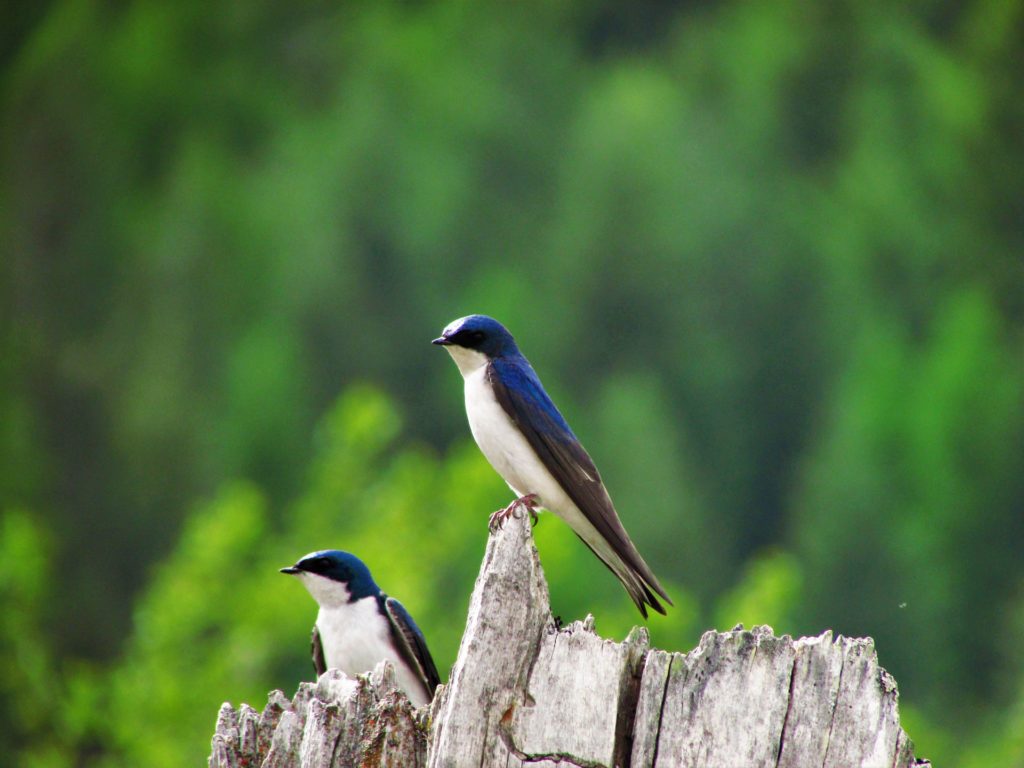
Photo: Tree swallows
Your afternoon walk doesn’t need to be in a wooded area to still reep the benefits of getting outside. Natural sunlight (in moderate levels) helps to mitigate pain and provides you with Vitamin D, helping you to absorb calcium, prevents osteoporosis and reduces inflammation.
Our public health officials are saying this physical distancing is “for now.” This isn’t easy, shifting our plans and normal ways of being. It pains me to ask the CPAWS community of nature lovers to stay away from the majestic, awe-inspiring parks system.
Like many of you, I have summer camping reservations that are sitting in limbo. The best chance for all of us to be able to get outside and connect with each other in nature is to forgo this in the short-term.
Note: CPAWS-BC is not a public health organization. This information was developed based on current information from the BC Centre for Disease Control. Please consult your local health authority for advice and updates in your area.
Cover Image by Tori Ball
You can find a list of federal and provincial closures from:
We use cookies and other similar technologies such as pixels and web beacons (“Cookies”) for various purposes, such as to ensure our website functions properly, enhance your browsing experience by remembering your preferences and provide personalized content and advertisements.
Functional
Always active
The technical storage or access is strictly necessary for the legitimate purpose of enabling the use of a specific service explicitly requested by the subscriber or user, or for the sole purpose of carrying out the transmission of a communication over an electronic communications network.
Preferences
The technical storage or access is necessary for the legitimate purpose of storing preferences that are not requested by the subscriber or user.
Statistics
The technical storage or access that is used exclusively for statistical purposes.The technical storage or access that is used exclusively for anonymous statistical purposes. Without a subpoena, voluntary compliance on the part of your Internet Service Provider, or additional records from a third party, information stored or retrieved for this purpose alone cannot usually be used to identify you.
Marketing
The technical storage or access is required to create user profiles to send advertising, or to track the user on a website or across several websites for similar marketing purposes.