Home » ross jameson
MP Alistair Macgregor Introduces Bill To Address Freighter Anchorages In The Salish Sea
MP Alistair Macgregor Introduces Bill To Address Freighter Anchorages In The Salish Sea
October 29, 2020
Unceded Coast Salish Territory/Vancouver, BC – This week, NDP MP for Cowichan-Malahat-Langford Alistair MacGregor introduced a Private Member’s Bill to prohibit the anchoring of freighters in the Southern Strait of Georgia. The Canadian Parks and Wilderness Society – British Columbia (CPAWS-BC) is supporting this amendment to the Canada Shipping Act, along with partners including First Nations, local government, and community activist groups.
For years, Southern Strait of Georgia residents have been sounding the alarm over the damage anchored ships do to coastal waters in BC. This overflow parking lot for the Port of Vancouver scars the seafloor habitat of clams, oysters and prawns. Noise, light and chemical pollution from these ships damages the critical habitat of the endangered Southern Resident killer whales.
Transport Canada’s 2018 Interim Protocol for the Use of Southern B.C. Anchorages did not adequately address this problem. These measures were voluntary and not enforced. The citizens and wildlife of the region deserve stronger protections.
World-renowned ocean explorer Jacques Cousteau called for the Southern Strait of Georgia’s protection in 1970. Parks Canada has been working on creating a National Marine Conservation Area Reserve (NMCAR) for the area since 2003. Almost two decades later, these waters are still not protected.
“An NMCAR would not only protect these waters from anchorages, but will manage commercial and recreational fishing and other human activities with a conservation-first approach,” says Ross Jameson, Ocean Conservation Manager for CPAWS-BC. An NMCAR will ensure that this natural jewel remains healthy and prosperous for generations to come.
-30-
For interviews, please contact:
Ross Jameson,
Ocean Conservation Manager
ross@cpawsbc.org
778-953-2372
Resources:
Alistair MacGregor, NDP. [October 26, 2020]. MP Alistair MacGregor Introduces Bill to Address Freighter Anchorages in the Salish Sea. Retrieved from https://alistairmacgregor.ndp.ca/news
For interview, please contact:
Ross Jameson, Ocean Conservation Manager
Canadian Parks and Wilderness Society-British Columbia
778-953-2372
ross@cpawsbc.org
Oceans Wise report recommends implementation of full protection for all of Howe Sound’s glass sponge reefs
September 1, 2020
Unceded Coast Salish Territory/Vancouver, BC — A new report from Ocean Wise has updated the health status of Howe Sound for 2020. While there is cautious optimism with some health ratings improving, the Ocean Wise report still has many labelled as critical or cautious, including glass sponge reefs which “remain vulnerable to mechanical damage and climate change.” The report recommends implementing full protection of glass sponge reefs throughout all of Howe Sound.
Long thought extinct, glass sponge reefs mainly grow off BC’s coast. Not only do these reefs provide important habitat for ocean life such as prawns and rockfish, they also filter ocean water, provide fertilizer for plankton, and store carbon.
Glass sponge reefs are particularly vulnerable to shattering from bottom contact fishing such as prawn traps as they are composed of the same material that makes glass. A DFO survey, in cooperation with the Marine Life Sanctuaries Society, not only discovered a dead reef near Ellesmere Creek at the north end of Howe Sound, but found historical damage from fishing activities in all of the surveyed reefs.
Climate change poses an urgent and even larger problem. A study cited by the Ocean Wise report included observation of glass sponge reef mortalities associated with the El Niño climate events of 2009/2010 and 2015/2016. Additionally, a study from UBC found that warming ocean temperatures and acidification drastically reduce the skeletal strength and filter-feeding capacity of glass sponges.
In March 2019, DFO announced the closure of the nine documented glass sponge reef complexes to bottom-contact fishing. A DFO report published earlier this year confirmed five more living glass sponge reefs in Howe Sound. However, these reefs are still open to bottom-contact fishing such as prawn trapping. Even if reefs are damaged, there are no threats of fines or legal recourse for the harmful activity.
Glass sponges are under siege from multiple threats. Without the chance to grow and expand, glass sponges will lock away less carbon, exacerbating the effects of climate change. “By removing the threat of bottom-contact fishing, glass sponges will be better able to adapt to a changing ocean,” says Ross Jameson, Ocean Conservation Manager for Canadian Parks and Wilderness Society British Columbia Chapter. We need the immediate designation of fishing closures for all of Howe Sound’s glass sponge reefs to protect these rare creatures for generations.
-30-
For interview, please contact:
Ross Jameson, Ocean Conservation Manager
Canadian Parks and Wilderness Society-British Columbia
778-953-2372
ross@cpawsbc.org
Resources
Miller A, Chapman J, Dearden A, Ross P (Editor). 2020. Ocean Watch Átl’ḵa7tsem/Txwnéwu7ts/Howe Sound Edition 2020. Ocean Wise Research Institute, Ocean Wise Conservation Association, Vancouver, B.C., Canada. 388 pp. ISBN: 978-1-7772408-2-0 available online at:https://ocean.org/wp-content/uploads/OceanWatch-HoweSoundReport2020-online.pdf
For Immediate Release
July 9, 2020
Unceded Coast Salish Territory/Vancouver, BC – Today, the Minister of Fisheries, Oceans and the Canadian Coast Guard, the Honourable Bernadette Jordan, announced that Canada has joined the United Kingdom and other countries in the Global Ocean Alliance. Canadian Parks and Wilderness Society – British Columbia (CPAWS-BC) applauds Canada’s active role in the protection of at least 30 percent of the global ocean through the establishment of marine protected areas (MPAs) and other effective area-based marine conservation measures by 2030.
In partnership with Indigenous Peoples, provinces and territories, and environmental and industry organizations, the Canadian government has made huge strides to protect almost 14 percent of our ocean. The bigger task remains to reach their goal of 25 percent ocean protection by 2025 and 30 percent by 2030.
“This is a pivotal moment for Canada as a global leader for ocean action” says Ross Jameson, Ocean Conservation Manager for CPAWS-BC. “We look forward to working with the Minister to help Canada reach 30 percent ocean protection by 2030 with effective marine protected areas in BC and beyond.”
Decades of harmful human practices including overfishing, oil and gas activities, pollution (including noise, chemicals, and plastics), and physical disturbance such as ship strikes and bottom trawling threaten ocean life and human well-being. MPA’s offer a natural solution to prevent further destruction and support a healthy ocean that will provide for us for generations to come.
By protecting entire ecosystems, MPAs can protect the full diversity of marine life and their habitats. MPAs can help depleted ocean life recover, and support sustainable fisheries. Kelp forests, eelgrass and other shoreline ecosystems can protect coastal communities and shorelines from erosion and sea-level rise.
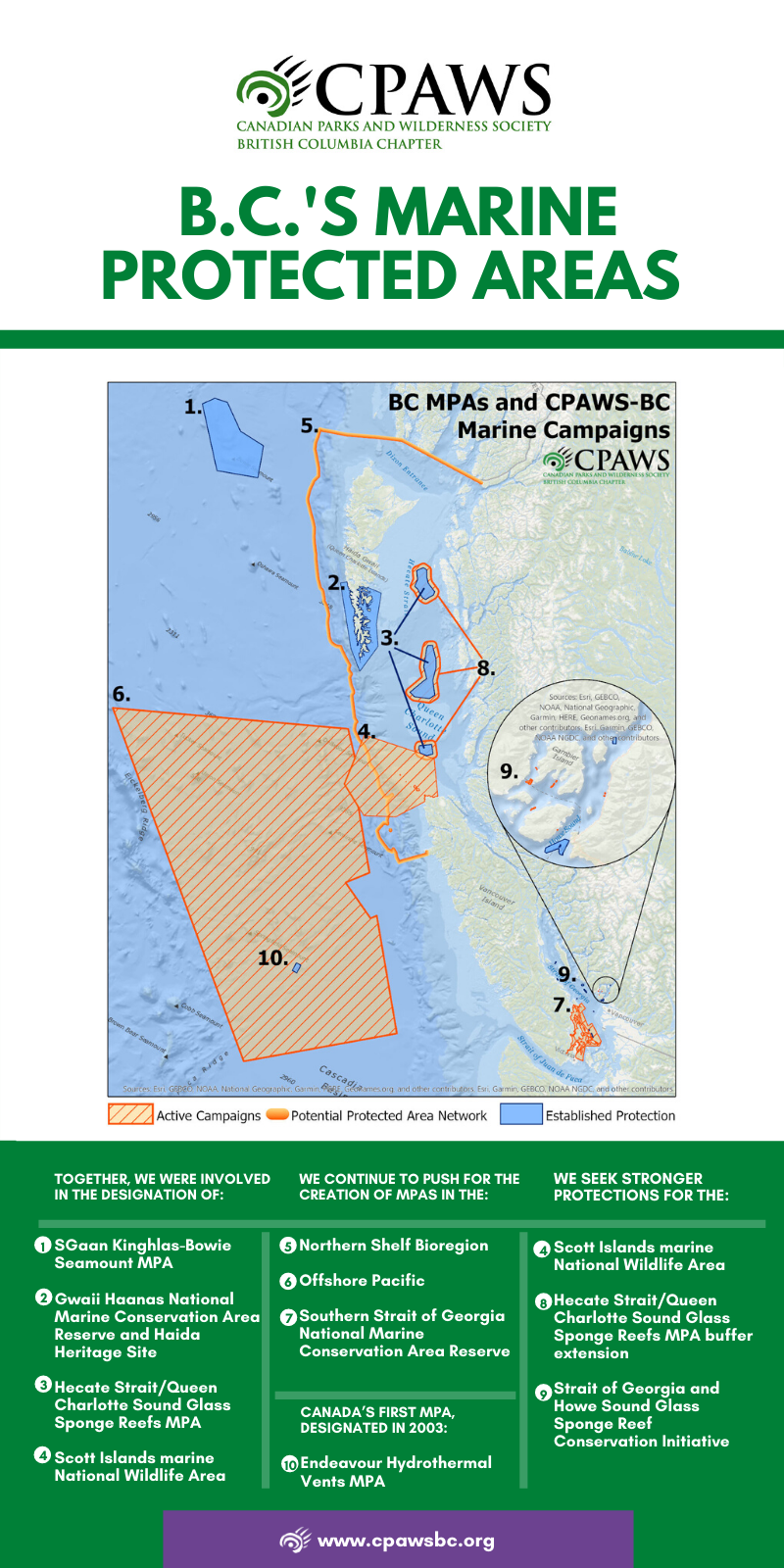
BC has been at the forefront of establishing Canada’s MPAs. The Endeavour Hydrothermal Vents MPA west of Vancouver Island was the first MPA created under the Oceans Act in 2003. The Gwaii Haanas National Marine Conservation Area Reserve and Haida Heritage Site is a prominent example of Indigenous-led, cooperatively managed MPAs in Canada.
We also have a large part to play in getting Canada to our 30 percent ocean protection by 2030 target with several MPAs in the planning process. The Offshore Pacific Area of Interest or Deepsea Oasis off the west coast of Vancouver Island will protect unique deep sea ecosystems and cover almost 2.5% of Canada’s ocean. The proposed Southern Strait of Georgia National Marine Conservation Area Reserve will safeguard important feeding waters for the critically endangered Southern Resident killer whales. Led by Indigenous communities, Canada’s first MPA network along BC’s north and central coasts will protect whales and other migrating ocean animals while also ensuring healthy coastal communities for generations.
-30-
For interview contact
Ross Jameson, Ocean Conservation Manager
Canadian Parks and Wilderness Society – British Columbia
778-953-2372
ross@cpawsbc.org

Download PDF Copy
Resources:
For Immediate Release
June 26, 2020
Unceded Coast Salish Territory/Vancouver, BC – A new study led by Angela Stevenson at the University of British Columbia indicates that ongoing climate change is a serious and immediate threat to BC’s ancient glass sponge reefs. The Canadian Parks and Wilderness Society – British Columbia (CPAWS-BC) calls for the urgent establishment of marine protected areas (MPAs) for glass sponge reefs in BC.
Glass sponge reef ecosystems shelter rockfish and prawns and are efficient filter feeders. Healthy glass sponge reef marine protected areas can filter out up to 90% of bacteria from ocean water and work to keep carbon locked in the seafloor.
Fisheries and Oceans Canada (DFO), along with the Marine Life Sanctuaries Society (MLSS), recently verified five new living glass sponge reefs and one dead reef during scientific surveys in Howe Sound. These reefs need urgent protection if they are to adapt and survive against threats from climate change and human activity.
“Marine protected areas will not only protect glass sponge reefs from physical damage caused by bottom-contact fishing, they will also act as natural climate solutions,” says Ross Jameson, Ocean Conservation Manager for CPAWS-BC. MPAs offer long term protection, prevent further damage and absorb carbon to help beat back climate change.
For two decades, CPAWS-BC has worked to establish stronger protection for BC’s known glass sponge reefs. In 2017, Hecate Strait/Queen Charlotte Sound Glass Sponge Reefs Marine Protected Area protected over 2000 km2 of glass sponge reefs off BC’s north and central coast. 17 fisheries closures protect reefs in Howe Sound and the Strait of Georgia. Unprotected glass sponge reefs in Howe Sound and Chatham Sound need urgent attention.
This new study underscores the pressure glass sponges face to adapt quickly to survive in a changing ocean. Protecting these unique biological treasures will not only safeguard economically important marine life, but also ensure the reefs can remain a source of awe and wonder for generations to come.
-30-
For interview, please contact:
Ross Jameson, Ocean Conservation Manager
Canadian Parks and Wilderness Society-British Columbia
778-953-2372
ross@cpawsbc.org
Resources
We would like to recognize the many other organizations who have worked tirelessly to conserve this unique habitat: Marine Life Sanctuaries Society, David Suzuki Foundation, Coastal Ocean Research Institute, Subsea Society of Howe Sound, Canadian Marine Environment Protection Society, and Sunshine Coast Conservation Society.
Stevenson, A., Archer, S.K., Schultz, J.A. et al. Warming and acidification threaten glass sponge Aphrocallistes vastus pumping and reef formation. Sci Rep 10, 8176 (2020). https://doi.org/10.1038/s41598-020-65220-9
 Media Release PDF here.
Additional Images here.