CPAWS-BC Welcomes Largest Investment To Date For Land and Ocean Conservation
For interviews, please contact: Rippon Madtha, Communications Manager Canadian Parks and Wilderness Society, BC Chapter rippon@cpawsbc.org (604) 685-7445 x23
FOR IMMEDIATE RELEASE
April 19, 2021
CPAWS-BC Welcomes Largest Investment To Date For Land and Ocean Conservation
Federal budget investments demonstrate a solid commitment to nature protection
Unceded Coast Salish Territory / Vancouver, BC – The Canadian Parks and Wilderness Society – British Columbia (CPAWS-BC) highly commends the federal government’s decision to invest $3+ billion over five years to protect Canada’s lands and ocean.
Today’s historic announcement bolsters collective action towards protecting 25 percent of Canada’s lands and ocean by 2025 and 30 percent by 2030 while enabling and supporting Indigenous-led conservation in British Columbia and across Canada.
“This announcement brings immense hope to British Columbians and Canadians for a resilient future brimming with healthy landscapes, waters, and biodiversity,” says Annita Mcphee, Executive Director of CPAWS-BC. “With this significant investment important conservation projects will be enabled to move forward on the ground and in the ocean”.
The Canadian Parks and Wilderness Society has been drumming up Ottawa’s support alongside leading conservation groups as part of the Green Budget Coalition. The coalition has proposed investments of $4.8 billion over five years, followed by $745 million per year to manage federal, provincial, territorial, and Indigenous protected areas.
Ross Jameson, Oceans Conservation Manager for CPAWS-BC comments, “This will add sorely needed investment into the health and well-being of coastal communities and the ecosystems that support them. Investment in ocean protection will support a web of marine life, increase recreation, tourism, and other conservation economy opportunities, and rebuild fisheries”.
Budget 2021 nature investment highlights:
$2.3 billion over five years to protect one million square kilometers of land and freshwater – which is equivalent to an additional 10% of Canada – including supporting Indigenous Protected and Conserved Areas, Indigenous Guardians programs, provincial and territorial protected areas, and to protecting species at risk.
$976.8 million over five years to protect the health of our oceans, commercial fishing stocks, and quality of life in coastal communities.
$200 million over three years supporting municipalities with natural infrastructure projects including establishing urban parks, green spaces, waterfronts, marshes, etc.
$1.4 billion over 12 years to replenish the Disaster Mitigation and Adaptation Fund, including $670 million dedicated to small-scale climate adaptation and mitigation projects, including natural infrastructure projects such as wetland restoration, etc.
“This incredible investment shows great wisdom and fortitude in putting the future of our communities first by furthering important international nature commitments. We look forward to working towards a resilient future with Indigenous, provincial, and federal governments by furthering conservation here in BC,” adds Mcphee.
-30-
For interviews, please contact: Rippon Madtha, Communications Manager Canadian Parks and Wilderness Society, BC Chapter rippon@cpawsbc.org (604) 685-7445 x23
About CPAWS-BC:
Canadian Parks and Wilderness Society – British Columbia (CPAWS-BC) is part of one of Canada’s oldest non-profit conservation groups. We protect wilderness in every corner of BC and deep into the ocean. We have been defending BC since 1978 and are dedicated to keeping BC’s natural environment thriving forever. Nature is BC’s best hope.
Background
According to the World Economic Forum, half of the world’s Gross Domestic Product (GDP) is moderately or highly dependent on nature and the services it provides, and the global food-, land-, and ocean-use system provides up to 40% of the world’s jobs. As a nation that relies on its rich natural resources, protecting nature and the multitude of services it provides is critical to Canada’s economic recovery.
Many studies done across Canada have found that natural assets, if maintained, already have tremendous value, which will increase as the climate changes. As an example, urban forests in Toronto, Vancouver, and Halifax are valued at billions of dollars for ecosystem services such as control of stormwater runoff, air quality regulation, and carbon sequestration.
Protecting and restoring forest, grassland, and wetland (including eelgrass, saltmarsh, and riparian areas) to store and reduce greenhouse gas emissions would help to address the climate and biodiversity crises, create jobs, and expand a green economy in Canada. The same is true for using natural infrastructure solutions to increase our resilience to climate change.
The World Economic Forum estimates that transitioning industry to a more nature-positive model could result in up to $10 trillion USD in annual business value and could create 395 million jobs by 2030.
Terrestrial parks and associated visitor spending support 64,000 jobs, generate a return of 6:1 in GDP, and return 44% of government investment back in taxes. Canada’s parks and protected areas have become increasingly important for domestic tourism as COVID-19 restricts international travel.
Effective Marine Protected Areas (MPAs) are a key component of a strong Blue Economy. Recent studies show that protecting 30% of our ocean in effective and well-managed MPAs can restore ocean health and produce an economic return on investments of ten to one.
The Green Budget Coalition (GBC) includes 25 leading environmental organizations in Canada that analyze environmental sustainability issues and provide fiscal and budgetary recommendations to the federal government. Feature recommendations for nature and biodiversity conservation include: Nature-Based Climate Solutions and Creating and Managing Protected Areas, including Indigenous Protected and Conserved Areas and Guardians programs, among other complementary nature conservation recommendations.
For interviews, please contact: Tori Ball, Senior Campaigner Canadian Parks and Wilderness Society, BC Chapter tori@cpawsbc.org (604) 685-7445 x24
FOR IMMEDIATE RELEASE
April 16, 2021
$80M Boost for BC Parks Upgrades, CPAWS-BC Ecstatic
Historic budget lift sets bright path for parks and recreation in BC
Unceded Coast Salish Territory / Vancouver, BC – The Canadian Parks and Wilderness Society – British Columbia (CPAWS-BC) is applauding the BC government’s announcement today of a new $80 million investment into BC’s provincial parks over the next three years. This represents a historic budget increase that’s been overdue for decades.
“After 20 years of fighting for this, we’re thrilled to finally see an investment of this magnitude for our provincial parks,” says Tori Ball, Senior Campaigner with CPAWS-BC. “This leap in budget funding will go a long way in helping BC Parks to refocus on protecting important landscapes and ecosystems, and supporting them to better meet the needs of British Columbians wanting to spend more time in these special places.”
Today’s budget announcement is the most recent and sizable upgrade to the BC Parks system. It comes on the heels of an announcement earlier this week creating hundreds of new conservation and park jobs for youth. BC Parks has received necessary increases for staffing, infrastructure, and park upkeep over the last year to manage pandemic-related demand. The BC government plans to inject additional funding over the next three years:
$36 million planned for operations
$47 million in capital investments
“Investing in BC’s parks is also a welcome boost to tourism – the sector hardest hit by the pandemic,” adds Ball. “More money for BC Parks means more jobs in remote and rural communities, and in the long term will serve to support natural climate solutions that will help stem the global biodiversity crisis.”
CPAWS-BC and its partners have been campaigning for bold budget upgrades for BC Parks for many years. As parks and other outdoor spaces continue to experience record high visitation through the pandemic, this announcement signals a turning point for BC Parks and can be widely celebrated as a long-overdue boost to upgrade visitor infrastructure, increase staffing in parks, and expand protected areas.
-30-
For interviews, please contact: Tori Ball, Senior Campaigner Canadian Parks and Wilderness Society, BC Chapter tori@cpawsbc.org (604) 685-7445 x24
Key Facts:
BC’s provincial parks welcome over 23 million visitors each year. However, decades of underfunding have created significant gaps in the system. A surge in outdoor recreation through the pandemic put further pressure on staffing, park expansion, trail building, and visitor facility upgrades.
Canadian public health officials strongly recommend outdoor recreation to alleviate lockdown blues. However, lack of funding and staffing resulted in complete park closures in Spring 2020 during the pandemic’s early days.
In October 2020, Premier Horgan announced a strong parks-focused mandate letter to Environment Minister George Heyman and Parliamentary Secretary of Environment Kelly Greene. This budget provides necessary resources to deliver on this mandate of expanding campgrounds, trails and protected areas.
CPAWS-BC, alongside partner organizations, including tourism associations, recreation organizations, and labor unions, has been campaigning for bold budget upgrades for BC Parks for many years to increase staffing and improve park infrastructure and visitor facilities.
Canadian Parks and Wilderness Society – British Columbia (CPAWS-BC) is part of one of Canada’s oldest non-profit conservation groups. We protect wilderness in every corner of BC and deep into the ocean. We have been defending BC since 1978 and are dedicated to keeping BC’s natural environment thriving forever. Nature is BC’s best hope.
For interviews, contact: Tori Ball, Senior Campaigner Canadian Parks and Wilderness Society, BC Chapter tori@cpawsbc.org (604) 685-7445 x24
FOR IMMEDIATE RELEASE
New youth jobs program bolsters conservation and recreation in BC, says conservationists
April 13, 2021
Traditional territories of the Coast Salish peoples/Vancouver, BC — The Canadian Parks and Wilderness Society – British Columbia (CPAWS-BC) is praising a new provincial program that will give youth opportunities to work in conservation and recreation. These jobs will help to launch careers in wilderness stewardship while preparing BC’s vast outdoor recreation network to host record visitor numbers through another pandemic summer.
“We’re thrilled to see this much needed capacity lift for nature and outdoor recreation in the province,” says Tori Ball, Senior Campaigner with CPAWS-BC. “We can all breathe a sigh of relief knowing that the province is preparing to better support the health and wellbeing of British Columbians by providing more access to parks, trails and camping opportunities.”
This is the second youth-focused work program the BC government has launched in the last year, both of which included conservation-specific opportunities. Hiring youth to improve parks and nature stewardship will help to meet the increasing need for more trails and campgrounds as people look to escape locally during the pandemic.
Long-standing budget constraints have created bottlenecks in BC’s parks system, from delays in planning to visitor facilities in need of maintenance or waiting to be built. Unfortunately, this resulted in BC’s provincial parks being forced to shut down last spring due to concerns with understaffing and overcrowding.
“Spending time outdoors has been a consistent public health recommendation during the pandemic, and we’re encouraged that the BC government is taking measures to ensure there are safe, well-managed places for people to get outside,” says Ball.
“As people invest in outdoor gear for the long-haul, we hope to see more long-term investments and programs of this kind coming down the pipe to support the vast and diverse nature and recreation systems in BC,” she adds.
–30–
For interviews, contact:
Tori Ball, Senior Campaigner Canadian Parks and Wilderness Society, BC Chapter tori@cpawsbc.org (604) 685-7445 x24
As a part of the Stronger BC Future Leaders Program, the BC government is investing in youth conservation jobs to accommodate and support growing demand for outdoor recreation:
The Ministry of Forests, Lands, Natural Resource Operations and Rural Development will invest more than $11 million for over 220 jobs in the Natural Resource Youth Employment program and the Recreation Sites and Trails program.
The Ministry of Environment and Climate Change Strategy will invest $4.6 million to create 37 positions with BC Parks and 46 positions with the Conservation Officer Service, to work in a variety of fields to gain experience and help protect the environment.
The Ministry of Environment and Climate Change Strategy is creating opportunities for up to 180 young people to help tackle marine debris and plastic pollution in coastal communities. An investment of $5 million in the Clean Coast, Clean Waters program is aimed at youth employment, including youth in Indigenous communities.
Canadian Parks and Wilderness Society – British Columbia (CPAWS-BC) is part of one of Canada’s oldest non-profit conservation groups. We protect wilderness in every corner of BC and deep into the ocean. We have been defending BC since 1978, and are dedicated to keeping BC’s natural environment thriving forever. Nature is BC’s best hope.
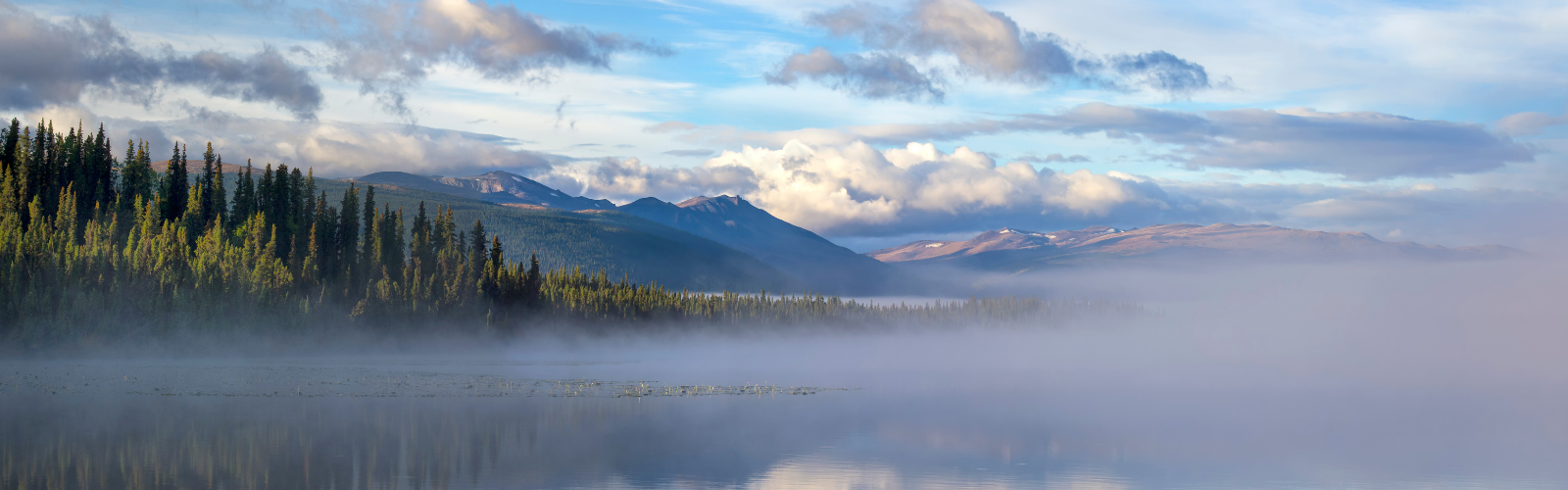
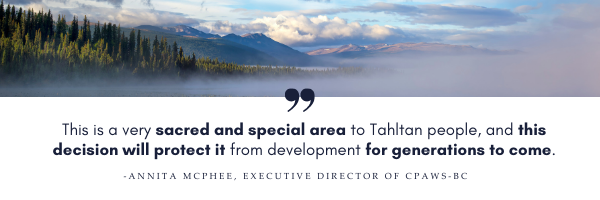
A new conservancy in Tahltan territory to be protected
Ice Mountain Lands beside Mt. Edziza Provincial Park in northwestern BC will protect ecological and cultural values for future generations.
April 8, 2021
The announcement of the new Mount Edziza Conservancy is very exciting. We would like to congratulate the Tahltan Central Government for their work to protect this important area.
This is a shining example of Indigenous leadership on land protection that will pave the way to delivering on Canada’s biodiversity conservation commitments to protect 25% by 2025 as a milestone on the way to 30% by 2030. The multisectoral collaboration between industry, non-governmental organizations, and provincial and federal governments can serve as a hopeful model for the future of conservation.
This area is of high biodiversity and cultural importance. The new conservancy fills in a ‘donut hole’ similar to the one found between Skagit and Manning provincial parks, another important area for wildlife, recreation and ongoing cultural connections. CPAWS-BC looks forward to supporting more of these collaborative efforts for a healthy and resilient future for the landscapes we all depend on.
BC Parks just released a new Visitor Use Management Strategy that was jointly created with Lílwat Nation and N’Quatqua and other key provincial ministries. Help us make sure BC Parks gets it right.
A surge in visitation to Joffre Lakes Provincial Park over the past decade is often blamed on only one force: social media. While social media offers easy access to information on stunning places to hike, camp and snowshoe, it does not deserve the entire burden of the public’s blame.
Joffre Lakes has seen a 222 percent increase in visitation since 2010, with close to 200,000 visitors in 2019 – the last year it was open to the public. This coincides with upgrades of the park’s 5km long trail which altered the route from being a challenging boulder-field to a steep but fairly smooth, and easy-to-navigate trail. It is not surprising that a trail that is perceived to be relatively safe, boasting stunning vistas, and just a few hours up the highway from Metro Vancouver, would attract massive crowds.
A sharp rise in demand for outdoor recreation in BC and across the globe has also contributed to the challenges which plague Joffre Lakes. The park was closed to the public throughout the pandemic to protect local communities from increased COVID risks. According to a 2014 Destination BC report, commercial outdoor adventures grew by 24 percent between 2001 and 2005. Within a decade, BC Parks saw nearly an additional 5 million, or 23 percent, rise in annual visitors between 2014 and 2019.
All this is underscored by a critical fact: BC Parks has been dramatically underfunded for two decades. This lack of funding has generated numerous challenges for parks managers and visitors alike. A lack of resources stalls the creating and updating of management plans to and cuts out environmental monitoring within the parks. Staff shortages remain rampant, leaving rangers and planners overworked. Low budgets mean that infrastructure upgrades and expansion plans are nowhere in sight
What’s in the strategy?
Increase presence of Lílwat Nation and N’Quatqua within the park through a Stewards program, interpretive signage that includes local Indigenous culture and history, and exploration for joint monitoring, economic opportunities, and collaborative management.
Support Lílwat Nation and N’Quatqua traditional uses by protecting harvest areas, installing restoration barriers, and supporting community access.
Mitigate impacts on vegetation and wildlife through visitor education and enforcement of restrictions, trail rehabilitation, creating viewing platforms at lookouts, gathering baseline data and monitoring changes, and exploring recreation monitoring and environmental projects through partnerships.
Address illegal parking with the Ministry of Transportation and enforcement by the RCMP, encouraging carpooling, sharing shuttle information when/if arranged by third parties ,such as Parkbus, increasing the parking lot from 250 to 350 spaces and improving the parking lot layout “as needed.”
Limit the number of people who can access the park during peak months by implementing a day-use permit, encouraging people to visit in less busy times, limiting commercial groups, and enforcing backcountry reservations.
Educate visitors and the general public as to proper park etiquette, trip planning and preparedness, while monitoring activities through trail counters, visitor surveys and external partner data.
Overall, what do we think about the draft strategy?
We are extremely happy with two aspects. First, we applaud the overdue inclusion of the original stewards of this area, Lílwat Nation and N’Quatqua, as critical planning partners. Secondly, we are pleased that BC Parks is undertaking this intensity of planning to improve park safety, visitor experience and meet conservation goals.
We are disappointed in the lack of detail that the strategy offers. The plan has been in development for two years and we had hoped . However, we have spent some time unpacking the strategy to offer recommendations. We hope our insights help BC Parks make the necessary strategy improvements.
Here are our detailed recommendations to further improve this strategy to create more equitable access, conserve the local natural and cultural values, and increase safety for visitors and staff alike.
CPAWS-BC Recommendations:
Full CPAWS-BC Consultation Feedback: Joffre Lakes Visitor Use Management Strategy here.
For Immediate Release December 14, 2020
New survey finds winter won’t be putting a chill on recreation for British Columbians
Survey shows enthusiasm for winter activities but concerns about park preparedness.
Traditional territories of the Coast Salish Peoples/Vancouver, BC — A new online survey from the Canadian Parks and Wilderness Society – BC Chapter (CPAWS-BC) found that British Columbians expect busier parks and trails as more people head outdoors this winter. This new survey draws out concerns around long-standing issues created by years of underfunding coupled with increasing visitor numbers in BC’s provincial parks.
“This past summer we saw a spike in the demand for outdoor adventures, and all signs point to outdoor enthusiasts across the province keeping the good times outside rolling this winter,” says Tori Ball, Terrestrial Campaigner with CPAWS-BC. “It’s essential that we make sure people can access parks and trails safely as the outdoors continue to provide comfort and joy through a challenging holiday and winter season.”
Key findings of CPAWS-BC’s new survey include:
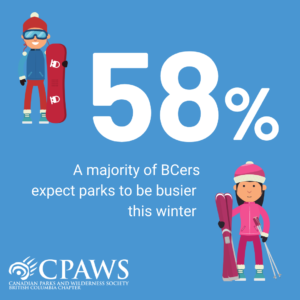
People expect busier parks this winter: A majority (58%) of people anticipate parks will be busier this season
24% of respondents said that, given travel restrictions, they’re going to try a new winter activity this season. The most popular new activities were cross-country skiing and snowshoeing.
Respondents said they were either somewhat, quite or extremely concerned about these top issues:
70% of people were concerned about their fellow park visitors being underprepared for winter conditions.
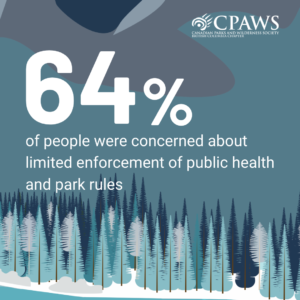
64% of people were concerned about limited enforcement of public health and park rules.
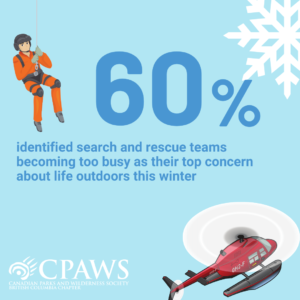
60% of people were concerned about search and rescue teams becoming too busy.
More education and information are key to success: Among the top recommendations to improve safety are more staff in parks, better signage and more education to the general public about conditions, risks and proper gear.
Winter brings shorter days, avalanche risk, as well as cold and quickly changing temperatures, which means that recreation comes with considerably more risk to unprepared visitors than summer adventures.
Ball continues, “long term lack of funding of our parks has left them ill-equipped to handle crowds at the best of times. It is critical that we get more staff into parks to promote safety and make sure visitor infrastructure is in place, and avoid putting more pressure on volunteer search and rescue teams.”
This survey was conducted online between December 2 and 6. Responses were collected from 1058 British Columbians, with a 95% confidence level and a margin of error of plus or minus (±) 3%.
CPAWS-BC continues to advocate for increased funding to improve the management and increase staffing essential to a robust and healthy provincial park system.
– 30 –
For interviews, contact: Tori Ball, Terrestrial Campaigner, CPAWS-BC tori@cpawsbc.org (604) 685-7445 x24
Resources
About CPAWS
The Canadian Parks and Wilderness Society (CPAWS) is Canada’s only nationwide charity dedicated solely to the protection of our public land, ocean, and freshwater, and ensuring our parks and protected areas are managed to protect nature. Since 1963, CPAWS has played a leading role in protecting over half a million square kilometers. Our vision is to protect at least half of Canada’s public land and water in a framework of reconciliation – for the benefit of wildlife and people.
The CPAWS British Columbia chapter (CPAWS-BC) works to protect wilderness in every corner of BC and deep into the ocean. We have been defending BC since 1978, and are dedicated to keeping BC’s natural environment thriving forever. Nature is BC’s best hope. Visit: cpawsbc.org | Follow: @CPAWSbc
Annita Mcphee joins CPAWS-BC as Executive Director
Vancouver/Unceded Coast Salish Territory – The Canadian Parks and Wilderness Society – British Columbia (CPAWS-BC) is thrilled to introduce Annita Mcphee as Executive Director, effective on December 7 2020.
Annita steps into the position as the first Indigenous person to lead a Canadian Parks and Wilderness Society chapter, and brings with her a wealth of experience. She holds a Bachelor of Law and a Bachelor of Social Work, served three terms as the President of the Tahltan Central Council, and is the recipient of numerous awards for her vision and leadership. Annita was instrumental in the fight to save the Sacred Headwaters in Tahltan Territory, and was honoured with the The Leadership Award from Ecotrust for her work.
“Annita’s expertise in strategic development holds the health of people, lands and waters at the heart,” says Catarina Moreno, CPAWS-BC Board President. “At this critical juncture for nature, Annita’s bold leadership and commitment to finding unique solutions for wilderness protection is an ideal fit to lead CPAWS-BC into a very bright future.”
Caring for lands and waters has always been Annita’s priority. “As a Tahltan woman, growing up on Tahltan and Stikine lands, I was always reminded that Indigenous Peoples in Canada have been stewarding lands since time immemorial. It’s always been our work,” said Mcphee “This is an exciting opportunity to bring forward these teachings and strengthen collaboration between Indigenous Peoples, conservation groups and governments to secure clean air, water, and nutritious food now and forever.”
Annita looks forward to sharing her stories and leadership vision in the weeks and months ahead. In the meantime, the CPAWS-BC team will continue to defend the wild places we love and depend on.
-30-
For interview, please contact Skye Vallance Communications and Development Coordinator 604.685.7445 x 22 skye@cpawsbc.org
Photo: Annita Mcphee, CPAWS-BC Executive Director
About CPAWS
The Canadian Parks and Wilderness Society (CPAWS) is Canada’s only nationwide charity dedicated solely to the protection of our public land, ocean, and freshwater, and ensuring our parks and protected areas are managed to protect nature. Since 1963, CPAWS has played a leading role in protecting over half a million square kilometers. Our vision is to protect at least half of Canada’s public land and water in a framework of reconciliation – for the benefit of wildlife and people.
The CPAWS British Columbia chapter (CPAWS-BC) works to protect wilderness in every corner of BC and deep into the ocean. We have been defending BC since 1978, and are dedicated to keeping BC’s natural environment thriving forever. Nature is BC’s best hope. Visit: cpawsbc.org | Follow: @CPAWSbc
Hope for the Coast: Commitment to Developing a Coastal Strategy a Priority for the New BC Cabinet
“With support from the Parliamentary Secretary for Environment and the Parliamentary Secretary for Fisheries and Aquaculture, lead work to develop a new provincial coastal strategy to better protect coastal habitat while growing coastal economies.”
From the recently released mandate letter to Nathan Cullen, Minister of State for Lands and Natural Resource Operations
For the past two years, the Canadian Parks and Wilderness Society (CPAWS-BC) and West Coast Environmental Law (WCEL) have been working on the Blueprint for the Coast initiative as we recognized the great need for a coastal strategy and law in BC. This collaboration has resulted in numerous presentations and discussions with Indigenous Nations, coastal communities, the federal government, and other coastal organizations and stakeholders to learn about local and coast-wide issues and opportunities.
This is a huge opportunity for British Columbia and it can learn from examples all around us. BC is one of the only coastal jurisdictions in North America without a united plan to protect the coast. Washington, Oregon, Nova Scotia, Quebec, and many other jurisdictions around the world have already developed coastal strategies or laws. This is the chance for BC to not only catch up but become a leader in coastal management.
Until now, BC governed the coast through a patchwork of regulations and laws overseen by different ministries and departments. As a result, BC isn’t prepared to deal with the pressures on the coast of development, climate change, and the growing demands of everyone who uses the coast.
The BC coast is a global treasure. It makes our province beautiful, abundant, and a desirable place to live. Thankfully, there’s an actionable, achievable way to protect the coastline by starting fresh with a united, thoughtful, and intentional plan – a blueprint for the coast, composed of a strategy and law.
Now is the moment for governments to fulfill their promise to future generations that they won’t let the coast we love become a casualty. A blueprint for the coast will ensure marine life and coastal communities get the future they deserve.
By Kate MacMillan, CPAWS-BC Coastal Campaign Manager and Michael Bissonnette, WCEL Marine Program Staff Lawyer
MP Alistair Macgregor Introduces Bill To Address Freighter Anchorages In The Salish Sea
October 29, 2020
Unceded Coast Salish Territory/Vancouver, BC – This week, NDP MP for Cowichan-Malahat-Langford Alistair MacGregor introduced a Private Member’s Bill to prohibit the anchoring of freighters in the Southern Strait of Georgia. The Canadian Parks and Wilderness Society – British Columbia (CPAWS-BC) is supporting this amendment to the Canada Shipping Act, along with partners including First Nations, local government, and community activist groups.
For years, Southern Strait of Georgia residents have been sounding the alarm over the damage anchored ships do to coastal waters in BC. This overflow parking lot for the Port of Vancouver scars the seafloor habitat of clams, oysters and prawns. Noise, light and chemical pollution from these ships damages the critical habitat of the endangered Southern Resident killer whales.
Transport Canada’s 2018 Interim Protocol for the Use of Southern B.C. Anchorages did not adequately address this problem. These measures were voluntary and not enforced. The citizens and wildlife of the region deserve stronger protections.
World-renowned ocean explorer Jacques Cousteau called for the Southern Strait of Georgia’s protection in 1970. Parks Canada has been working on creating a National Marine Conservation Area Reserve (NMCAR) for the area since 2003. Almost two decades later, these waters are still not protected.
“An NMCAR would not only protect these waters from anchorages, but will manage commercial and recreational fishing and other human activities with a conservation-first approach,” says Ross Jameson, Ocean Conservation Manager for CPAWS-BC. An NMCAR will ensure that this natural jewel remains healthy and prosperous for generations to come.
-30-
For interviews, please contact:
Ross Jameson, Ocean Conservation Manager ross@cpawsbc.org 778-953-2372
Resources:
Alistair MacGregor, NDP. [October 26, 2020]. MP Alistair MacGregor Introduces Bill to Address Freighter Anchorages in the Salish Sea. Retrieved from https://alistairmacgregor.ndp.ca/news
#IMPAC5OceanFest Photo Contest
IMPAC5, the 5th International Marine Protected Congress, is coming to Vancouver, BC in February. Scientists, knowledge holders, decision makers and community leaders from around the world will be discussing how to create a healthier ocean. And we want you to join in the ocean conservation enthusiasm by submitting your ocean photos into a contest.
How to Enter
Post your ocean photo from the last 12 months on Instagram. Photos must be public so we can see them!
In your caption, tell us why you love the ocean or why ocean conservation matters to you
Tag and follow @CPAWSBC, @IMPAC5 and use the hashtag #IMPAC5OceanFest on Instagram
Make sure that your profile is public so that we can see it. Posts must be put in a feed, unfortunately Instagram stories will not be eligible to win.
Prizes
Over $100 in prizes, including a stunning photography print of rockfish and glass sponge reef by Jeff Wilson.
Contest closes on Friday, February 10, 2023. Find the full contest rules here.
We use cookies and other similar technologies such as pixels and web beacons (“Cookies”) for various purposes, such as to ensure our website functions properly, enhance your browsing experience by remembering your preferences and provide personalized content and advertisements.
Functional
Always active
The technical storage or access is strictly necessary for the legitimate purpose of enabling the use of a specific service explicitly requested by the subscriber or user, or for the sole purpose of carrying out the transmission of a communication over an electronic communications network.
Preferences
The technical storage or access is necessary for the legitimate purpose of storing preferences that are not requested by the subscriber or user.
Statistics
The technical storage or access that is used exclusively for statistical purposes.The technical storage or access that is used exclusively for anonymous statistical purposes. Without a subpoena, voluntary compliance on the part of your Internet Service Provider, or additional records from a third party, information stored or retrieved for this purpose alone cannot usually be used to identify you.
Marketing
The technical storage or access is required to create user profiles to send advertising, or to track the user on a website or across several websites for similar marketing purposes.